














6 Secret Length Measurement Conversion Guide Tips I Learned the Hard Way
There was a time I thought length conversions were simple. A meter is a meter, a foot is a foot, and Google exists for everything else—so what could possibly go wrong? Quite a lot, actually. Over the years, through school assignments, DIY projects, online orders, and even a failed attempt at assembling imported furniture, I learned that converting measurements is less about memorizing numbers and more about understanding context, precision, and human error.
This article is not just a guide—it’s a collection of mistakes, realizations, and habits formed through trial and error. Each “secret” here is something I wish I had understood earlier.
- The illusion of “simple conversions”
At first glance, converting units looks like basic math. Multiply, divide, done. But what tripped me up repeatedly was assuming all conversions behave the same way.
Take meters to feet. I used to round 1 meter to 3 feet just to make things easier. That tiny shortcut didn’t seem like a big deal—until I used it in a woodworking project. By the time I converted multiple measurements, those tiny rounding errors stacked up and left me with pieces that didn’t fit.
The hard lesson: conversions are not just numbers—they carry precision. Even a small rounding difference can compound over multiple steps.
Now, I follow a rule: never round until the very end.
- Context matters more than the formula
One of my biggest mistakes came from blindly applying formulas without considering context. I once converted a room’s dimensions from feet to meters for a renovation estimate. The numbers were correct, but I forgot that the materials I was buying were labeled differently—some in square meters, some in linear meters.
Length conversion alone wasn’t enough. I needed to understand what I was measuring: length, area, or volume.
That mistake cost me extra material and money.
The lesson here is simple but powerful: always ask, “What exactly am I measuring?” before converting anything.
- Metric vs imperial is not just a system—it’s a mindset
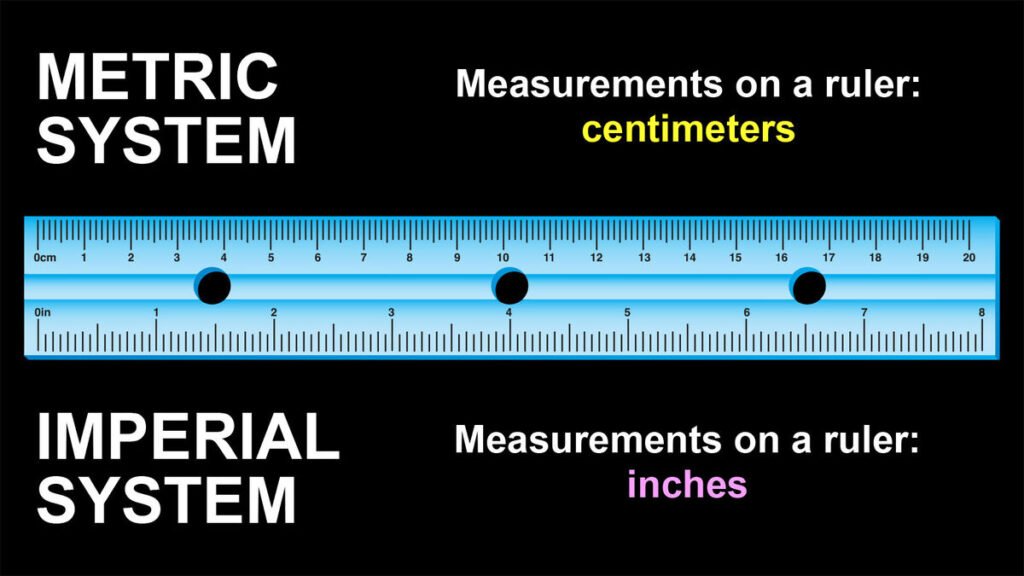
Growing up around metric units, I assumed imperial measurements were just another version of the same thing. But they’re not just different scales—they’re built on different logic.
Metric is clean and predictable. Everything moves in powers of ten. Imperial, on the other hand, is more historical and less intuitive: 12 inches in a foot, 3 feet in a yard, 5280 feet in a mile.
The first time I worked with inches and fractions like 5/8 or 3/16, I struggled more than I expected. It wasn’t just conversion—it was interpretation.
What helped me was shifting my mindset. Instead of forcing imperial units into metric thinking, I learned to treat them as their own system. Once I did that, conversions became easier and less frustrating.
- Fractions are silent troublemakers
Decimals are straightforward. Fractions, however, can quietly ruin your calculations if you’re not careful.
I remember measuring a piece of wood as 7 3/4 inches and converting it quickly into centimeters. I rushed the fraction part, treated 3/4 as 0.3 instead of 0.75, and ended up with a completely wrong result.
The problem wasn’t the conversion—it was my handling of fractions.
Now I always convert fractions into decimals properly before doing anything else. It adds an extra step, but it saves a lot of trouble later.
- Tools are helpful—but dangerous if misunderstood
Online converters and apps feel like lifesavers. And they are—if used correctly.
But I’ve made the mistake of trusting tools without double-checking inputs. Once, I entered 150 cm thinking I’d get feet and inches, but the tool gave me decimal feet instead. I misread the output and ended up ordering something that didn’t fit at all.
That experience taught me that tools don’t think for you. They only process what you give them.
Now, whenever I use a converter, I double-check:
– What units am I entering?
– What format is the result in?
– Does the answer make sense logically?
A quick sanity check can prevent costly mistakes.
- Estimation is an underrated superpower
After all the precise calculations and exact conversions, one skill turned out to be just as important: estimation.
Before trusting any conversion, I now do a rough mental check. If I convert 1 meter and get something like 10 feet, I instantly know something is wrong.
Estimation acts like a filter. It catches errors before they turn into real problems.
Over time, I’ve developed a mental sense of common conversions:
– 1 meter is a bit more than 3 feet
– 1 inch is about 2.5 cm
– 1 kilometer is a little over half a mile
These aren’t exact, but they’re close enough to guide intuition.
Why these mistakes matter more than you think
Length conversion isn’t just for students or engineers. It shows up in everyday life more often than we realize—buying furniture online, measuring spaces, traveling, cooking with international recipes, or even reading maps.
Each mistake I made taught me that accuracy isn’t just about getting the “right answer.” It’s about understanding what you’re doing at every step.
When you rely too much on shortcuts, ignore context, or skip validation, errors become inevitable.
Practical habits that changed everything for me
After learning these lessons the hard way, I developed a few habits that made conversions almost second nature:
– Write down units clearly every time
– Convert fractions carefully before anything else
– Avoid rounding until the final step
– Use tools, but never blindly trust them
– Do a quick mental estimate before accepting any result
These habits don’t take much time, but they dramatically reduce mistakes.
A small story that sums it all up
I once ordered a desk from another country. The dimensions were listed in inches, and I converted them into centimeters quickly, thinking I had it all figured out.
When the desk arrived, it didn’t fit the space I had planned. It was off by just a few centimeters—but that was enough to make it unusable.
That moment stuck with me. It wasn’t a math problem—it was a thinking problem. I had rushed, assumed, and skipped validation.
Since then, I’ve treated every conversion with a bit more respect.
Frequently Asked Questions
- Why do small rounding errors matter so much in length conversion?
Because they accumulate. A tiny difference in one measurement might seem harmless, but when repeated across multiple dimensions, it can lead to noticeable inaccuracies. - Is it better to memorize conversion values or rely on tools?
Both have value. Memorizing common conversions helps with estimation and quick checks, while tools provide precision. The best approach is to use both together. - How can I avoid mistakes when working with fractions?
Always convert fractions into decimals correctly before performing any calculations. Take your time with this step—it’s where many errors begin. - What’s the easiest way to switch between metric and imperial systems?
Start by learning a few key reference points (like 1 inch ≈ 2.54 cm). Then practice regularly until the relationships feel natural. - Why do different countries use different measurement systems?
It’s mostly historical. The metric system was designed for standardization, while imperial units evolved over time based on practical usage. - How can I quickly check if my conversion is correct?
Use estimation. If the result feels far off from what you expect, it probably is. A rough mental comparison can catch most mistakes instantly.
In the end, mastering length conversion isn’t about memorizing numbers—it’s about thinking carefully, checking your assumptions, and learning from mistakes. That’s what took me the longest to understand, but once I did, everything else became easier.