









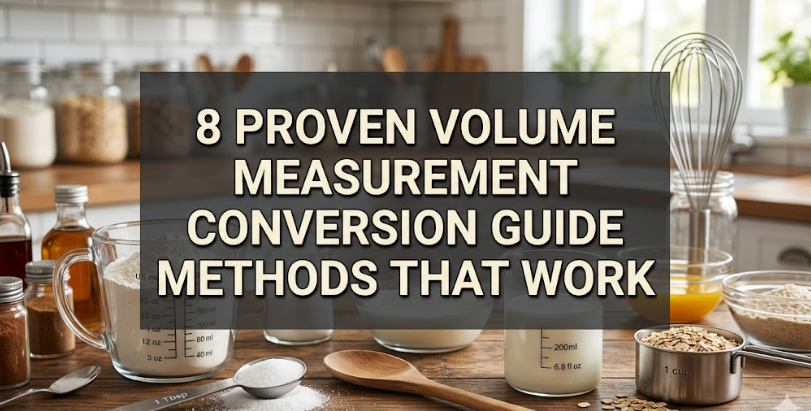

8 proven volume measurement conversion guide methods that work
If you’ve ever stood in a kitchen holding a cup measure while reading a recipe written in milliliters—or tried to make sense of liters versus gallons in a science problem—you already know that volume conversions can feel deceptively simple. The numbers themselves are not complicated, yet the confusion creeps in through unfamiliar systems, inconsistent units, and small but costly assumptions.
This guide doesn’t just list formulas. It walks through practical, tested methods that people actually use in real-life situations—cooking, laboratory work, education, and everyday problem-solving. Think of it as a working toolkit rather than a memorization exercise.
method 1: understand the base relationships first, not the formulas
Most people begin by memorizing conversion factors: 1 liter = 1000 milliliters, 1 gallon = 4 quarts, and so on. While that works temporarily, it often breaks down when you forget a number.
A better method is to understand the relationships behind those numbers.
Metric system:
- 1 liter = 1000 milliliters
- 1 milliliter = 1 cubic centimeter
This system is based on powers of 10. Once you internalize that, conversions become simple shifts of decimal points rather than calculations.
Imperial/US system:
- 1 gallon = 4 quarts
- 1 quart = 2 pints
- 1 pint = 2 cups
Here, the logic is fractional and hierarchical. Instead of decimals, you move through divisions.
Try this exercise:
If you know 1 liter = 1000 mL, then:
- 2.5 liters = 2500 mL (just move the decimal)
No calculator needed.
method 2: use the “unit ladder” approach
The unit ladder is one of the most reliable techniques, especially for beginners.
Imagine a vertical ladder:
kiloliters
liters
milliliters
Each step down multiplies by 1000. Each step up divides by 1000.
Example:
Convert 3 liters to milliliters:
Move one step down → multiply by 1000
Result: 3000 mL
Now try the reverse:
Convert 4500 mL to liters:
Move one step up → divide by 1000
Result: 4.5 liters
This method reduces errors because you’re not guessing—you’re visually following direction.
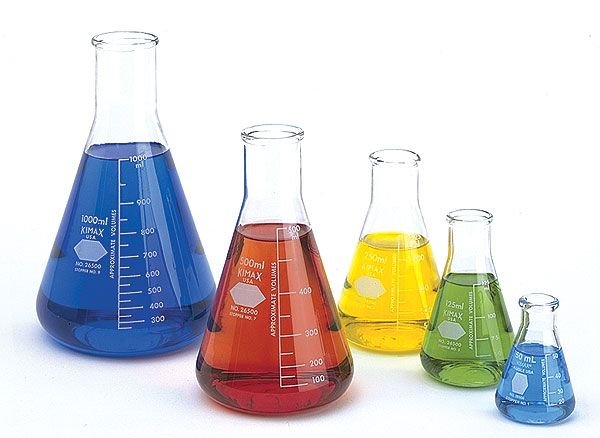
method 3: convert through a common base unit
When dealing with unfamiliar conversions, always return to a base unit.
For volume, liters are often the safest base.
Example:
Convert 2 gallons to milliliters.
Step 1: Convert gallons to liters
(1 US gallon ≈ 3.785 liters)
2 gallons ≈ 7.57 liters
Step 2: Convert liters to milliliters
7.57 × 1000 = 7570 mL
Instead of trying to memorize a direct gallons-to-milliliters formula, you break it into manageable steps.
This method works especially well when:
- You don’t remember direct conversions
- You’re mixing systems (metric + US)
- Accuracy matters
method 4: use estimation before exact calculation
One of the most overlooked techniques is estimation.
Before calculating, ask:
“What should this roughly be?”
Example:
Convert 1 liter to cups.
You might not remember the exact number (about 4.2 cups), but you know:
1 liter ≈ 1 quart
1 quart ≈ 4 cups
So your estimate: ~4 cups
Now when you calculate and get 4.23 cups, you immediately know it’s reasonable.
Estimation helps you:
- Catch mistakes
- Build intuition
- Work faster under pressure
method 5: memorize only high-frequency conversions
Instead of trying to remember everything, focus on the conversions you actually use.
High-frequency conversions:
- 1 liter = 1000 mL
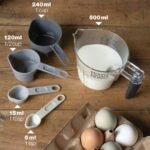
- 1 cup ≈ 240 mL
- 1 tablespoon ≈ 15 mL
- 1 teaspoon ≈ 5 mL
- 1 gallon ≈ 3.785 liters
These few conversions cover:
- Cooking
- Daily measurements
- Basic science problems
Once these are automatic, you can derive most other conversions without memorizing extra data.
method 6: use proportional reasoning instead of formulas
Proportions are powerful because they rely on logic, not memorization.
Example:
If 1 liter = 1000 mL
Then 0.5 liters = ?
Set it up:
1 L → 1000 mL
0.5 L → x
x = 500 mL
This works for more complex cases too.
Example:
If 1 cup = 240 mL
How many mL in 3.5 cups?
1 cup → 240 mL
3.5 cups → x
x = 3.5 × 240 = 840 mL
No special formula—just consistent reasoning.
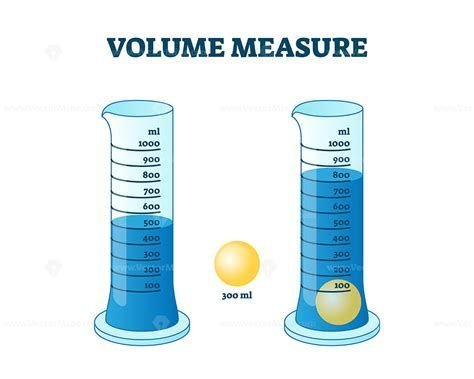
method 7: visualize real-world objects
Abstract numbers become easier when you tie them to real objects.
Examples:
- 1 liter ≈ a standard water bottle
- 1 milliliter ≈ a few drops of water
- 1 cup ≈ a small tea mug
- 1 tablespoon ≈ a spoonful of syrup
When you visualize:
- 500 mL = half a water bottle
- 2 liters = two large bottles
You stop relying purely on numbers and start understanding scale.
method 8: double-check using reverse conversion
One of the most effective error-checking methods is reversing your calculation.
Example:
You convert 2 liters → 2000 mL
Now reverse it:
2000 mL ÷ 1000 = 2 liters
If you get back your original value, your conversion is correct.
This method is especially useful when:
- Working on exams
- Handling important measurements
- Dealing with unfamiliar units
practical scenarios where these methods shine
cooking and baking
Recipes often mix units—cups, tablespoons, milliliters. Using estimation and key conversions prevents disasters like overly salty soup or undercooked batter.
Example:
If a recipe calls for 500 mL milk and you only have cups:
500 ÷ 240 ≈ 2 cups
You don’t need perfect precision—just a reliable method.
science and laboratory work
In labs, precision matters more than intuition. Methods like base-unit conversion and reverse checking become essential.
Example:
Converting cubic centimeters to milliliters is straightforward because:
1 cm³ = 1 mL
Knowing this saves time and reduces calculation errors.
everyday life
From fuel measurements to beverage quantities, volume conversions appear more often than we realize.
Buying drinks, mixing cleaning solutions, or measuring liquids for home projects all benefit from quick mental conversions.
common mistakes to avoid
Even with good methods, people often fall into these traps:
- mixing US and imperial units without noticing
- forgetting to adjust decimal places
- skipping estimation and trusting incorrect results
- relying only on memorization without understanding
The key is not perfection—it’s awareness. Once you know where mistakes happen, you can prevent them.
building long-term confidence
Volume conversion isn’t about being fast at math. It’s about recognizing patterns.
When you:
- understand relationships
- use visual methods
- rely on logical steps
You gradually stop “converting” and start thinking naturally in multiple units.
That’s when the skill becomes permanent.
quick reference mini-table
Unit | Equivalent
1 liter | 1000 mL
1 mL | 1 cm³
1 cup | ~240 mL
1 tbsp | ~15 mL
1 tsp | ~5 mL
1 gallon | ~3.785 L
Keep this small table in mind, and most problems become manageable.
frequently asked questions
- what is the easiest way to convert between liters and milliliters?
The easiest way is to move the decimal point. Multiply by 1000 when going from liters to milliliters, and divide by 1000 when going the other way. - why are there different volume systems like metric and US customary?
They developed historically in different regions. The metric system is standardized and decimal-based, while the US system evolved from older measurement traditions. - how can i avoid mistakes during conversions?
Use estimation first, follow a clear method like the unit ladder, and always double-check by reversing the conversion. - is it necessary to memorize all conversion factors?
No. Focus on a few common ones and use logic or proportional reasoning to derive the rest. - what is the most accurate method for complex conversions?
Converting through a base unit (like liters) is the most reliable method, especially when dealing with unfamiliar units. - how do professionals handle volume conversions quickly?
They rely on experience, key memorized values, estimation, and structured methods like proportional reasoning rather than memorizing everything.
In the end, volume conversion is less about numbers and more about approach. Once you adopt these eight proven methods, what once felt confusing becomes predictable—and eventually, almost automatic.