














7 Easy Length Measurement Conversion Guide Tips You Must Know
There’s something oddly satisfying about getting measurements right. Whether you’re measuring a piece of wood for a small home project, adjusting fabric for stitching, or simply trying to understand distances better, length conversion quietly plays a role in everyday life. Yet, for many people, it feels confusing—like switching between two languages mid-sentence.
The truth is, length conversion doesn’t have to feel like math homework. It can become second nature once you understand a few simple patterns. In this guide, we’ll explore seven practical tips that go beyond memorization. These are habits, shortcuts, and mental models you can actually use in real situations.
Tip 1: Understand the “base unit mindset”
Before diving into conversions, it helps to shift how you think about measurements. Instead of seeing meters, centimeters, inches, and feet as separate things, think of them as different expressions of the same length.
The meter acts as a base unit in the metric system. Everything else—centimeters, millimeters, kilometers—branches out from it.
For example:
1 meter = 100 centimeters
1 meter = 1000 millimeters
Instead of memorizing dozens of conversions, focus on the base and build from there. When you do this, conversions become a matter of moving up or down the scale rather than starting from scratch each time.
Imagine you’re converting 2 meters to centimeters. Instead of recalling a formula, you just think: “Meters to centimeters means ×100.” So 2 becomes 200. That’s it.
This mindset reduces mental clutter. You’re not juggling numbers—you’re following a pattern.
Tip 2: Learn the metric ladder once—and reuse it forever
The metric system follows a beautifully predictable structure. Think of it like a ladder:
Kilometer → Meter → Centimeter → Millimeter
Each step down multiplies by 10 (or 100 depending on the jump), and each step up divides.
Let’s visualize a simple movement:
- From meter to centimeter → multiply by 100
- From centimeter to millimeter → multiply by 10
- From kilometer to meter → multiply by 1000
Instead of memorizing individual conversions, imagine physically moving along this ladder. Each step is consistent, which makes it far easier to remember.
A practical example:
You have 3.5 meters and want centimeters.
Move one step down → multiply by 100
3.5 × 100 = 350 cm
No formula sheet required—just the ladder.
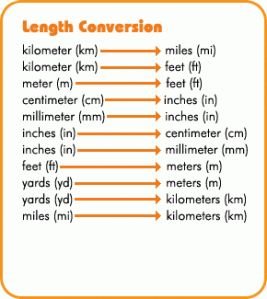
Tip 3: Use anchor conversions for the imperial system
The imperial system (inches, feet, yards, miles) doesn’t follow a clean pattern like metric units. That’s why many people struggle with it. But there’s a trick: anchor conversions.
Memorize just a few key relationships:
- 1 foot = 12 inches
- 1 yard = 3 feet
- 1 mile = 5280 feet
Once you lock these in, everything else becomes a combination.
For example:
Convert 2 yards into inches.
Step 1: yards → feet
2 × 3 = 6 feet
Step 2: feet → inches
6 × 12 = 72 inches
Instead of memorizing “1 yard = 36 inches,” you build it logically. This approach is more reliable because you’re less likely to forget how you got the answer.
Tip 4: Round smartly for quick real-life estimates
Not every situation needs perfect accuracy. Sometimes you just need a quick estimate.
For example:
1 inch ≈ 2.5 cm
1 foot ≈ 30 cm
1 meter ≈ 3.3 feet
These rounded values are incredibly useful in daily life. If you’re estimating the size of furniture, checking your height, or comparing distances, rough conversions save time.
Imagine you’re told something is 50 inches long. Instead of calculating exactly:
50 × 2.54 = 127 cm
You can estimate:
50 × 2.5 = 125 cm
Close enough for most situations.
This habit makes you faster and more confident, especially when you don’t have a calculator nearby.
Tip 5: Convert in steps, not in one jump
One of the most common mistakes is trying to convert directly between distant units. For example, jumping from miles to centimeters in one go can feel overwhelming.
Instead, break it into steps:
Miles → feet → inches → centimeters
Each step is manageable. You reduce the chance of errors because you’re dealing with familiar conversions.
Let’s say you want to convert 1 mile to inches:
1 mile = 5280 feet
5280 × 12 = 63,360 inches
By breaking it down, the process feels structured instead of chaotic.
This step-by-step approach is especially helpful in exams, technical work, or construction tasks where accuracy matters.
Tip 6: Use visual references to build intuition
Numbers alone can feel abstract. But when you connect measurements to real-world objects, they become easier to understand.
Here are some simple visual anchors:
- A standard door height ≈ 2 meters
- A pencil ≈ 15–20 cm
- Your thumb width ≈ 2–2.5 cm
- A football field ≈ 100 meters
When you think in terms of objects, conversions become more intuitive.
For instance, if someone says “300 cm,” you can quickly think:
“That’s about 3 meters… roughly the height of a tall room wall.”
This mental imagery helps you avoid mistakes and gives you a better sense of scale.
Tip 7: Practice through everyday activities
The best way to master conversions isn’t through memorization—it’s through use.
Try incorporating conversions into daily routines:
- Measure your desk and convert units
- Check your height in both cm and feet
- Convert distances while traveling
- Compare product dimensions while shopping
Even small actions build familiarity.
For example, if your height is 170 cm:
Divide by 30 (approximation for feet) → about 5.6 feet
The more often you do this, the less effort it requires. Eventually, conversions become automatic.
A short practical section: combining everything
Let’s put all these tips together with a simple example.
You have a piece of wood that is 2.5 meters long. You need the length in inches.
Step 1: meters → centimeters
2.5 × 100 = 250 cm
Step 2: centimeters → inches
250 ÷ 2.54 ≈ 98.4 inches
Or use estimation:
250 ÷ 2.5 = 100 inches
You now have both a precise and an approximate answer. That’s the power of combining methods.
Common mistakes to avoid
Even with good techniques, some errors show up frequently:
Mixing units mid-calculation
Always stick to one system until the final step.
Forgetting conversion direction
Multiplying when you should divide is a common slip.
Overcomplicating simple conversions
Sometimes a rough estimate is all you need.
Ignoring context
Precision matters more in engineering than in casual measurement.
By being aware of these pitfalls, you can avoid unnecessary confusion.
Why mastering length conversion matters
Length conversion isn’t just academic—it’s practical. It shows up in:
- Construction and design
- Cooking and tailoring
- Travel and navigation
- Online shopping
Understanding conversions helps you make better decisions. It reduces mistakes and improves confidence.
More importantly, it trains your brain to think flexibly. You start seeing relationships between numbers rather than isolated values.
A conversational reflection
Think about the last time you struggled with measurements. Maybe you were trying to understand a product size online or follow instructions that used unfamiliar units.
The frustration usually doesn’t come from the numbers—it comes from not having a clear method.
Once you adopt these seven tips, that confusion starts to fade. You stop guessing and start understanding.
FAQs
- What is the easiest way to remember metric conversions?
The easiest way is to use the metric ladder. Think of units as steps where each move up or down changes the value by powers of 10. - How do I quickly convert inches to centimeters?
Use the approximation: 1 inch ≈ 2.5 cm. Multiply the number of inches by 2.5 for a quick estimate. - Why is the imperial system harder to use?
Because it doesn’t follow a consistent pattern like the metric system. Each unit has a different conversion factor, so it requires memorization or step-by-step conversion. - When should I use exact conversions instead of estimates?
Use exact conversions in technical work, engineering, or when precision is critical. Estimates are fine for everyday use. - Can I rely on mental math for conversions?
Yes, especially for common conversions and rough estimates. With practice, mental math becomes fast and reliable. - What’s the best way to practice length conversion?
Apply it in daily life—measure objects, compare units, and convert values regularly. Real-world practice builds long-term understanding.
In the end, length conversion isn’t about memorizing numbers—it’s about recognizing patterns, building intuition, and practicing consistently. Once you see it that way, it becomes less of a task and more of a skill you naturally use.