


































5 Easy Temperature Measurement Conversion Guide Tips That Actually Work
If you’ve ever paused mid-recipe, mid-experiment, or even mid-conversation wondering how to convert temperature correctly, you’re not alone. Temperature conversion looks simple on paper, yet in real life, it often turns into guesswork, especially when switching between Celsius, Fahrenheit, and Kelvin. The truth is, most people don’t struggle because the math is hard—they struggle because they were never shown practical ways to remember and apply it.
This guide isn’t just a list of formulas. It’s a collection of usable, real-world methods, memory tricks, relatable examples, and small exercises that help temperature conversion actually stick. By the time you finish reading, you won’t just know how to convert—you’ll feel confident doing it without second-guessing yourself.
Let’s begin with the basics, but in a way that feels natural.
Understanding the three main temperature scales
Before jumping into conversion tips, it helps to understand what you’re converting between.
Celsius is used in most countries and is built around water. Zero degrees is freezing, and 100 degrees is boiling. It’s clean, logical, and easy to visualize.
Fahrenheit is used mainly in the United States. It spreads temperatures out more, making it useful for everyday weather descriptions. For example, 68°F feels comfortably warm, while 86°F feels hot.
Kelvin is used in science. It starts at absolute zero, the point where molecular motion stops. Unlike the others, it doesn’t use degrees—just Kelvin.
Here’s a quick mental anchor:
Water freezes at:
0°C = 32°F = 273 K
Water boils at:
100°C = 212°F = 373 K
These two points alone can already help you estimate conversions without doing full calculations.
Now let’s move into the five tips that make conversion actually work in daily life.
Tip 1: Use the “double and add 30” shortcut for quick estimates
One of the easiest and most practical tricks is the “double and add 30” method. It’s not perfectly exact, but it’s surprisingly accurate for everyday use.
Here’s how it works:
To convert Celsius to Fahrenheit quickly:
Multiply by 2, then add 30.
Example:
25°C → (25 × 2) + 30 = 80°F
The exact answer is 77°F, so you’re very close.
This method is perfect when:
– You’re checking weather differences
– You’re cooking and need a rough idea
– You don’t need scientific precision
Now reverse it:
To go from Fahrenheit to Celsius:
Subtract 30, then divide by 2.
Example:
86°F → (86 − 30) ÷ 2 = 28°C
Actual value is 30°C, again very close.
Mini practice:
Try estimating 20°C → Fahrenheit
(20 × 2) + 30 = 70°F
Actual: 68°F
You’re within 2 degrees—good enough for most real-life situations.
Why this works:
The true formula uses 1.8 (not 2), but rounding to 2 makes mental math easy while keeping results close.
Tip 2: Remember key “anchor temperatures”
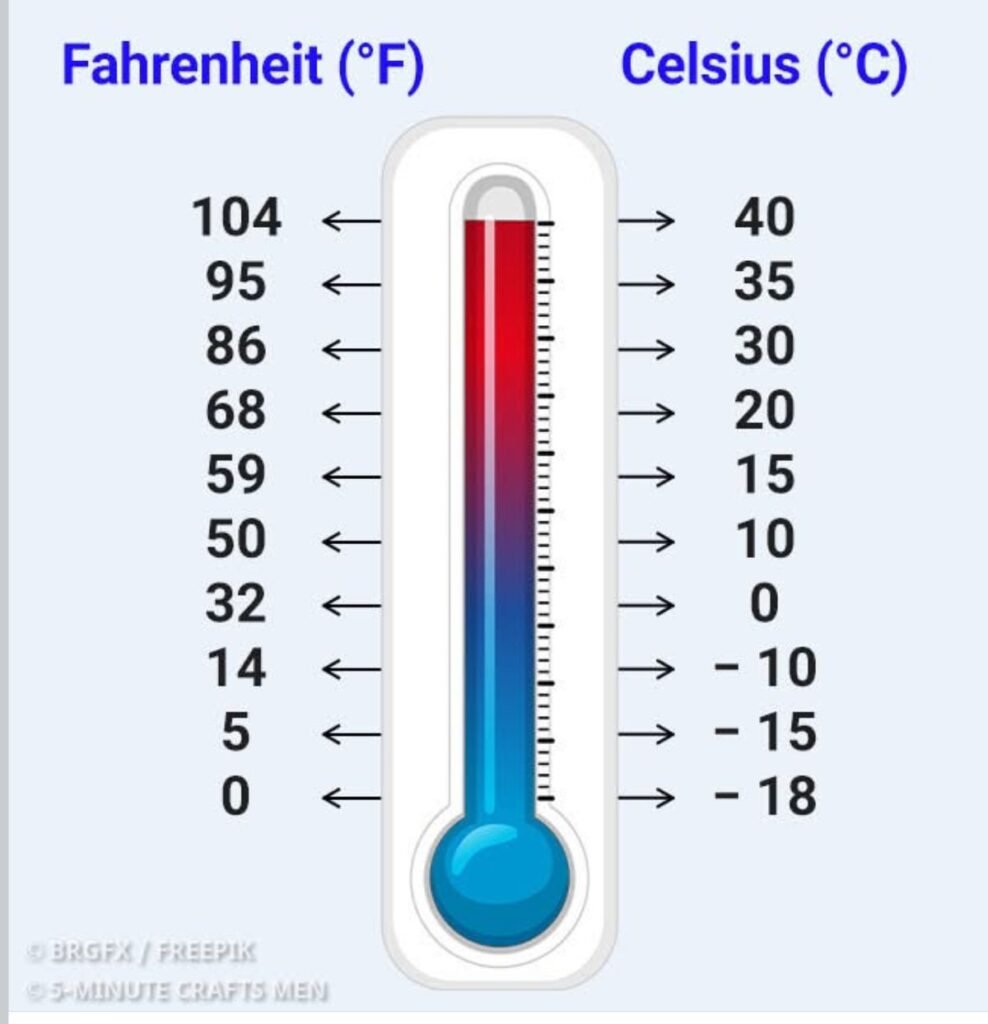
Instead of memorizing formulas, memorize a few key temperature points. These act like landmarks in your mind.
Here are the most useful ones:
0°C = 32°F → freezing
10°C = 50°F → cool weather
20°C = 68°F → room temperature
25°C = 77°F → warm
30°C = 86°F → hot
37°C = 98.6°F → body temperature
100°C = 212°F → boiling
When you remember these, you can estimate anything in between.
Example:
If 30°C = 86°F, then 28°C must be slightly below 86°F, around 82°F–83°F.
This technique builds intuition rather than relying on formulas every time.
A helpful exercise:
Close your eyes and imagine a typical day:
– Morning chill → around 10°C
– Comfortable room → around 20°C
– Hot afternoon → around 30°C
Attach feelings to numbers, not just values. That’s how memory becomes natural.
Tip 3: Understand the real formula—but simplify it mentally
At some point, you’ll want precision. That’s where formulas come in.
Celsius to Fahrenheit:
F = (C × 9/5) + 32
Fahrenheit to Celsius:
C = (F − 32) × 5/9
Kelvin conversions:
K = C + 273
C = K − 273
Now here’s the trick: simplify the fractions.
Instead of 9/5, think:
Multiply by 2, then subtract a little.
Example:
20°C
Double it → 40
Add 32 → 72
Actual answer: 68
Now adjust slightly downward.
This “adjust after doubling” method keeps your brain from getting stuck in fractions.
For Kelvin, things are even easier:
Just add or subtract 273.
Example:
25°C → 298 K
300 K → 27°C
No multiplication needed.
Small challenge:
Convert 15°C to Kelvin
15 + 273 = 288 K
Done in seconds.
Tip 4: Use real-life scenarios instead of abstract numbers
Numbers alone don’t stick—but situations do.
Let’s connect temperature conversion to everyday life.
Cooking example:
If a recipe says 180°C, what is that in Fahrenheit?
Use the quick method:
(180 × 2) + 30 = 390°F
Actual: 356°F
Since ovens aren’t exact anyway, you now know it’s “around 350–375°F.”
Weather example:
You see 95°F on a forecast.
Convert:
(95 − 30) ÷ 2 = 32.5°C
That tells you it’s a very hot day.
Health example:
A fever of 102°F
Convert:
(102 − 30) ÷ 2 = 36°C (approx)
Actual: ~39°C
Now you understand it’s a serious fever.
The key insight:
Attach conversions to situations you already understand—cooking, weather, body temperature. This turns math into meaning.
Tip 5: Practice with patterns, not random numbers
Most people practice conversions randomly, which makes it harder to learn.
Instead, practice in sequences.
Example pattern:
0°C → 32°F
10°C → 50°F
20°C → 68°F
30°C → 86°F
Notice something?
Every increase of 10°C adds 18°F.
That’s the hidden pattern.
Now try filling in the gaps:
5°C → about 41°F
15°C → about 59°F
25°C → about 77°F
Your brain starts predicting values automatically.
Try another pattern:
Kelvin scale
273 K → 0°C
283 K → 10°C
293 K → 20°C
Every 10 K equals 10°C.
No scaling needed—just a shift.
This kind of pattern-based practice builds speed and confidence much faster than isolated calculations.
A short reflection exercise
Take a moment and answer these without calculating:
What does 22°C feel like?
What does 75°F feel like?
Which is hotter: 300 K or 25°C?
If you can answer these intuitively, you’ve already moved beyond memorization.
Common mistakes people make (and how to avoid them)
Mistake 1: Forgetting to add or subtract 32
Solution: Always remember that Fahrenheit has an offset.
Mistake 2: Mixing up multiplication order
Solution: Multiply first, then add or subtract.
Mistake 3: Treating Kelvin like Celsius
Solution: Kelvin is just Celsius shifted by 273—no scaling.
Mistake 4: Overcomplicating mental math
Solution: Use approximations unless exact values are required.
Mistake 5: Not practicing regularly
Solution: Convert temperatures you see daily—weather apps are perfect for this.
A practical daily habit
For one week, try this:
Every time you check the weather, convert it mentally.
Morning:
“Today is 28°C… that’s about 82°F.”
Evening:
“Tonight it’s 68°F… that’s about 20°C.”
Within days, conversions will start feeling automatic.
Why these tips actually work
These methods work because they align with how the brain learns:
– Patterns are easier than formulas
– Context is stronger than abstraction
– Approximation builds confidence
– Repetition creates fluency
Instead of forcing memorization, you’re building understanding step by step.
And once that understanding is there, the formulas become tools—not obstacles.
Frequently Asked Questions (FAQs)
- What is the fastest way to convert Celsius to Fahrenheit?
The quickest method is to double the Celsius value and add 30. It gives a close estimate and works well for everyday use like weather and cooking. - How accurate is the “double and add 30” method?
It’s usually within 1–3 degrees of the exact value. For daily situations, this is more than accurate enough. For scientific work, use the full formula. - Why does Fahrenheit use 32 as a base?
Fahrenheit was designed with different reference points, including a saltwater mixture and body temperature. That’s why it includes an offset of 32 instead of starting at zero like Celsius. - Is Kelvin harder to convert than Celsius or Fahrenheit?
Not at all. Kelvin is actually the simplest—just add or subtract 273. There’s no multiplication involved. - Which temperature scale is best?
It depends on context. Celsius is best for everyday use, Fahrenheit for detailed weather perception, and Kelvin for scientific calculations. - How can I get better at temperature conversion quickly?
Practice daily using real-life examples like weather forecasts and cooking temperatures. Focus on patterns and anchor points rather than memorizing formulas.
Final thought
Temperature conversion isn’t really about math—it’s about familiarity. Once numbers connect with real experiences, they stop feeling abstract. With a few simple tricks and a bit of consistent practice, you can turn something that once felt confusing into something almost automatic.
And once that happens, you won’t need to “figure it out” anymore—you’ll just know.