
































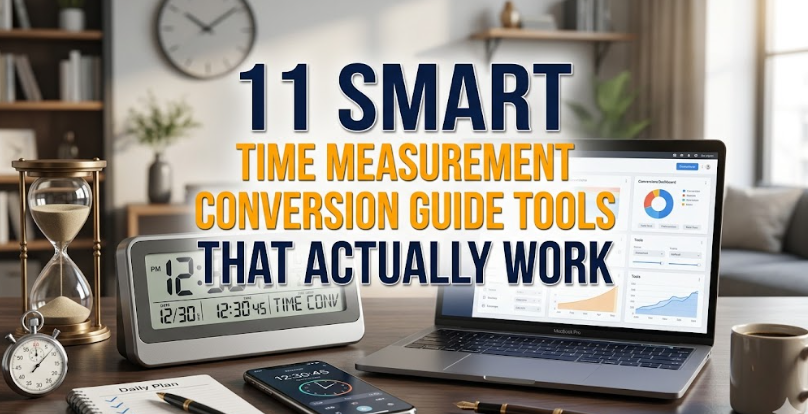

11 Smart Time Measurement Conversion Guide Tools That Actually Work
Time conversion sounds simple until you actually need it. Seconds become minutes, minutes become hours, hours become days, and suddenly you’re staring at a spreadsheet wondering why everything looks wrong. Whether you’re a student, engineer, traveler, freelancer, scientist, or project manager, converting time accurately is one of those tiny skills that quietly saves hours of stress.
This guide is designed to be more than just text. You’ll find mini tables, quick reference blocks, real-life examples, visual breakdowns, and practical exercises you can actually use. Instead of memorizing endless formulas, you’ll learn the tools and systems that make conversions feel automatic.
Let’s dive into the tools that truly work.
Understanding the hidden complexity of time conversion
Before tools, we need context. Time is not a pure base-10 system like meters or grams. It mixes base-60, base-24, base-7, and base-365. That’s why mistakes happen.
Here’s the layered structure of time:
1 minute = 60 seconds
1 hour   = 60 minutes
1 day    = 24 hours
1 week   = 7 days
1 month  ≈ 28–31 days
1 year   = 365 days (366 leap year)
The inconsistency is the root of conversion mistakes. Good tools compensate for this.
Tool 1 — The Anchor Ratio Method
This is the most powerful mental conversion tool.
Instead of memorizing many conversions, memorize anchor ratios and chain them.
Core anchors to memorize:
| Anchor | Value |
|---|---|
| 1 hour | 3600 seconds |
| 1 day | 1440 minutes |
| 1 week | 168 hours |
| 1 year | 8760 hours |
Example:
Convert 3.5 hours to seconds.
Step chain:
3.5 hours × 60 minutes × 60 seconds
= 3.5 × 3600
= 12,600 seconds
Why it works:
You only memorize a few anchors and build everything from them.
Mini exercise:
Convert 2.25 days into minutes.
Solution:
2.25 × 1440 = 3240 minutes.
Tool 2 — The Ladder Conversion Sketch
Draw a “conversion ladder” when numbers feel messy.
Example ladder:
Days → Hours → Minutes → Seconds
 ×24    ×60      ×60
If converting backwards, divide instead of multiply.
Example:
Convert 18,000 seconds to hours.
18000 ÷ 60 = 300 minutes
300 ÷ 60 = 5 hours
This tool prevents skipping steps, which is where most errors happen.

Tool 3 — The 60-Factor Shortcut Trick
Since 60 appears everywhere in time, you can speed up math using factor pairs.
Factor pairs of 60:
60 = 6×10 = 3×20 = 4×15 = 5×12
Example:
Convert 45 minutes to seconds quickly.
Instead of 45 × 60:
Use 45 × (3 × 20)
45 × 3 = 135
135 × 20 = 2700 seconds
This reduces mental strain dramatically.
Tool 4 — The Percentage Estimation Tool
Perfect for quick approximations.
Memorize:
| Fraction of hour | Minutes |
|---|---|
| 25% | 15 min |
| 50% | 30 min |
| 75% | 45 min |
Example:
2.75 hours = 2 hours + 75% of hour
= 2 hours + 45 minutes
Used in scheduling, meetings, cooking, workouts.
Tool 5 — The Decimal Hour Converter
This tool is essential for freelancers and payroll work.
Businesses use decimal hours:
1.5 hours instead of 1 hour 30 minutes.
Conversion formula:
Decimal hours × 60 = minutes
Examples:
| Decimal | Real Time |
|---|---|
| 1.25 | 1h 15m |
| 1.5 | 1h 30m |
| 1.75 | 1h 45m |
| 2.2 | 2h 12m |
Practice:
Convert 3.6 hours → 3h 36m.
Tool 6 — The Reverse Conversion Formula
When you need decimal from minutes:
Minutes ÷ 60 = decimal hours
Examples:
| Minutes | Decimal |
|---|---|
| 15 | 0.25 |
| 30 | 0.5 |
| 45 | 0.75 |
| 90 | 1.5 |
Example:
135 minutes → 135 ÷ 60 = 2.25 hours.
This is extremely useful in timesheets.
Tool 7 — The Time Block Visualizer
Visual thinking eliminates mistakes.
Imagine a clock divided into blocks:
Quarter hour = 15 min
Half hour = 30 min
Three quarters = 45 min
Use visual chunks instead of numbers.
Example:
7 hours 45 minutes → think: 7 hours + ¾ hour.
Much easier to convert:
7.75 hours.
Tool 8 — The Seconds Compression Trick
Large seconds look scary. Compress them first.
Example:
Convert 250,000 seconds into hours.
Step 1: Divide by 3600.
Instead, split:
250,000 ÷ 36 ≈ 6944
Then divide by 100 → 69.4 hours.
Approximation tool saves time.
Exact:
69 hours 26 minutes.
Tool 9 — The Weekly Planner Conversion Tool
Weekly planning often needs hour/day conversion.
Memorize weekly anchors:
| Work hours/day | Weekly total |
|---|---|
| 6 h | 42 h |
| 7 h | 49 h |
| 8 h | 56 h |
| 9 h | 63 h |
Example:
You study 3.5 hours daily →
3.5 × 7 = 24.5 hours/week.
Tool 10 — The Yearly Projection Tool
Used in budgeting, fitness, productivity.
Key anchors:
| Daily habit | Yearly result |
|---|---|
| 10 min/day | 60 hours/year |
| 30 min/day | 182.5 hours/year |
| 1 hour/day | 365 hours/year |
This tool shows long-term impact instantly.
Example:
20 minutes daily learning:
20 × 365 = 7300 minutes
= 121.6 hours/year.
Tool 11 — The Mistake-Proof Conversion Checklist
Before finalizing any conversion, check:
✔ Did I multiply or divide correctly?
✔ Did I skip a unit level?
✔ Did I confuse decimal vs minutes?
✔ Did I round too early?
✔ Did I use 24h or 12h correctly?
This simple checklist catches most real-world errors.
Real-life scenarios where these tools shine
Freelancing and billing
Incorrect decimal conversion = lost income.
Travel planning
Flight duration + layovers require multi-step conversions.
Fitness tracking
Weekly totals motivate consistency.
Academic work
Physics and engineering heavily depend on seconds.
Cooking & baking
Timing precision matters.
Project management
Time estimates determine deadlines.

Practice workshop section
Convert step-by-step:
- 4.2 hours → minutes
4.2 × 60 = 252 minutes - 5400 seconds → hours
5400 ÷ 3600 = 1.5 hours - 2 days → seconds
2 × 24 × 3600 = 172,800 seconds - 95 minutes → hours
95 ÷ 60 = 1.583 hours ≈ 1h 35m - 3 weeks → hours
3 × 168 = 504 hours
Quick reference cheat sheet
1 hour = 3600 sec
1 day = 1440 min
1 week = 168 hours
1 year = 8760 hours
Keep this saved. It replaces dozens of formulas.
The psychology of time conversion mistakes
Why errors happen:
• Base-60 is unnatural
• We rush calculations
• We mix decimal and clock time
• We round too early
• We skip unit steps
Using structured tools removes these mental traps.
How to build automatic conversion speed
Practice daily micro-drills:
Day 1: seconds ↔ minutes
Day 2: minutes ↔ hours
Day 3: hours ↔ days
Day 4: mixed conversions
Day 5: real-life scenarios
Within a week, conversions become instinctive.
The long-term payoff
Mastering time conversion saves:
• Money
• Planning stress
• Scheduling mistakes
• Study time
• Mental energy
Tiny skill, massive impact.
FAQs
- Why is time not based on 100 like most units?
Time comes from ancient astronomy. Civilizations used base-60 because it divides easily into many fractions (½, ⅓, ¼, ⅕). - What is the fastest way to convert hours to minutes mentally?
Multiply by 6 and add a zero.
Example: 7 hours → 7×6=42 → 420 minutes. - Why do businesses use decimal hours instead of minutes?
Decimal hours make payroll and accounting easier because calculations become standard base-10 math. - How can I avoid mixing decimal hours and clock time?
Always convert minutes using ×60 or ÷60 before combining with hours. - What conversion should everyone memorize first?
Memorize: 1 hour = 3600 seconds and 1 day = 1440 minutes. - How long does it take to get fast at time conversions?
With daily practice, most people become comfortable within one week and fluent within a month.
Time conversion stops being confusing when you stop memorizing everything and start using smart tools. Once these 11 tools become habits, you’ll rarely second-guess your numbers again.