















Your Conversion Confusion Ends Here
Your friend in Europe just messaged you: “I’ve found the perfect rug for your apartment! It’s 200 cm × 150 cm. Want me to grab it?”
You stare at your phone. Your living room is 8′ x 6′. Will it fit? Is it too big? Too small?
You have no idea.
This happens more often than you might guess. You’re ordering furniture online, and there are centimeters involved. You’re on a workout plan and the distances are in kilometers. You’re assisting with homework that involves the metric system.
And each and every time, you slam into the same wall: conversion confusion.
But here’s the dirty little secret that most people don’t understand: you don’t need to be a human calculator in order to become adept at making conversions.
What you need are proven tips that work every time. Basic shortcuts that stick in your brain. Helpful tips for life that you won’t need your phone to use.
This guide serves you with 8 ultimate length measurement conversion tricks that really work. They are all tested and proven, made for real life.
By the end, you’ll be able to convert anything with confidence. No more guessing. No more expensive mistakes. Nothing fancy, no hassle and accurate every time.
Let’s dive in.
Why These 8 Tips Change Everything
Before I get to the tips themselves, it’s important that you understand why learning conversions is actually important.
Think about the last month. How many times did you:
- Shop online from international stores
- Load dimensions of unknown units
- Follow recipes from other countries
- Plan journeys with several distance measurement units
- Tutor kids on science or math homework
Each situation required conversion skills. And if you’re like most people, you’ve probably struggled through or made a mistake.
A Seattle woman purchased a “compact” European sofa listed at 180 cm. When it arrived, she realized that it was 71 inches, and way too small for her space. She had to pay $400 to send it back.
A contractor in Texas purchased 50 meters of pipe, mistakenly thinking it was roughly equivalent to the number of yards as advertised. He was 14-and-a-half feet short on his project, and had to reorder: a three-day delay.
These aren’t rare stories. They happen constantly.
The 8 absolute length measurement conversion guide tricks in this post eliminate these errors. They will save you money, time and headaches.
More importantly, they build confidence. You will glance at any measurement and suddenly know what it means in units you recognize.
That’s powerful.
Tip 1: Learn The Magic Number 2.5
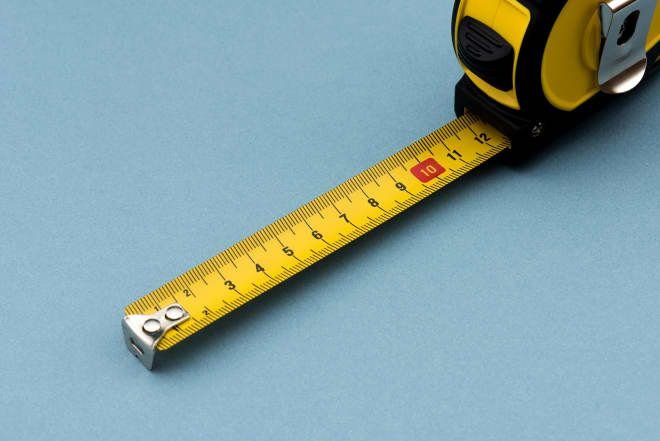
This number is the key that unlocks the most frequent conversion you’ll ever have to make.
The Tip: To get centimeters from inches, multiply by 2.5.
The correct conversion is 2.54, but close enough for almost everything is 2.5 and a heck of a lot easier to do in your head.
Why 2.5 Works
Your brain can double a number in no time. It can, of course, divide numbers in half with ease. So 2.5 is just “double it, and then add half more of the original.”
10 inches? Double it (20), and add half (5) = 25 cm. Done in three seconds.
Real-Life Applications
Buying shoes online:
- Size 9 is about 9 inches long
- 9 × 2.5 = 22.5 cm
- This is 22-23 cm on European size charts
Measuring screen sizes:
- 15-inch laptop = 15 × 2.5 = 37.5 cm
- 27-inch screen = 27 × 2.5 = 67.5 cm
Home improvement:
- 36-inch doorway = 36 × 2.5 = 90 cm
- 24-inch tile = 24 × 2.5 = 60 cm
Going Backward
Divide by 2.5 to get from centimeters to inches.
- A 50 cm shelf = 50 ÷ 2.5 = 20 inches
- A table with 75 cm width = 75 ÷ 2.5 = 30 inches
Quick Reference Table:
| Inches | × 2.5 | Centimeters | Exact |
|---|---|---|---|
| 6 | 15 | 15.2 | |
| 12 | 30 | 30.5 | |
| 18 | 45 | 45.7 | |
| 24 | 60 | 61.0 | |
| 36 | 90 | 91.4 |
Tip 2: The Rule of Three—Feet and Meters
Feet and meters are a lot closer than people think.
The Tip: Three feet is approximately equivalent to one meter.
Or more exactly, 1 meter = 3.28 feet. But for rough estimates, this 3-to-1 rule is easy to use.
How to Use This
Converting room dimensions:
- 12-foot bedroom = 12 ÷ 3 = 4 meters
- 18-foot garage = 18 ÷ 3 = 6 meters
- 9-foot ceiling = 9 ÷ 3 = 3 meters
Going the other way:
- 5-meter pool = 5 × 3 = 15 feet
- 2-meter door height = 2 × 3 = 6 feet
- 10-meter rope = 10 × 3 = 30 feet
When This Matters
You are browsing apartments in a foreign country on the web. One shows “25 square meters.”
Applying the 3-to-1 rule: Each side measures 5 meters, or about 15 feet. (That’s a 15×15 foot room—rather small for a studio apartment.)
Another reads “50 square meters.” That’s equivalent to about 7 meters per side, or 21 feet. Now we are getting into a good, large room.
Quick Reference Table:
| Feet | ÷ 3 Method | Meters (Approx) | Exact |
|---|---|---|---|
| 3 | 1.0 | 0.91 | |
| 6 | 2.0 | 1.83 | |
| 9 | 3.0 | 2.74 | |
| 15 | 5.0 | 4.57 | |
| 30 | 10.0 | 9.14 |
For a complete list of measurement conversions, visit Measurement Conversion Guide for charts and other handy tools.
Tip 3: Add 60 Percent for Miles to Kilometers
Driving abroad? This tip becomes essential.
The Tip: Multiply your miles by 160 percent (or add 60%) and you’ve got kilometers.
The precise factor is 1.609, so the increase of 60% lands you in very nearly the right spot.
The Mental Math
60% sounds confusing, but it isn’t. Just take 50 percent (half) and add 10%.
Example: 50 miles
- Half is 25
- 10% is 5
- 25 + 5 = 30
- 50 + 30 = 80 km
The exact answer is 80.5 km. You nailed it.
Quick Highway Math
Speed limits:
- 30 mph = 30 + 18 = 48 km/h (correct: 48.3)
- 55 mph = 55 + 33 = 88 km/h (exact: 88.5)
- 70 mph = 70 + 42 = 112 km/h (exact: 112.7)
Trip distances:
- 100-mile road trip = 160 km
- 250-mile journey = 400 km
- 500-mile drive = 800 km
Reverse Direction
For kilometers to miles, subtract around 40%.
- 100 km – 40 = 60 miles (exact: 62.1 miles)
- 80 km – 32 = 48 miles (exact: 49.7 miles)
Quick Reference Table:
| Miles | Add 60% | Calculation | Kilometers (Approx) |
|---|---|---|---|
| 10 | 10 + 6 | 16 | |
| 25 | 25 + 15 | 40 | |
| 60 | 60 + 36 | 96 | |
| 100 | 100 + 60 | 160 |
Tip 4: Measure With Your Thumb
Your body is an instrument you always carry.
The Tip: The adult thumb on average is just under one inch wide.
This isn’t random. The inch used to be a measure of thumb width, so it’s built into human proportions.
How to Use This
Shopping without a ruler:
- Need a 2-inch gap? Two thumbs wide.
- Want to know if something is 4 inches? Four thumbs.
Quick estimates:
- Measure tiny objects by placing them against your thumb
- Count thumb widths to ‘eyeball’ distances
- Work on picture frames, shelves and decorations
Other Body Measurements Worth Knowing
- Hand width (thumb to pinky spread out): 8-9 inches (20-23 cm)
- Forearm (elbow to fingertip): About 17-18 inches (43-46 cm)
- Foot length: 10-12 inches (25-30 cm)
- Your pace: One step when you walk is about 2.5 feet (76 cm)
The One-Time Setup
Once, take 5 minutes to measure these body parts. Write them down. Memorize them.
Thereafter, you have a measuring device that never requires batteries or gets lost.
Your Personal Measurements:
| Body Part | Average Adult Size | Your Size |
|---|---|---|
| Thumb width | 1 inch / 2.5 cm | ______ |
| Hand span | 8-9 inches / 20-23 cm | ______ |
| Forearm | 17-18 inches / 43-46 cm | ______ |
| Foot length | 10-12 inches / 25-30 cm | ______ |
| Stride | 30 inches / 76 cm | ______ |
Tip 5: Yards and Meters Are Twins
This may be the simplest advice in this entire guide.
The Tip: For rough approximations, yards and meters are just about the same.
One meter is technically 1.094 yards (about 9 percent longer). But for day-to-day choices you can consider them equal.
When This Simplifies Life
Buying fabric:
- Need 5 yards? Get 5 meters. Close enough.
- Want 10 meters? That’s about 10 yards.
Sports and fitness:
- 100-yard dash ≈ 100-meter dash (really 91.4 m)
- 400-meter track ≈ 440 yards (really 437 yards)
Landscaping:
- 50 yards of fencing ≈ 50 meters
- 25-meter garden hose ≈ 25 yards
When Precision Matters
For those projects where precise measurements count, remember the 9% rule.
If you need exactly 10 meters of rope, but your store only sells it by yards, purchase 11 to be safe.
If you require 20 yards and can only purchase meters, buy 19 meters (because 20 × 0.914 = 18.28).
Quick Reference Table:
| Yards/Meters | Approximate | Exact Conversion |
|---|---|---|
| 10 | Same | 10 yd = 9.14 m |
| 25 | Same | 25 yd = 22.86 m |
| 100 | Same | 100 yd = 91.44 m |
Tip 6: Divide by 25 for Tiny Measurements
Working with small parts? Tools? Jewelry? This tip is for you.
The Tip: To go from millimeters to inches, divide by 25.
The actual factor is 25.4, but 25 makes much more convenient mental arithmetic and it’s remarkably close anyway.
Workshop Applications
Tool sizes:
- 10mm wrench = 10 ÷ 25 = 0.4 inch (exact: 0.39)
- 50mm bolt = 50 ÷ 25 = 2 inches (exact: 1.97)
- 6mm drill bit = 6 ÷ 25 = 0.24 inch (exact: 0.24)
Photography:
- 50mm lens = 2 inches
- 85mm lens = 3.4 inches
- 200mm lens = 8 inches
Smartphone screens:
- 160mm phone = 6.4 inches
- 140mm phone = 5.6 inches
Reverse Math
Multiply inches by 25 to make millimeters.
- 1/4 inch screw = 0.25 × 25 = 6.25mm (actual: 6.35)
- 3/8 inch = 0.375 × 25 = 9.4mm (exact: 9.5)
Quick Reference Table:
| Millimeters | ÷ 25 Method | Inches (Approx) | Exact |
|---|---|---|---|
| 5 | 0.2 | 0.20 | |
| 12.5 | 0.5 | 0.49 | |
| 25 | 1.0 | 0.98 | |
| 50 | 2.0 | 1.97 | |
| 100 | 4.0 | 3.94 |
Tip 7: Apply the Sanity Check for Fast Verification
This tip puts all the conversions into one convenient checking system!
The Tip: Take a few seconds to quickly verify these benchmarks before committing to anything expensive:
- 1 inch ≈ 2.5 cm
- 1 foot ≈ 30 cm
- 1 meter ≈ 3 feet
- 1 mile ≈ 1.6 km
The Sanity Check Process
You are purchasing an online $2,000 sectional sofa. The measurements are indicated as “240 cm × 180 cm”.
Check 1: 240 cm ÷ 30 = 8 feet across Check 2: 180 cm ÷ 30 = 6 feet deep
That’s an 8-by-6-foot couch. Does that fit your space? Makes sense for the price? Seems reasonable for a sectional?
Anything less than “yes” and you may want to pause and carefully recalculate before pulling the trigger on a purchase.
Red Flag Examples
Red flag: A “full-size” bed that’s only 120 cm wide
Check: 120 ÷ 30 = 4 feet wide. That’s actually twin-size, not full!
Red Flag: A ‘compact’ car that’s 5 meters long
Check: 5 × 3 = 15 feet. That’s fairly standard; not at all compact.
Red Flag: A “short” 2K run listed in kilometers
Check: 2 × 1.6 = 3.2 miles. That’s hardly short—that’s a pretty good workout!
This easy confirmation prevents costly errors. More tools and resources for verifying conversions can be found at the National Institute of Standards and Technology.
Tip 8: Create Your Personal Conversion Cheat Sheet
The last piece of advice puts it all in perspective.
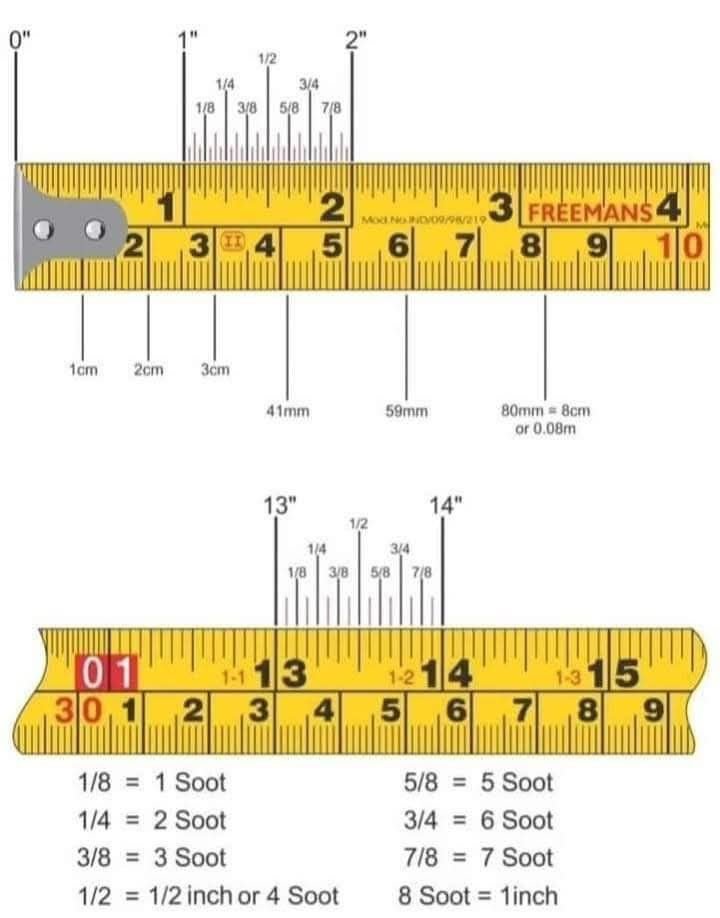
The Tip: Personalize a reference card by making it only about the conversions you really use.
Don’t try to memorize everything. Concentrate on what is important in your life.
What to Include
For online shoppers:
- Inches to cm (× 2.5)
- Shoe sizes in both systems
- Common clothing measurements
For travelers:
- Miles to km (× 1.6)
- Speed conversions
- Common distances
For DIY enthusiasts:
- Feet to meters (÷ 3)
- Millimeters to inches (÷ 25)
- Common lumber sizes
For everyone:
- Your body measurements as a reference
- Quick verification benchmarks
- One or two specific conversions for precision
Sample Cheat Sheet Format
MY QUICK CONVERSION GUIDE
========================

SHORTCUTS:
Inches → cm: × 2.5
Feet → meters: ÷ 3
Miles → km: × 1.6
mm → inches: ÷ 25
Yards ≈ meters

EXACT (when precision matters):
1 inch = 2.54 cm
1 foot = 30.48 cm
1 meter = 3.28 feet
1 mile = 1.609 km

MY BODY MEASUREMENTS:
Thumb = _____ inch
Hand span = _____ inches
Forearm = _____ inches
Foot = _____ inches
Stride = _____ feet
Where to Store It
- Phone screenshot
- Wallet card (laminated)
- Workshop wall
- Kitchen drawer
- Car glove box
- Bookmark in browser
Review it once a week. You won’t need to see it anymore in a month.
Putting All 8 Tips Together
Here’s what these tricks look like in action.
Scenario 1: Buying Furniture Online
Product: European dining table 180 cm × 90 cm
Using the tips:
- Tip 1: 180 cm ÷ 2.5 = 72 inches = 6 feet
- Tip 2: 90 cm ÷ 30 = 3 feet
- Tip 7: Sanity check—6×3 ft seems right for a table
Result: You know exactly what you’re getting.
Scenario 2: Planning a European Vacation
Distance: 280 km from Florence to Rome
Using the tips:
- Tip 3: 280 km × 0.6 = 168, so 280 – 112 = 168 miles
- Or: 280 ÷ 1.6 = 175 miles
- Tip 7: Both solutions are about 170 miles
Result: You know it’s about a 3-hour drive at highway pace.
Scenario 3: Home Improvement Project
Need: 15 meters of baseboard trim
Using the tips:
- Tip 2: 15 meters × 3 = 45 feet
- Tip 5: Or buy 15 yards (it’s more or less the same)
- Tip 7: Test—15 yards for an entire room’s worth of baseboard is reasonable
Result: You’re purchasing just what you need, and not a drop more.
Common Mistakes These Tips Prevent
Mistake #1: Confusing Centimeters With Inches
50 cm is NOT 50 inches. It’s 20 inches (50 ÷ 2.5).
Prevention: Use Tip 1.
Mistake #2: Assuming One System is Always Larger
It can be both. A yard is shorter than a meter. A mile is longer than a kilometer.
Prevention: Apply the sanity checks in Tip 7.
Mistake #3: Focusing Too Much on Precision
If it’s a $20 purchase, being within 10% is fine. If you’re purchasing something for $2,000, round carefully.
Prevention: Tip 8 helps you know when accuracy counts.
Mistake #4: Forgetting Your Built-In Rulers
You always have tools of measurement with you—your body parts.
Prevention: Tip 4 teaches you to use them effectively.
Frequently Asked Questions
What tip should I start with?
Begin with Tip 1 (inches to centimeters multiplied by 2.5). That’s the most practical for everyday shopping and the easiest one to remember.
Are these tips professional enough?
For rough estimates, yes. For construction, engineering or medical work, exact conversion factors and proper tools must be used.
How long does it take to learn these conversions?
People are generally at ease with 2-3 tips a week. By 1 month you’ve got all 8 as muscle memory.
Can I use these tips for cooking measurements, too?
No. These tips cover length only. Cooking involves volume (cups, liters) and weight (ounces, grams), which have different conversions.
What if I need to convert a unit you haven’t provided?
Use a calculator or search function on your phone. These eight tips will get you through 90% of all conversions, but specialty conversions may require digital assistance.
Do I really need to create a cheat sheet?
It helps tremendously. The act of making it strengthens the learning and having it available accelerates your progress a lot.
Why not just use a smartphone app each time?
Apps work well, but it takes time to pull out your phone. Quick mental conversions make you faster and sound more confident. Plus, you look smarter!
Are these tips used worldwide?
The conversions are universal. But only three countries (US, Liberia, Myanmar) primarily use imperial measurements. The rest of the world uses metric.
Can kids learn these tips?
Absolutely! Children often pick them up more quickly than adults. Make it hands-on with real objects, and they’ll take to it quickly.
What is the most important tip?
Tip 7 (sanity checking) saves you from the most expensive mistakes. Always check that your conversion makes sense before making a big purchase.
How do I know which way to convert?
Ask yourself: “Should this number become smaller or larger?” Since centimeters are smaller units than inches, converting to centimeters will make the number bigger.
What if I make a mistake?
Everyone does at first. The trick is to catch mistakes with sanity checks like those in Tip 7 before they turn into slow and expensive problems.
Learn These Tips and You’ll Never Struggle Again
Now, you have 8 ultimate length measurement conversion guide tips to manage almost every situation you’ll run across.
You don’t need to master all of them right away. Begin with those that reflect your life:
- Online Shoppers: Tips 1, 5 and 7
- Travelers: Tips 3, 6 and 7
- Do-it-yourselfers: Tips 2, 4 and 6
- Everyone: Tip 8
Practice this week with real objects. Measure your furniture in both systems. Calculate your distance to work in miles and kilometers. Check product dimensions before buying.
In two weeks it will be the most natural thing in the world. Within a month you’ll be the one friends text to ask for conversion help.
Save this guide. Bookmark it. Make your cheat sheet using Tip 8.
Now, when you come across a measurement you don’t recognize, you’ll be able to quickly and accurately convert it in no time flat.
No more confusion. No more expensive mistakes. Never again feel lost when measurements fall outside your familiar system.
Nothing but confidence, speed and accuracy when you’re converting lengths.
The world works in many different measurement formats, but with these 8 essential length measurement conversion guide tips you become fluent in all.
Now go put them to work.