
















What Nobody Tells You About Length Conversions
It’s crazy, right? Millions go through life never learning why everyday measurements are the way they are.
You use inches, feet and miles all the time. But do you know why an inch is precisely 2.54 centimeters? Or why there are 5,280 feet in a mile?
Probably not. And that’s okay.
But here’s what isn’t okay: struggling with conversions you can’t grasp because you don’t get the facts.
Think about it. When you understand why measurements are what they are, conversions make sense instead of being random. You stop memorizing and you start knowing.
This guide shares 21 must-know length measurement conversion guide facts everyone should know, but have no clue about. And these are not dull history lessons or trivia with no utility. Every fact makes conversion more practical and readily achievable in the shortest amount of time.
Some of these facts are crazy but true. Others will leave you slapping your forehead saying, “How did no one tell me this until now?”
You’re going to look at measurements differently by the end. You’ll get why those numbers make sense. And best of all, you’ll feel as comfortable moving from one system to the other as possible.
Now, let’s discover these 21 facts that will change everything.
Facts 1-7: The Unexpected Origins of Your Measurements
Fact 1: The Inch Was Standardized to the Size of a King’s Thumb
For medieval England, King Edward II set the length of one inch when trying to standardize a universally acceptable measurement and so defined the 1 inch according to what had already been in use there. It was later standardized as the width of a man’s thumb.
That’s why your thumb is about an inch wide. That’s not a coincidence — it’s by design.
Why it matters: To get a rough estimate of an inch, hold your thumb up. It’s a ruler you carry with you.
Fact 2: The Meter Is Defined By Earth’s Circumference
One meter was defined by French scientists in 1791 as one ten-millionth of the distance from the North Pole to the equator.
They actually measured the earth and divided by 10,000,000.
The modern definition uses the speed of light, but an exact length always remained.
Why it matters: The metric system is not arbitrary — it’s based on universal constants. That’s why it’s used worldwide.
Fact 3: A Foot Is One Foot Because of Old Math
Why 12? Since 12 can be evenly divided by 1, 2, 3, 4 and 6. This made it extremely useful for commerce and construction in ancient times.
You could cut a foot in half, thirds, quarters or sixths and get whole numbers.
Why it matters: The Imperial system can feel arbitrary, but buried in history is a system for practical division without calculators.
Fact 4: Originally, the Mile Was Just 1,000 Paces
The mile of ancient Rome was defined as 1,000 Roman paces, which measured slightly more than half a standard English/US mile.
“Mile” is derived from the Latin “mille passus,” or 1,000 paces. Two steps made one Roman pace.
1,000 paces × 5 feet = 5,000 feet
It was later changed to 5,280 feet to correspond with other measurements.
Why it matters: A mile was made to be walked, not driven. That’s why walking measurements seem more natural than driving ones.
Fact 5: The Yard Was the Length of King Henry I’s Arm
It was King Henry I of England who decided that the yard is as long as the distance from his nose to outstretched thumb.
Seriously. That’s how arbitrary the old measurements were.
Why it matters: Your arm span is probably about one yard. Test it! And it gives you a second body-based measurement tool.
Fact 6: The Reason Centimeters Beat Inches
There is another reason that centimeters work better than inches.
A centimeter is 1/100th of a meter exactly. The math is beautifully simple.
There are 12 inches in a foot and 3 feet in a yard. The math is messy.
Why it matters: Converting in metric is an easy matter of multiplying or dividing by 10. For imperial conversions you must remember oddball numbers.
Fact 7: The US Nearly Changed to the Metric System in 1975
Congress made metric the “preferred system” in America with the passage of the Metric Conversion Act in 1975.
But it was voluntary, rather than mandatory. Most people ignored it.
Why it matters: This is why American products list both measurements. We’re living in a transition that never ended.
Facts 8-14: The Numbers That Make Conversion a Breeze
Fact 8: The Number 2.54 Is Official Law
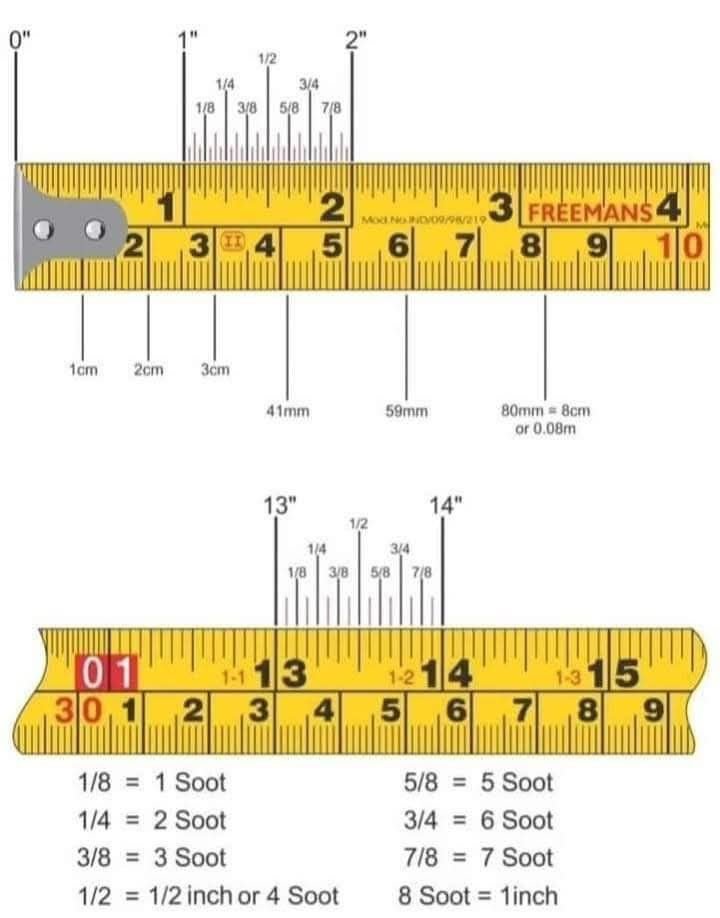
In 1959, English-speaking nations defined one inch as exactly 2.54 centimeters.
Before then, individual countries all had their own slightly different conversions. Now it’s standardized worldwide.
Conversion Reminder:
- 1 inch = 2.54 cm (exactly)
- 1 cm ≈ 0.39 inches (about)
Why this matters: This is the SINGLE number you need to commit to memory. Everything else builds from it.
Fact 9: Imperial Conversions Follow Their Own Logic
Look at these relationships:
| Unit | Equals |
|---|---|
| 1 foot | 12 inches |
| 1 yard | 3 feet |
| 1 mile | 5,280 feet |
| 1 mile | 1,760 yards |
Notice the pattern? The numbers are not multiples of 10. They arise from what divides evenly in the pre-calculator world of mathematics.
Why it matters: Stop looking for patterns like the ones in the metric system. Imperial uses different logic entirely.
Fact 10: All Metric Lengths Are Divisible By Ten
The metric system is gloriously consistent:
| Unit | Equals |
|---|---|
| 1 meter | 100 centimeters |
| 1 meter | 1,000 millimeters |
| 1 kilometer | 1,000 meters |
| 1 centimeter | 10 millimeters |
Why it matters: You never have to do any complex math. Just move the decimal point.
Fact 11: The Ratio of Kilometers to Miles Is Roughly the Golden Ratio
One mile equals 1.609 kilometers.
Golden Ratio (Phi) = 1.618
They’re remarkably close! This is no coincidence — it’s one reason why the Fibonacci sequence works for these conversion approximations.
Why it matters: Knowing this relationship allows you to remember that 1 mile ≈ 1.6 km.
Fact 12: There’s More to a Meter Than a Yard
One meter is equivalent to 1.094 yards, or about 9% longer.
This small distinction constantly trips people up.
Visual comparison:
- 1 yard = 36 inches = 91.44 cm
- 1 meter = 100 centimeters = 39.37 inches
Why it matters: When you hear “meters,” think “a little longer than yards.” This prevents underestimation errors.
Fact 13: A Hundred Centimeters Is NOT the Same as a Hundred Inches
Now that may look obvious written out, but people get this wrong all the time.
- 100 cm = 39.37 inches (not 100 inches!)
- 100 inches = 254 cm (not 100 cm)
Why it matters: Your brain perceives numbers that look similar as if they are equivalent. Fight this instinct.
Fact 14: The Millimeter Is the Shortest Utility Measurement
One millimeter equals:
- 0.1 cm
- 0.001 meters
- About 1/25th of an inch
- Credit card thickness
Anything smaller requires specialized tools.
Why it matters: When accuracy is what you are after — woodworking, engineering, jewelry making — millimeters give you precision without diving into the microscopic.
Facts 15-21: The Reality of the Situation That Saves Time
Fact 15: You Don’t Always Need to Convert Exactly
Perfect accuracy isn’t always necessary. Useful estimates include:
| Conversion | Exact | Quick Estimate |
|---|---|---|
| Inches to cm | × 2.54 | × 2.5 or “double and add half” |
| Feet to meters | × 0.3048 | × 0.3 |
| Miles to km | × 1.609 | × 1.6 (or use Fibonacci) |
| Km to miles | × 0.621 | ÷ 1.6 or -40% |
Why it matters: Better to be swift than perfect. Understand when “close enough” is good enough.
Fact 16: Your Body Is a Really Good Ruler
Standard body-based measurements:
| Body Part | Approximate Length |
|---|---|
| Thumb width | 1 inch / 2.5 cm |
| Palm width | 4 inches / 10 cm |
| Hand span (stretched) | 8-9 inches / 20-23 cm |
| Forearm from elbow to wrist | 12 inches / 30 cm |
| Foot length | 10-12 inches / 25-30 cm |
| Arm length (shoulder to fingertip) | 24-30 inches / 60-75 cm |
| Stride (walking) | 30 inches / 75 cm |
Why it matters: Measure these yourself once. You’ll have a portable measuring instrument for life.
Fact 17: Digital Tools Are Ending the Need for Memorization
Back before smartphones, you had to memorize this stuff. Now you can Google “50 feet to meters” with the click of an icon.
There’s only one problem: pulling your phone out takes longer than knowing that answer.
Why it matters: Practice common conversions for speed. Use digital tools for difficult or complex calculations.
Fact 18: You Don’t Need to Be as Exact in the Kitchen
Recipes claim exact measurements matter. But professional chefs estimate constantly.
For most cooking:
- Being within 10% is fine
- For baking, tighter tolerances are required (within 5%)
- Candy-making and bread-baking require precise measurements
Why this matters: Stop stressing out about converting 237 mL to precisely one cup. Round to 240 mL and move on.
Fact 19: How We Build Is Different Than Science
Carpenters measure to 1/16th of an inch. Scientists measure down to the millimeter or less.
Both are “accurate” for their applications, but they are based on different systems.
Comparison table:
| Field | Typical Precision | System Preferred |
|---|---|---|
| Home building | 1/16 inch | Imperial |
| Science | 0.1 mm | Metric |
| Automotive | 0.01 mm | Metric |
| Casual cooking | 1/4 cup | Imperial |
| Professional baking | 1 gram | Metric |
Why it matters: Fit your precision to your purpose. More precise isn’t always better.
Fact 20: The Same Number Means Something Different in the Other System
5 feet seems short for a person. 5 meters seems tall for one person.
10 miles is a long run. 10K is a medium run.
Your brain processes numbers differently depending on the unit they’re associated with.
Why it matters: Always translate to your familiar system when making decisions. Never assume based only on the numbers.
Fact 21: Most of the World Does Not Use Your System
The only three countries that still rely on the Imperial system:
- United States
- Liberia
- Myanmar
Everyone else uses metric.
Global measurement adoption:
| System | Countries Adopting It | Percent of World |
|---|---|---|
| Metric | ~195 | 95% |
| Imperial (primary) | 3 | <5% |
Why it matters: If you travel, work internationally or shop online with businesses outside the U.S., there’s no getting around learning metric conversions. For comprehensive conversion resources, visit Measurement Conversion Guide.
The Impact of These Facts on Your Conversion Game
Now that you know these 21 length measurement conversion guide facts, let’s put them to work.
Before: Confused Conversion
You read: “Table has a length of 180 cm”
You think: “Uh… is that big? Small? I have no idea. Let me Google it.”
After: Informed Conversion
You read: “The table length is 180 cm.”
You think:
“100 cm = 1 meter (Fact 10)
So 180 cm = 1.8 meters (easy division)
1 meter ≈ 1 yard (Fact 12)
So approximately 1.8 yards or about 5.4 feet (Fact 9)
That would be an average table size (Fact 16 — about 3 arm lengths)”
Total time: 5 seconds. No tools needed.
Real Example: Online Shopping
Product description: “Rug Size is 2m × 3m”
Using the facts:
- Each meter ≈ 3 feet (Fact 15)
- 2m ≈ 6 feet, 3m ≈ 9 feet
- That’s a 6×9 foot rug
- My bedroom is 10×12 feet (Fact 16)
- The rug is going to fit perfectly with plenty of room
Decided in seconds, not minutes.
Real Example: Travel Planning
European traffic sign: “25 km to the next exit”
Using the facts:
- Using Fact 11, estimate: 25 km ≈ 15-16 miles
- At 60 mph, that’s about 15 minutes
- (Real: 15.5 miles, computation time: 3 seconds)
Real Example: Recipe Adaptation
Recipe says: “300 g flour”
Using the facts:
- You have no scale, only measuring cups
- 1 cup of flour ≈ 120-125 g
- 300 ÷ 120 = 2.5 cups
- Use 2.5 cups and it will be close enough (Fact 18)
Conversion complete without conversion charts.
Building Your Measurement Intuition
These 21 facts are not just pieces of information — they’re tools for building intuition.
Week 1: Historical Facts (1-7)
Read them daily. Understand WHY measurements exist.
This is the context that makes everything else fall into place.
Week 2: Master the Numbers (8-14)
These are your foundation:
- 2.54 (inches to cm)
- 3.28 (meters to feet)
- 1.6 (miles to km)
- 100 (cm in a meter)
- 1,000 (meters in a km)
Write them on sticky notes. Place them where you’ll see them.
Week 3: Practice Estimation (15-17)
Convert everything you see into rough estimates.
Don’t aim for perfection. Embrace speed and the “close enough” approach.
Week 4: Real-World Application (18-21)
Deploy these facts in the field:
- Shopping
- Cooking
- Traveling
- DIY projects
Real experience teaches more effectively than any textbook.
Month 2 and Beyond
By now, conversion feels natural. You don’t think “I’m using Fact 12.” You just know that a meter is close to a yard.
That’s the point where these length measurement conversion guide facts have genuinely altered the way you view everything.
The Bigger Picture: Why This Matters
The ability to convert measurements isn’t about being good at math.
It’s about confidence.
- Being able to shop online from any country without second-guessing sizes
- The ability to tackle any recipe, no matter the source
- Traveling with ease, no longer confused by different measurement systems
- Starting DIY projects without the fear of buying wrong materials
You gain all of this with these 21 facts.
They turn inscrutable numbers into sensible, comprehensible information that you can use.
You’re not just learning conversions. You’re no longer subject to conversion charts, apps and confusion.
That’s powerful.
Your Next Steps
Here’s how to make these 21 facts stick:
Today: Re-read all 21 facts one more time. Note the 5 you find most surprising.
This Week: Focus on those 5. Really understand them. Use them in daily life.
This Month: Add 5 more facts. Build your knowledge systematically.
This Year: All 21 of these facts ought to feel as natural as your own phone number.
Print this guide. Keep it in your workshop, kitchen or office.
Reference it when you convert. You won’t even need to look it up before too long.
These length measurement conversion guide facts are going to become part of how you think.
And that’s when converting measurements becomes a breeze.
Frequently Asked Questions
Do I actually need to commit all 21 facts to memory?
No. Begin with Facts 8, 10 and 16. These three are the most practical. Add more as you need them for specific situations.
What is the single most useful fact for everyday life?
Fact 8 (the 2.54 conversion) and Fact 16 (body measurements). Between them, they enable you to convert and estimate without the aid of a tool.
Are these facts acceptable for professional work?
The numbers are exact. The shortcuts in estimations (e.g., 2.5 instead of 2.54) are to facilitate quick mental calculations, not exact measurements. For professional work, use precise calculations.
Why does the US still use Imperial measurements?
It would be expensive to change (new road signs, updated textbooks, retrained workers). The 1975 metric conversion was largely voluntary and few people adopted it.
Can I remember the meters/yards difference somehow?
Use Fact 12 — a meter is 9% longer than a yard. Think “meters are meatier” — a silly phrase that helps you remember they’re slightly larger!
What is the single most practical fact on this list?
Fact 10 about metric dividing by 10. Once you get that, all metric conversions are easy. It’s the bedrock of the entire system.
Is it a good idea to teach these facts to my children?
Absolutely! Kids learning both systems from the start have a huge advantage. Begin with the body measurement fact (16) because it’s hands-on and fun.
Can I use this information in other countries?
Yes! Fact 21 shows that 95% of the world uses metric. Converting between metrics is not an optional skill for world traveling and business. For more details on international measurement standards, check out the National Institute of Standards and Technology.
What about that Fibonacci trick mentioned in Fact 11?
It’s pretty accurate for most common distances. The error is typically below 1 percent. For everyday estimates, it’s excellent. For precise navigation, use exact conversions.
What’s a single thing I can take away from this article?
Remember this: An inch is exactly 2.54 cm, and all metric increments work in tens. Those are the two facts that unlock all the rest.