
















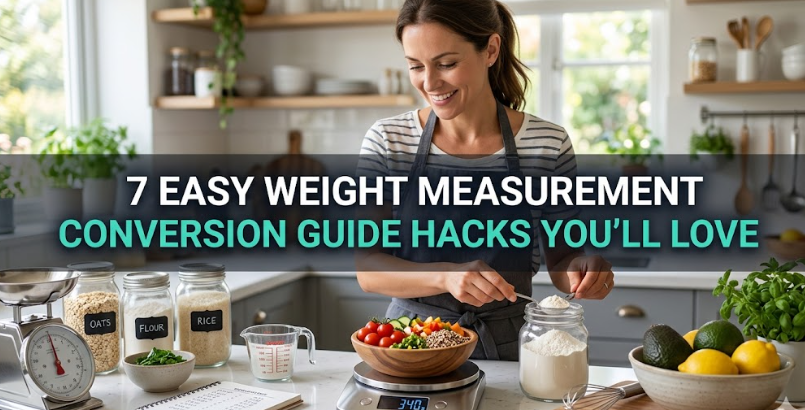

7 Easy Weight Measurement Conversion Guide Hacks You’ll Love
There’s something oddly frustrating about weight conversions. You’re in the middle of cooking, calculating shipping costs, planning a fitness goal, or even studying—and suddenly you’re stuck wondering how many pounds are in a kilogram or why ounces even exist. It’s one of those small, everyday annoyances that quietly eats time and patience.
But here’s the thing: weight conversions don’t have to be complicated. In fact, once you understand a few simple tricks—what I like to call “conversion hacks”—you can do most of them in your head without needing a calculator or app.
This guide isn’t just a list of formulas. It’s a practical, experience-based walkthrough filled with mental shortcuts, patterns, and relatable examples that make conversions feel natural instead of mechanical. Whether you’re a student, home cook, traveler, or someone trying to track fitness goals, these hacks will stick with you.
Let’s get into it.
understanding the basics before hacking them
Before diving into shortcuts, it helps to know the two main systems you’re dealing with: the metric system and the imperial system.
The metric system is built around simplicity. Everything is based on powers of 10. Kilograms, grams, milligrams—they all scale neatly.
The imperial system, on the other hand, is… less cooperative. Pounds, ounces, stones—there’s no clean pattern. That’s why most of the hacks you’ll learn are about bridging these two systems.
Here’s the key anchor:
1 kilogram ≈ 2.2 pounds
This single relationship powers most of the tricks in this guide.
hack #1: the “double it and add a little” trick
If you remember nothing else, remember this.
To convert kilograms to pounds:
Double the number, then add a little extra (about 10%).
Example:
10 kg → double = 20 → add ~2 → 22 lb
That’s it.
You don’t need exact math. Your brain is surprisingly good at estimating 10%. This works especially well for everyday numbers like body weight, grocery items, or luggage limits.
Why it works:
Since 1 kg ≈ 2.2 lb, doubling gives you 2.0, and the extra 0.2 is roughly 10%.
Once you practice this a few times, it becomes automatic.
hack #2: the reverse shortcut (pounds to kilograms)
Now flip it.
To convert pounds to kilograms:
Divide by 2, then subtract a little (about 10%).
Example:
100 lb → half = 50 → minus ~5 → 45 kg
This is slightly trickier than the first hack, but still very manageable.
Real-life use:
If you’re reading product labels, gym equipment, or body weight in pounds but think in kilograms, this shortcut saves time.
hack #3: memorize anchor weights
Instead of memorizing formulas, memorize a few key reference points.
Here are some powerful anchors:
- 1 kg ≈ 2.2 lb
- 5 kg ≈ 11 lb
- 10 kg ≈ 22 lb
- 50 kg ≈ 110 lb
- 100 kg ≈ 220 lb
Once these are in your head, you can build everything else around them.
Example:
If you know 10 kg ≈ 22 lb, then:
15 kg = 10 kg + 5 kg = 22 + 11 = 33 lb
No calculator needed.
hack #4: think in halves and quarters
Breaking numbers into parts makes conversions easier.
Let’s say you want to convert 8 kg to pounds.
Instead of doing it all at once:
- 8 kg = 4 kg + 4 kg
- 4 kg ≈ 8.8 lb
- So 8 kg ≈ 17.6 lb
Or even simpler:
Use your anchor (5 kg ≈ 11 lb), then adjust.
This approach works especially well when dealing with awkward numbers.
hack #5: use grams for precision, kilograms for speed
Here’s a trick most people overlook.
When you need accuracy (like in cooking or science), switch to grams.
Why?
Because:
1 kg = 1000 g
1 lb ≈ 454 g
This makes it easier to handle smaller quantities.
Example:
If a recipe calls for 500 g:
That’s roughly half a pound.
Instead of struggling with decimals, you just think in halves.
hack #6: round first, refine later
Perfection slows you down.
If you’re converting quickly, round the number first, then adjust.
Example:
23 kg → round to 20 kg
20 kg ≈ 44 lb
Add back the extra 3 kg (~6.6 lb)
Total ≈ 50.6 lb
Even if you estimate, you’ll usually be within 1–2 pounds, which is more than enough for most situations.
hack #7: build intuition through repetition
This isn’t a formula—it’s a habit.
The more you casually convert weights in your daily life, the more intuitive it becomes.
Try this:
- When you see a weight on packaging, mentally convert it
- When you check your weight, think of it in both units
- When cooking, switch between grams and ounces
Over time, your brain stops “calculating” and starts recognizing.
why these hacks actually work
What makes these hacks effective isn’t just math—it’s psychology.
Your brain prefers:
- patterns over formulas
- estimates over exact figures
- familiar numbers over abstract ones
These hacks align with how we naturally think.
Instead of forcing your brain to memorize rigid rules, they let you work with approximations and build confidence through repetition.
real-world scenarios where these hacks shine
cooking
Recipes often mix grams, ounces, and pounds. Instead of stopping to convert every time, you can estimate on the fly.
travel
Airlines list baggage limits in kilograms, but you might think in pounds. Quick conversions help you avoid overweight fees.
fitness
Gym equipment may use pounds, while your health goals might be in kilograms. These hacks keep everything consistent.
shopping
International products often use metric units. Knowing rough conversions helps you understand quantity instantly.
common mistakes to avoid
Even with hacks, a few pitfalls can trip you up.
Overestimating the “extra 10%”
If you add too much, your result drifts. Keep it modest.
Forgetting context
Precision matters in science, but not always in daily life. Use hacks where appropriate.
Mixing up ounces and pounds
Remember:
16 ounces = 1 pound
It’s easy to confuse the two when moving quickly.
building your own conversion style
Not every hack works for everyone.
Some people prefer anchors. Others like doubling tricks. The goal is to experiment and settle into what feels natural.
You might even create your own shortcuts based on numbers you use frequently.
That’s when conversion stops being a task and becomes second nature.
a quick mental exercise
Try this without writing anything down:
Convert 12 kg to pounds.
Step 1: double → 24
Step 2: add ~10% → +2.4
Final ≈ 26.4 lb
Now compare that to the exact value (about 26.5 lb). You’re already very close.
That’s the power of these hacks.
closing thoughts
Weight conversions don’t need to feel like math homework. With a few simple mental tricks, you can handle most situations quickly and confidently.
The goal isn’t perfection—it’s fluency.
Once you start using these hacks in everyday life, you’ll notice something interesting: you stop thinking about the process entirely. The numbers just make sense.
And that’s when you know you’ve mastered it.
frequently asked questions (faqs)
- what is the easiest way to convert kilograms to pounds quickly?
The easiest method is to double the kilograms and add about 10%. It’s fast, simple, and accurate enough for everyday use. - how accurate are these conversion hacks?
Most of these hacks are accurate within 1–2%, which is perfectly fine for daily activities like cooking, shopping, or fitness tracking. - when should i avoid using shortcuts?
Avoid shortcuts when precision is critical, such as in scientific calculations, medical measurements, or professional baking. - why is the imperial system harder to work with?
Because it doesn’t follow a consistent base like 10. Units like ounces, pounds, and stones don’t scale in a simple pattern. - is it better to memorize formulas or use estimation tricks?
For most people, estimation tricks are faster and easier to remember. Formulas are useful but often slower in real-life situations. - how can i get better at conversions over time?
Practice casually in everyday situations—while cooking, shopping, or exercising. Repetition builds intuition faster than memorization.