





























8 Essential Length Measurement Conversion Guide Mistakes to Avoid
Length conversion sounds simple—just move a decimal, multiply by a number, or glance at a chart. Yet, in real life, small misunderstandings can turn into big problems. A carpenter cuts wood too short, a student loses marks on an exam, or a traveler misjudges distance. The truth is, length conversion is less about memorizing numbers and more about thinking clearly, understanding context, and avoiding subtle traps.
This guide is not just a list of rules. It’s a practical walkthrough shaped by real-world thinking, small examples, quick reflections, and tiny exercises you can try as you read. If you’ve ever felt confused switching between meters, feet, inches, or kilometers, you’ll likely recognize some of these mistakes—and more importantly, learn how to avoid them.
mistake 1: treating all units as if they scale the same way
One of the most common errors is assuming that every unit conversion behaves like a simple step up or down. For example, people often think converting from meters to centimeters is the same kind of jump as converting from kilometers to meters.
But here’s the catch: the metric system is consistent (based on powers of 10), while other systems like imperial are not.
Quick reflection
1 meter = 100 centimeters
1 kilometer = 1000 meters
But
1 foot = 12 inches
1 yard = 3 feet
1 mile = 5280 feet
See the difference? The metric system flows smoothly, while the imperial system feels like a staircase with uneven steps.
Mini exercise
Convert 2 meters into centimeters
→ 2 × 100 = 200 cm
Now try
Convert 2 feet into inches
→ 2 × 12 = 24 inches
Seems simple—but imagine converting miles to inches. Suddenly, the uneven steps become a challenge.
Lesson
Never assume all systems behave the same. Always check the specific conversion factor instead of guessing.
mistake 2: ignoring context when choosing units
People often focus only on numbers and forget the meaning behind them. This leads to strange or impractical results.
For example
Saying a road is 0.002 kilometers long instead of 2 meters
Or describing a city distance as 500,000 centimeters instead of 5 kilometers
Technically correct—but completely unhelpful.
Real-world analogy
It’s like describing your age in days instead of years. Accurate, but confusing.
Quick guideline
Use smaller units (mm, cm, inches) for small objects
Use larger units (meters, kilometers, miles) for larger distances
Practice
Which is better?
A table is 120 cm long
or
A table is 0.0012 km long
Clearly, the first one makes sense.
Lesson
Conversion is not just about correctness—it’s about clarity.
mistake 3: forgetting to reverse the conversion factor
A subtle but dangerous mistake is using the correct conversion factor in the wrong direction.
Example
1 inch = 2.54 cm
If you want to convert inches to centimeters, you multiply.
But if you want to convert centimeters to inches, you divide.
Common error
10 cm × 2.54 = 25.4 inches ❌
Correct
10 cm ÷ 2.54 ≈ 3.94 inches ✔️
Mini checklist
Ask yourself:
Am I going from bigger to smaller? → multiply
Am I going from smaller to bigger? → divide
Lesson
Direction matters just as much as the number itself.
mistake 4: rounding too early in calculations
Rounding numbers too soon may seem harmless, but it can create significant errors—especially in multi-step calculations.
Example
1 mile = 1.60934 km
If you round it to 1.6 too early, your final answer will drift further from accuracy.
Scenario
Convert 5 miles to kilometers
Using precise value
5 × 1.60934 = 8.0467 km
Using rounded value
5 × 1.6 = 8.0 km
Difference = 0.0467 km (about 47 meters)
That’s a noticeable error in real-world applications.
Lesson
Round only at the final step, not during the process.
mistake 5: mixing systems without awareness
Another frequent mistake is combining metric and imperial units without realizing it.
Example
Adding 5 meters and 3 feet directly
This is incorrect because they are different units.
Correct approach
Convert one unit into the other first
5 meters ≈ 16.4 feet
Now
16.4 + 3 = 19.4 feet
Lesson
Always unify units before performing calculations.
mistake 6: relying only on memory instead of logic
Many people try to memorize dozens of conversion values. This often leads to confusion.
Instead, focus on understanding patterns.
Example
Metric system pattern
1 km = 1000 m
1 m = 100 cm
1 cm = 10 mm
Once you understand this, you don’t need to memorize every single conversion.
Quick trick
Think in steps
km → m → cm → mm
Each step is ×10 or ×100 depending on direction.
Lesson
Understanding beats memorization every time.
mistake 7: ignoring significant figures and precision
In scientific or technical work, precision matters. Using too many or too few digits can misrepresent the result.
Example
If a measurement is 2.5 meters, reporting it as 2.500000 meters gives a false sense of accuracy.
Similarly
Converting 2.5 m to cm
2.5 × 100 = 250 cm
Not 250.000 cm unless precision demands it.
Lesson
Match the precision of your answer to the precision of your measurement.
mistake 8: skipping verification of results
Perhaps the most overlooked mistake is not checking whether the result makes sense.
Example
Convert 1 meter to centimeters
If your answer is 0.01 cm, something is clearly wrong.
Quick sanity check
1 meter is larger than 1 centimeter
So the number should increase, not decrease
Mental estimation
1 meter ≈ 100 cm
Lesson
Always pause and ask: does this answer feel right?
practical conversion table for quick reference
Metric system
1 km = 1000 m
1 m = 100 cm
1 cm = 10 mm
Imperial system
1 foot = 12 inches
1 yard = 3 feet
1 mile = 5280 feet
Cross-system
1 inch = 2.54 cm
1 meter ≈ 3.28 feet
1 kilometer ≈ 0.621 miles
real-life scenarios where mistakes happen
In construction
A small conversion error can waste materials or cause structural issues
In travel
Misjudging distances can lead to poor planning
In education
Students lose marks due to simple conversion slips
In online shopping
Incorrect size conversions can result in wrong purchases
reflection: why these mistakes happen
Most errors don’t come from lack of intelligence—they come from rushing, assumptions, or overconfidence.
People often think
“It’s just a simple conversion”
But simplicity can be deceptive. The details matter.
building a habit of accurate conversion
Here’s a simple routine you can follow:
- Identify the units
- Understand the relationship
- Choose the correct operation (multiply or divide)
- Perform the calculation
- Check the result
This five-step approach reduces most errors significantly.
short practice section
Try these on your own:
- Convert 3 meters to centimeters
- Convert 12 inches to centimeters
- Convert 2 kilometers to meters
- Convert 100 cm to meters
Answers
- 300 cm
- 30.48 cm
- 2000 m
- 1 m
frequently asked questions
- why do people find length conversion confusing
Because different systems (metric and imperial) follow different rules. Metric is consistent, while imperial requires memorization of irregular values. - what is the easiest way to remember conversions
Focus on understanding patterns instead of memorizing. For example, in the metric system, everything is based on powers of 10. - when should i round my answers
Only at the final step. Rounding too early can lead to inaccurate results. - how can i quickly check if my answer is correct
Use estimation. Ask yourself whether the result should be bigger or smaller based on the units. - is it necessary to learn both metric and imperial systems
Yes, especially because both are used globally. Understanding both increases flexibility and accuracy. - what tools can help with conversion
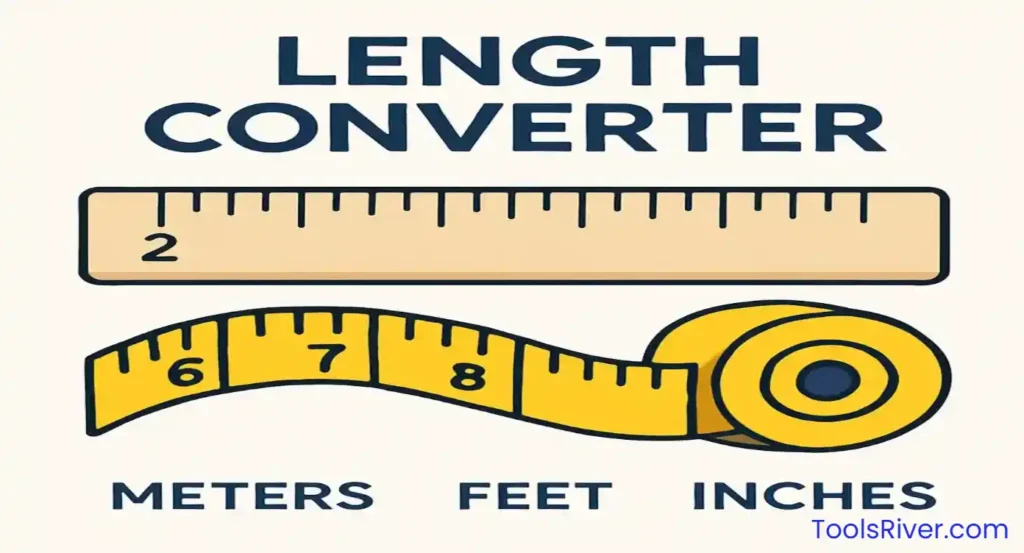
Digital calculators, conversion charts, and interactive tools (like the one above) can help—but it’s still important to understand the logic behind them.
closing thought
Length conversion is not just about numbers—it’s about awareness. The difference between a correct answer and a mistake often lies in a small detail: a misplaced decimal, a forgotten unit, or a rushed assumption.
Once you slow down, understand the structure, and apply a simple checking habit, conversion becomes less of a task and more of a skill. And like any skill, the more you practice it, the more natural it becomes.