

















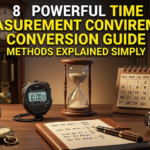



















10 Quick Time Measurement Conversion Guide Fixes That Work Instantly
Time is one of the few things every human shares equally, yet it often feels confusing when we try to convert it. Minutes blur into hours, seconds stretch in stressful moments, and days shrink when deadlines approach. Many people think time conversion is complicated, but in reality, most struggles come from a handful of simple misunderstandings.
This guide is designed to be practical and hands-on. Instead of dry explanations, you’ll find mental shortcuts, quick reference tables, mini exercises, and real-life scenarios. By the end, converting time will feel natural and automatic.
Let’s begin with the fixes that make the biggest difference instantly.
fix 1: memorize the core conversion ladder once and forever
Most time confusion comes from not having a clear mental ladder. Once you memorize this ladder, everything becomes easier:
60 seconds = 1 minute
60 minutes = 1 hour
24 hours = 1 day
7 days = 1 week
30 days ≈ 1 month
365 days = 1 year
The secret is to visualize this as a ladder rather than isolated facts. Imagine climbing upward:
seconds → minutes → hours → days → weeks → months → years
When converting upward, divide.
When converting downward, multiply.
Example
120 minutes → hours
120 ÷ 60 = 2 hours
2 hours → minutes
2 × 60 = 120 minutes
Mini exercise
Convert 3 hours into minutes.
3 × 60 = 180 minutes.
Once this ladder is memorized, most time conversions become a one-step problem.
fix 2: use the “divide or multiply by 60” rule
The number 60 appears constantly in time. Instead of remembering dozens of formulas, remember this rule:
Moving to a larger unit → divide by 60
Moving to a smaller unit → multiply by 60
Examples
Seconds → minutes
240 seconds ÷ 60 = 4 minutes
Minutes → seconds
7 minutes × 60 = 420 seconds
Hours → minutes
5 hours × 60 = 300 minutes
Minutes → hours
90 minutes ÷ 60 = 1.5 hours
Quick practice table
Unit change | What to do | Example
Minutes → Hours | divide by 60 | 180 ÷ 60 = 3
Hours → Minutes | multiply by 60 | 4 × 60 = 240
Seconds → Minutes | divide by 60 | 300 ÷ 60 = 5
Minutes → Seconds | multiply by 60 | 6 × 60 = 360
Mastering this rule alone eliminates most conversion stress.

fix 3: learn the most common “ready-made” conversions
Some conversions appear so often that it saves time to memorize them directly.
Quick reference list
15 minutes = 0.25 hours
30 minutes = 0.5 hours
45 minutes = 0.75 hours
90 minutes = 1.5 hours
120 minutes = 2 hours
These are extremely useful in work, travel, and scheduling.
Real-life scenario
A meeting lasts 90 minutes. How many hours is that?
You instantly know: 1.5 hours.
Another example
Half an hour = 0.5 hours.
Memorizing these saves mental energy daily.
fix 4: convert step by step instead of jumping levels
Many people try to convert seconds directly into days and get overwhelmed. Instead, move step by step.
Example
Convert 7200 seconds into hours.
Step 1: seconds → minutes
7200 ÷ 60 = 120 minutes
Step 2: minutes → hours
120 ÷ 60 = 2 hours
Done.
This approach reduces errors dramatically.
Mini practice
Convert 10,800 seconds into hours.
10,800 ÷ 60 = 180 minutes
180 ÷ 60 = 3 hours
fix 5: use fractions to simplify tricky minutes
When minutes don’t divide evenly, use fractions.
Example
75 minutes → hours
75 ÷ 60 = 1 remainder 15
So: 1 hour + 15 minutes
Now convert the remainder
15 ÷ 60 = 0.25 hours
Final answer
1.25 hours
Another example
105 minutes → hours
105 ÷ 60 = 1 remainder 45
45 minutes = 0.75 hours
Answer = 1.75 hours
This technique makes conversions smooth and precise.
fix 6: remember the “quarter-hour trick”
Time is often divided into quarters.
Quarter hour = 15 minutes
Half hour = 30 minutes
Three quarters = 45 minutes
Decimal equivalents
15 minutes = 0.25 hours
30 minutes = 0.5 hours
45 minutes = 0.75 hours
These appear everywhere in schedules, invoices, and project planning.
Practice
Convert 2 hours 45 minutes into decimal hours.
45 minutes = 0.75 hours
2 + 0.75 = 2.75 hours
fix 7: master the day-to-hour shortcut
Instead of recalculating every time, memorize:
1 day = 24 hours
2 days = 48 hours
3 days = 72 hours
7 days = 168 hours
Example
How many hours in 5 days?
5 × 24 = 120 hours.
This shortcut is powerful in logistics, travel planning, and deadlines.
fix 8: use estimation for quick decisions
Sometimes exact numbers aren’t needed. Estimation saves time.
Example
200 minutes → hours
You know 180 minutes = 3 hours.
So 200 minutes ≈ 3 hours 20 minutes.
Estimation is perfect for quick planning and rough scheduling.
fix 9: convert long durations using chunks
Large numbers feel intimidating. Break them into chunks.
Example
Convert 10,000 minutes into days.
Step 1: minutes → hours
10,000 ÷ 60 = 166.67 hours
Step 2: hours → days
166.67 ÷ 24 ≈ 6.94 days
Answer ≈ 7 days
Breaking into chunks keeps calculations manageable.
fix 10: build a personal time cheat sheet
Create your own quick reference sheet.
Example cheat sheet
60 sec = 1 min
3600 sec = 1 hour
1440 min = 1 day
168 hours = 1 week
Keep it near your desk or phone.
This simple habit eliminates repeated calculations forever.
real life applications of instant time conversions
work scheduling
Employees track hours and convert minutes into decimal time for payroll.
travel planning
Flight durations and layovers require quick conversions.
fitness tracking
Workout durations often mix minutes and hours.
cooking and baking
Recipes require precise timing.
project management
Deadlines often use mixed units.
Time conversion skills improve productivity in every area of life.

practice section
Convert the following:
- 150 minutes → hours
150 ÷ 60 = 2.5 hours - 3 hours 30 minutes → hours
30 minutes = 0.5 hours
Answer = 3.5 hours - 5400 seconds → hours
5400 ÷ 60 = 90 minutes
90 ÷ 60 = 1.5 hours - 2 days → hours
2 × 24 = 48 hours - 300 minutes → hours
300 ÷ 60 = 5 hours
common mistakes to avoid
Mixing up multiplication and division
Skipping steps when converting large units
Forgetting decimal equivalents
Not memorizing key reference values
Trying to calculate everything from scratch
Avoid these and conversions become effortless.
quick reference mega table
Seconds | Minutes | Hours
60 | 1 | 0.0167
600 | 10 | 0.167
1800 | 30 | 0.5
3600 | 60 | 1
7200 | 120 | 2
Minutes | Hours | Days
60 | 1 | 0.0417
120 | 2 | 0.083
720 | 12 | 0.5
1440 | 24 | 1
This table alone can solve dozens of daily calculations.
building confidence through repetition
Like learning a language, time conversion improves with practice. The more you use these shortcuts, the more automatic they become.
Try converting time mentally during daily activities:
Estimate travel time
Convert video duration
Track study sessions
Calculate work hours
Within days, you’ll notice a huge improvement.
mental math tips for speed
Round numbers first
Use known conversions
Break numbers into parts
Convert in steps
Estimate when possible
These habits dramatically speed up calculations.
creating a daily time conversion habit
Morning routine
Estimate commute time in minutes and hours.
Work hours
Track tasks in decimal hours.
Evening
Convert screen time into hours.
Practice turns skill into instinct.
final thoughts
Time conversion isn’t difficult — it just requires the right shortcuts. Once you memorize key values and apply the divide/multiply rule, conversions become second nature.
The goal isn’t perfection; it’s speed and confidence. With these 10 instant fixes, you now have the tools to handle time conversions effortlessly.
frequently asked questions
- What is the easiest way to convert minutes to hours?
Divide the number of minutes by 60. For quick mental math, remember common conversions like 30 minutes = 0.5 hours and 15 minutes = 0.25 hours. - How do I convert hours into seconds quickly?
Multiply hours by 3600. This works because 1 hour = 60 minutes and 1 minute = 60 seconds, so 60 × 60 = 3600. - Why do we use 60 instead of 100 in time?
The time system comes from ancient civilizations that used base-60 counting. It allows many fractions like 1/2, 1/3, and 1/4 to divide evenly. - How can I convert time faster without a calculator?
Memorize key conversions, use the divide/multiply by 60 rule, and practice estimation techniques. - What is decimal time and why is it useful?
Decimal time expresses hours as decimals (like 1.5 hours instead of 1 hour 30 minutes). It simplifies payroll, billing, and project tracking. - How long does it take to master time conversions?
With daily practice, most people become comfortable within a few days and fully confident within a few weeks.