































Temperature Conversion and Why It Is Important in Your Daily Life
Temperature conversion is not just for science class anymore. Whether you are cooking a dish from another country, following the weather while traveling or dabbling in a home-improvement project, knowing how to convert temperatures can make things easier.
A lot of people have trouble with temperature conversions because they use guesswork or memorize the wrong formulas. This results in burnt food, unpleasant conditions in the room and errors on critical calculations. The good news? It becomes very easy to convert temperatures once you know the simple guidelines.
This handbook provides a comprehensive look at ten fundamental rules for achieving accurate temperature conversions – every single time. You’ll pick up some shortcut tips and tricks, side-step pitfalls and develop a clear understanding of how to convert back and forth between Fahrenheit, Celsius, and Kelvin. For more detailed guides on various measurement conversions, explore additional resources that can help with your everyday calculations.
Rule 1: Get the Hang of Your Three Major Temperature Scales
Before you convert anything, however, you need to understand what exactly you are working with. Three temperature scales are commonly used across the globe.
Fahrenheit (°F) is used in the United States. Water freezes at 32 degrees F and boils at 212 degrees F under normal conditions.
Most countries use the metric system which uses Celsius (°C) as its standard for measuring temperature. Water freezes at 0 and boils at 100 degrees Celsius.
Kelvin (K) is the scientific standard that has an absolute zero. Water freezes at 273.15K and boils at 373.15K.
Having those reference points makes it easier for you to see if your conversions are in the right ballpark. If you convert 25°C to get -50°F, the conversion wasn’t done correctly somehow; 25°C is room temperature, not freezing cold.
Quick Reference Points
| Temperature Point | Fahrenheit | Celsius | Kelvin |
|---|---|---|---|
| Absolute Zero | -459.67°F | -273.15°C | 0K |
| Water Freezes | 32°F | 0°C | 273.15K |
| Room Temperature | 68-72°F | 20-22°C | 293-295K |
| Body Temperature | 98.6°F | 37°C | 310.15K |
| Water Boils | 212°F | 100°C | 373.15K |
Rule 2: Memorize the Fahrenheit to Celsius Formula
The conversion between Fahrenheit and Celsius is the one most people need. The formula seems intimidating at first, but is really very simple.
Formula: °C = (°F – 32) × 5/9
Here is how it works, step by step:
- Take your Fahrenheit temperature
- Subtract 32 from it
- Multiply the result by 5
- Divide by 9
Example: Convert 77°F to Celsius
- Start with 77°F
- Subtract 32: 77 – 32 = 45
- Multiply by 5: 45 × 5 = 225
- Divide by 9: 225 ÷ 9 = 25°C
The answer is 25°C, which should be reasonable since it’s a comfortable room temperature.
Why This Formula Works
The formula takes into consideration two critical differences between the scales. First, the 32 represents those different freezing points. The fraction 5/9 is used as a corrective factor for the varying degrees of temperature.
Rule 3: Convert Celsius to Fahrenheit With No Mistakes
There is a different formula for going the other way. They’re very easily confused with the one before.
Formula: °F = (°C × 9/5) + 32
Breaking it down:
- Take your Celsius temperature
- Multiply by 9
- Divide by 5
- Add 32 to the result
Example: Convert 30°C to Fahrenheit
- Start with 30°C
- Multiply by 9: 30 × 9 = 270
- Divide by 5: 270 ÷ 5 = 54
- Add 32: 54 + 32 = 86°F
This tells you 30°C is the same as 86°F, a warm summer day.
Rule 4: Employ Mental Math Shortcuts for Rough Calculations
Sometimes you want a quick estimate and don’t want to fetch a calculator. These are shortcuts that work well enough for everyday use.
Celsius to Fahrenheit Quick Method:
- Double the Celsius temperature
- Add 30
Example: 20°C yields (20 × 2) + 30 = 70°F (actual value: 68°F)
Fahrenheit to Celsius Quick Method:
- Subtract 30 from Fahrenheit
- Divide by 2
Example: 80°F ⇒ (80 – 30) ÷ 2 = 25°C (actual: 26.7°C)
These shortcuts function optimally from 0°C to 40°C (32°F to 104°F). They’re ideal for the weather, room comfort and cooking when precision isn’t a matter of life, death or dinner.
Rule 5: Conversion from Celsius to Kelvin is Only Simply Addition or Subtraction
Kelvin conversions aren’t as difficult as people may believe them to be. The same unit of measurement as Celsius is used in the Kelvin scale, but starting at a different point.
Celsius to Kelvin Formula: K = °C + 273.15
Kelvin to Celsius Formula: °C = K – 273.15
Example: Convert 25°C to Kelvin
- Take 25°C
- Add 273.15
- Result: 298.15K
For all intents and purposes, you can approximate 273.15 as 273. This rounded value will not result in any confusing conversions for everyday purposes (though scientists do use the exact number).
Fahrenheit to Kelvin Conversion
It’s important to look at Celsius first when you want to convert Fahrenheit to Kelvin.
Formula: K = (°F – 32) × 5/9 + 273.15
Example: Convert 98.6°F to Kelvin
- Subtract 32: 98.6 – 32 = 66.6
- Multiply by 5/9: 66.6 × 5/9 = 37°C
- Add 273.15: 37 + 273.15 = 310.15K
Rule 6: Always Check Your Work with Common Sense
The quickest method to catch conversion errors is to ask yourself whether your answer seems logical or not.
Reality Checks to Use:
- Room temperature is around 20-25°C or 68-77°F
- Water freezes at 0°C or 32°F
- The average body temperature is 37°C or 98.6°F
- A hot day in summer hits 35°C (95°F)
- Oven baking temperatures are 150-230°C (300-450°F)
If you convert 25°C and get back 200°F, you can tell right away that something is off. You can’t get hotter, at room temperature, than boiling water.
Common Sense Temperature Ranges
| Setting | Celsius Range | Fahrenheit Range |
|---|---|---|
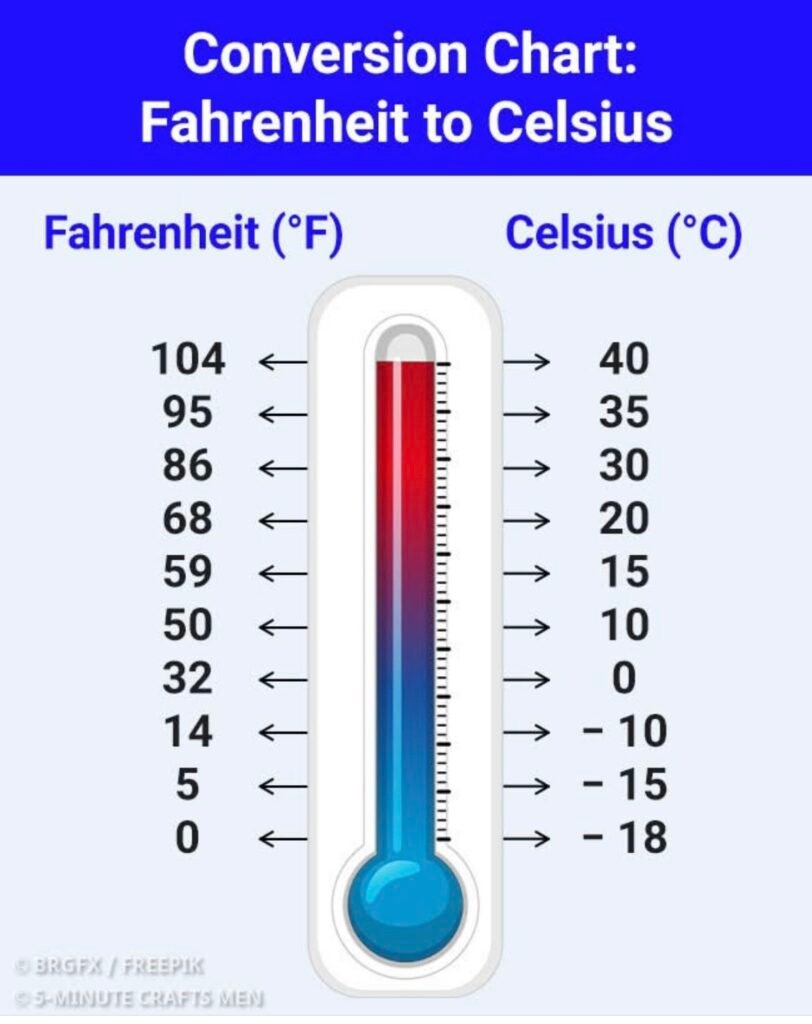
| Freezer | -18 to -15°C | 0 to 5°F |
| Refrigerator | 1 to 4°C | 34 to 40°F |
| Cold Winter Day | -10 to 5°C | 14 to 41°F |
| Pleasant Spring Day | 15 to 20°C | 59 to 68°F |
| Hot Summer Day | 30 to 40°C | 86 to 104°F |
| Oven Baking | 175-200°C | 350-400°F |
Rule 7: Know That Negative Temperatures Don’t Convert in the Same Way
Negative temperatures are confusing for many of us, because the math seems backwards. The formulas are the same but you will need to be careful with negative signs.
Example: Convert -40°C to Fahrenheit
- Start with -40°C
- Multiply by 9: -40 × 9 = -360
- Divide by 5: -360 ÷ 5 = -72
- Add 32: -72 + 32 = -40°F
Curiously, -40°C is the same as -40°F – it’s the only temperature corresponding to a numerical value on both scales.
Example: Convert -10°F to Celsius
- Start with -10°F
- Subtract 32: -10 – 32 = -42
- Multiply by 5/9: -42 × 5/9 = -23.3°C
When you are dealing with negative numbers, confirm your subtraction and also remember that subtracting a positive number from another negative number makes the latter more negative.
Rule 8: For Your Purpose, Round Numbers Appropriately
Some situations call for less precision. Rounding does save time, and knowing when to round can prevent confusion.
For Everyday Use:
Round to the nearest whole number.
Example: 25.6°C becomes 26°C
For Cooking:
Round to nearest 5 degree increment for ovens.
Example: 177°C is rounded off to 175°C or 180°C
For Science and Medicine:
Keep one decimal place.
Example: 37.2°C stays as 37.2°C
For Weather Reports:
Whole numbers work fine.
Example: 22.8°C becomes 23°C
Over-precision creates unnecessary complexity. If you’re adjusting your thermostat, knowing that it’s 21°C is sufficient. You don’t need 21.11111°C.
Rule 9: Don’t Make These Typical Conversion Mistakes
Even those who know the formulas make predictable mistakes. Watch out for these traps.
Mistake 1: Forgetting to Add or Subtract 32
- Incorrect: 50°F × 5/9 = 27.8°C
- Correct: (50 – 32) × 5/9 = 10°C
Mistake 2: Using 9/5 Instead of 5/9
The fractions are reversed in the conversion directions. Celsius to Fahrenheit uses 9/5. Fahrenheit to Celsius uses 5/9.
Mistake 3: Converting Fahrenheit Directly to Kelvin
You can’t easily convert Fahrenheit to Kelvin by just adding 273. You have to convert into Celsius first.
Mistake 4: Forgetting the Proper Order of Operations
It should always be PEMDAS (Parentheses, Exponents, Multiplication, Division, Addition, Subtraction). First perform the subtraction or addition inside parentheses.
Mistake 5: Using Degree Symbols With Kelvin
Kelvin does not use a degree sign. Write 300K, not 300°K.
Conversion Mistake Checker
| If You Get This | Result | The Likely Mistake |
|---|---|---|
| A very large number | Forgot to divide the result by 9 or 5 | |
| A very small number | Forgot to multiply the result by 9 or 5 | |
| ~30 degrees off | Forgot to add (for F) or subtract (for C) 32 | |
| Should be negative | Wrong formula used |
Rule 10: Verify Complex Conversions With Tools and Apps
And while learning the math is one thing, tools help you work faster and avoid errors with important conversions.
Reliable Conversion Tools:
- Google search (enter “25 celsius to fahrenheit”)
- Phone apps that serve as calculators and converters
- Scientific calculators
- Apps that give you the weather in both scales
- Kitchen thermometers with dual displays
But tools aren’t everything. Knowing the process also enables you to identify cases where a tool will give the wrong answer because of input errors. For comprehensive information on temperature scales and their history, the National Institute of Standards and Technology (NIST) provides detailed scientific documentation.
When to Calculate Manually vs. Use Tools
Calculate Manually When:
- Learning the concept
- Testing an answer from a tool
- You only need a rough estimate
- Teaching someone else
Use Tools When:
- You require accurate measurements for science or medicine
- Converting multiple temperatures quickly
- Working with odd or difficult numbers
- Accuracy is critical for safety
Practical Applications of Temperature Conversion
These rules are useful in real-world scenarios that you encounter on a daily basis.
Cooking and Baking:
International recipes use Celsius. American ovens use Fahrenheit. Conversion accurately avoids burnt or undercooked food.
Travel:
Weather forecasts abroad use Celsius. Conversion helps in organizing the right clothes and activities.
Health Care:
Medical devices can show either scale. Parents wonder whether 38°C is a fever (yes, and it’s equivalent to 100.4°F).
Home Improvement:
There are also other critical temperature operations such as thermostat instructions, insulation requirements and when applying paint that require conversions to be done correctly.
Science and Education:
Students convert between scales for chemistry, physics and biology experiments.
Frequently Asked Questions
Which temperature in Celsius is equal to that in Fahrenheit?
40 degrees below zero is equal on each scale. -40°C equals -40°F exactly.
Why does the US use Fahrenheit for temperature?
The US adopted Fahrenheit well before the metric system was popularized. Making the switch would mean changing thousands of devices, signs and documents.
Is 0K the coldest temperature?
Yes. 0 Kelvin (absolute zero) is equivalent to -273.15°C or -459.67°F – nothing can get colder, because molecular movement stops altogether.
How do I convert Celsius oven temperatures to Fahrenheit?
Use the equation: °F = (°C × 9/5) + 32. For 180°C: (180 × 9/5) + 32 = 356°F, so it is nearer to 350°F.
Can I use Celsius and Fahrenheit formulas for Kelvin?
Kelvin uses different formulas. Always change Kelvin to Celsius first, then Fahrenheit if necessary.
How do you estimate Celsius to Fahrenheit the easiest?
Double the Celsius number and then add 30. This provides a close approximation for normal temperatures.
Do negative temperatures convert differently?
No. You can use the same formulas, but be consistent with signs while making computations. Follow the order of operations and remember that subtracting from a negative number makes the value more negative.
Why do scientists prefer Kelvin?
Kelvin doesn’t have negative numbers, making it easier to solve mathematical equations. It is also an absolute scale rooted in the motion of molecules.
Your Path to Conversion Confidence
You’ll soon find that converting from one temperature to another becomes second nature. Begin with memorizing important reference points, such as the freezing and boiling of water. Then drill the basic formulas until they roll off your tongue.
Apply the mental math speed tricks for quick calculations in your everyday life. Reserve the exact mathematics for when actual precision is important. Make sure your answers make sense.
Mistakes are learning opportunities, after all. Every mistake is a learning experience about how you do things. Keep these 10 rules as a reference guide until converting becomes second nature.
These temperature conversion shortcuts will give you confidence whether you’re cooking a French recipe, traveling in Europe or helping with homework. The formulas may seem complex, but they’re really just basic math functions performed in the proper sequence.
Learn these ten rules, and temperature conversion goes from a dizzying confusion to an easy skill you will use so often you’ll forget you even do it.