





Volume Conversions You Didn’t Know Were So Important
Imagine this: You’re cooking from a British cookbook, but all the measurements adhere to the metric system — and you only have measuring cups. Or perhaps you’re assisting your younger brother with science homework, and the question asks how to transfer gallons into liters. Frustrating, right?
Volume conversions aren’t just for helping you pass math tests. They are life skills you will actually use! With dozens of uses such as cooking, mixing paint, checking your fish tank water levels or even determining the cost of gas for a road trip – when you know how to convert one volume measurements to another—time is saved and costly mistakes are prevented.
The good news? You won’t have to memorize each and every conversion, or whip out your calculator for every calculation. But with the right hacks and mental shortcuts, you can master volume conversions in no time.
This guide covers 5 phenomenal hacks you can use to make volume conversion easier. We’re going to look at measurements you see every day — cups, tablespoons and pounds — get swept up in the metric system and show you ways to make everyday conversions, no matter whether you’re in the kitchen or the chemistry lab.
Hack #1: The “Double-Double” Shortcut to Speedy Kitchen Conversion
The kitchen is where many individuals first run into volume conversion issues. The following hack concentrates on the most frequently used cooking measures and how they measure up to one another.
The Basic Kitchen Pyramid
To make that easier, try to remember the following simple hierarchy:
- 3 teaspoons = 1 tablespoon
- 4 tablespoons = 1/4 cup
- 2 cups = 1 pint
- 2 pints = 1 quart
- 4 quarts = 1 gallon
Notice the pattern? Many kitchen conversions use doubling. This is your secret weapon.
The Double-Double Method in Action
Imagine that you have a recipe that calls for 6 cups of water, but all you own is a quart container. Here’s your thought process:
- Remember that 2 cups = 1 pint
- So 6 cups = 3 pints
- 2 pints = 1 quart so 3 pints is also 1.5 quarts
Now instead of complex math, you are just doubling or halving simpler numbers.
The Tablespoon Trick
Bonus hack inside a hack: If you do need to convert between teaspoons and cups, one cup is 48 teaspoons. Why does this matter? The easiest answer is that 48 divides evenly into a lot of standard recipe measurements.
Need 1/4 cup? That’s 12 teaspoons (48 ÷ 4).
Need 1/3 cup? That’s 16 teaspoons (48 ÷ 3).
Need 1/2 cup? That’s 24 teaspoons (48 ÷ 2).
This hack is a great way to optimize your kitchen when you’ve lost all of your measuring cups but kept your measuring spoons.
Hack #2: The Metric Water Bottle Reference System
The metric system actually simplifies volume conversions because it uses one unit (of 10) for everything. But the challenge is in being able to see what those measurements mean in real life.
Your Portable Reference Guide
Standard water bottles are either 500 milliliters or 1 liter. This is what makes them ideal reference tools.
Here’s the foundation:
- 1 liter = 1000 milliliters
- 1 liter = 10 deciliters
- 1 liter = 100 centiliters
Up and Down the Metric Ladder
Moving up: Divide by 1000
- 5000 mL ÷ 1000 = 5 L
- 2500 ml / 1000 = 2.5 l
Moving down: Multiply by 1000
- 3 liters × 1000 = 3000 milliliters
- 0.75 liters × 1000 = 750 milliliters
The great thing about this system is that you remember only one number: 1000.
Real-World Applications
Now let’s use this on some everyday examples:
At the pharmacy: Orders 2.5 liters of fluid a day, as prescribed by the doctor. You can fill your water bottle with 500 ml. How many bottles do you need?
Answer: 2.5 liters = 2500 ml. Then 2500 ÷ 500 = 5 bottles.
In class: An experiment needs 250 ml of solution. You have a 1-liter beaker. What fraction should you fill?
Answer: 250 ml is 1/4 of a liter, take your beaker and fill it up 1/4 of the way.
Quick Metric Reference Table
| Metric Unit | Equals | Shortcut |
|---|---|---|
| 1 liter | 1000 milliliters | Standard water bottle |
| 500 ml | 0.5 liters | Half of a water bottle |
| 250 ml | 0.25 liters | Small juice box |
| 2 liters | 2000 ml | Large soda bottle |
| 100 ml | 0.1 liters | Small medicine cup |
Hack #3: The “Gallon Guy” Visual Memory Trick
For the visual learners out there. The Gallon Guy is an easily drawn figure that will help you remember how gallons, quarts, pints and cups are related.
Drawing Your Gallon Guy
Think of a big letter “G” (for gallon). Draw four “Q”s (for quarts) inside this G. Within each Q, add two “P”s (one for pints). Inside each P, draw two “C”s (for cups).
What this shows you:
- 1 gallon = 4 quarts
- 1 quart = 2 pints (so 1 gallon = 8 pints)
- 1 pint = 2 cups (so there’s 1 gallon = 16 cups)
Using Gallon Guy for Conversions
Do you want to transform 12 cups into gallons? Look at your Gallon Guy:
- 2 cups = 1 pint
- 12 cups = 6 pints
- 2 pints = 1 quart
- 6 pints = 3 quarts
- 4 quarts = 1 gallon
- 3 quarts = 0.75 gallons
With your visual guide, you can position your way through any conversion.
Advanced Gallon Guy Applications
This trick can also be used in the other direction. If you want to convert 2.5 gallons to cups then, it will be:
- 1 gallon = 16 cups
- 2.5 gallons = 2.5 × 16 = 40 cups
The Gallon Guy helps you visualize the relationships, so the math feels less abstract and more a part of real life.
Hack #4: The Cross-System Anchor Point Technique
And here is where things start to get interesting. What do you do when you need to transfer measurements between metric and imperial systems? Like, say, liters to gallons or milliliters to ounces?
Key Anchor Points to Memorize
You just have to have a few key conversions memorized. Everything else builds from these:
Primary anchor:
- 1 liter ≈ 0.264 gallons (or about one-quarter of a gallon)
- 1 gallon ≈ 3.785 L (or about 3.8 liters)
Secondary anchors:
- 1 fluid ounce (US) ≈ 29.6 milliliters (or roughly 30 ml)
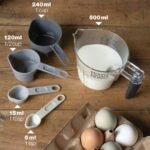
- 1 cup (US) = 8 fl oz ≈ 237 ml (or about 240 ml)
The Rounding Strategy
For daily use, rounding simplifies the change:
- Round 3.785 to 4 if you’re trying to go from gallons to liters
- Round 0.264 to 0.25 (or 1/4) when converting liters to gallons
- Round 29.6 to 30 when used for the conversion fluid ounces to milliliters
Yes, it makes the measurement very slightly inaccurate, but for cooking, shopping, and general estimation purposes this is fine.
Practical Conversion Examples
Example 1: You’re driving in Europe and you need to fill up your car’s 15-gallon tank. How many liters is that?
With rounded anchor: 15 gallons × 4 = 60 liters (real volume 56.775 liters)
Example 2: An American recipe specifies 2 cups of milk, but you’ve got a metric measuring cup. How many milliliters?
Using the anchor: 2 cups × 240 ml = 480 ml (real: 473 ml)
It doesn’t matter to most purposes.
Cross-System Conversion Table
| Imperial | Metric (Approximate) | Memory Trick |
|---|---|---|
| 1 gallon | 4 liters | Four corners of a gallon |
| 1 quart | 1 liter | Almost twins |
| 1 cup | 240 ml | A cup of coffee |
| 1 fl oz | 30 ml | Medicine dose |
| 1 pint | 470 ml | Just under half a liter |
For more detailed conversion tables and comprehensive resources, visit the Measurement Conversion Guide to explore additional tools and calculators.
Hack #5: The Smartphone Calculator Shortcut Formula
But even with mental tricks, some conversions need precision. This hack I’ll teach you, gives you a formula system that will work in any basic calculator or on your smartphone.
The Universal Formula
To convert from Unit A to Unit B:
Quantity in Unit A × Conversion Factor = Quantity in Unit B
The trick isn’t the equation itself — it’s being aware which conversion factors you should keep handy.
Essential Conversion Factors to Save
Enter these main points in your phone note:
Metric to Imperial:
- Liters to gallons: × 0.264172
- Milliliters to fluid ounces: × 0.033814
- Liters to quarts: × 1.05669
Imperial to Metric:
- Gallons to liters: × 3.78541
- Fluid ounces to milliliters: × 29.5735
- Quarts to liters: × 0.946353
Within Imperial:
- Gallons to quarts: × 4
- Quarts to pints: × 2
- Pints to cups: × 2
- Cups to fluid ounces: × 8
- Tablespoons to teaspoons: × 3
Quick Calculator Method
Here’s how to do all of this on your phone:
Problem: You need to convert 5.7 liters into gallons.
- Open calculator
- Enter: 5.7
- Multiply by: 0.264172
- Result: 1.506 gallons
Problem: How many cups is 12 tablespoons?
- Open calculator
- Enter: 12
- Divide by: 16 (required as there’s 16 tablespoons in 1 cup)
- Result: 0.75 cups
Developing Your Very Own Conversion Cheat Sheet
Spend a few minutes making a note on your phone called “Volume Conversions.” Include:
- The conversion factors listed above
- Any hobby-related conversions (e.g. brewing, aquariums, etc.)
- A couple of worked-out examples for easy reference
Now your pocket guide to conversions is always in your pocket.
Combining Hacks for Maximum Efficiency
The true power is in stacking these hacks. Here’s how they reinforce each other:
Leverage the Double-Double Method for a fast check in the kitchen and confirm with the Calculator Shortcut when accuracy counts.
So, for when you need to know relationships between units, a good rule of thumb to remember is draw the Gallon Guy and Anchor Point Method your way across.
Stick to the Metric Water Bottle Reference for visualization, then jump over to your Smartphone Formulas for precise measurements.
A Real-World Scenario
Here, you’re throwing an international dinner party. The Italian recipe has 750 milliliters of broth, the American one calls on 3 cups of cream, and you are doubling a British recipe that takes 2 pints of stock.
Solution path:
- Italian recipe: 750 ml = 0.75 liters (Metric hack)
- American recipe: 3 cups × 240 ml = 720 ml (Anchor point hack)
- British recipe doubled: 2 pints × 2 = 4 pints = 2 quarts (Gallon Guy hack)
You now can read any shopping list, no matter how you wrote it out on your measuring tools.
What Volume Conversion Mistakes to Avoid
With these hacks aside, though, some people will still get caught out. Beware the following pitfalls:
Mistake #1: Mixing up Weight and Volume
They are used to measure both weight (in dry ounces) and volume (in fluid ounces). They’re not interchangeable. There are 8 fluid ounces spoken as 8 oz of water to make up 1 cup, but how much is 8 oz of flour by weight if it becomes 1.75 cups?
Mistake #2: Forgetting Regional Differences
A US cup is 237 ml, whereas a UK cup is 250 ml. The US pint is 473 ml but the UK pint is 568 ml. If you are using international recipes, find out which system they’re using.
Mistake #3: Over-Relying on Approximations
The tricks of rounding work fine in most everyday cooking, but don’t use them when measuring for scientific experiments, medication doses, or precision baking. Know when exactness matters.
Mistake #4: Mixing Systems Mid-Calculation
Use one set of variables throughout your work. Just don’t try to add 2 cups + 500 ml without converting.
For more guidance on avoiding common conversion errors, check out this helpful resource from NIST on measurement standards.
Frequently Asked Questions
How many cups are in a liter?
1 liter is around 4.23 cups. To make this easier to calculate in your head, 1 liter is a little more than 4 cups (a little over 4 and 1/4 cups).
What Is the Simplest Way to Convert Tablespoons Into Cups?
Then divide the tablespoons measurement by 16. There are 16 tablespoons to a cup, so 8 tablespoons equals 0.5 cups (8 ÷ 16 = 0.5).
What is a fast way to convert gallons to liters?
A good rough approximation is to multiply the number of gallons by 4. For more accuracy, multiply by 3.785. So 5 gallons per day is roughly equivalent to 20 liters (quick) or 18.93 liters (exact).
Is a fluid ounce the same as an ounce?
No. Fluid ounces are a measure of volume (how much space something takes up), and regular ounces are a measure of weight (how heavy something is). You can’t exchange them directly without being given a density of the material.
Why is it that conversions in the metric system aren’t as challenging?
The metric system is base 10, so everything in it multiplies by 10, or 100, or 1000. The system of imperial measurements relies on inconsistent multipliers (3 teaspoons to a tablespoon, 4 quarts to a gallon), making calculations more cumbersome.
Can I use these conversion hacks for measurements of gas and liquids?
Yes, everyone should be able to convert volumes for liquids and gas. But keep in mind that gases can be compressed, and will have a different volume according to pressure and temperature.
How to make sense of the UK and US measurements?
Imperial units are used for both, but the actual volumes aren’t the same. U.S. gallon is equal to 3.785 liters, while a UK (imperial) gallon equals 4.546 liters. US and UK pints and fluid ounces, furthermore, are of different sizes.
How precise should I be in my conversions when it comes to cooking?
For most cooking, being within 5% is totally acceptable. Baking is more picky — 2% or better if you can. Use the precise conversions for medications or scientific work; don’t round.
Wrapping It All Together
Volume conversions don’t have to be scary or confusing. With these five ingenious hacks, you have a superpower for all occasions — from estimating measures in the kitchen to working through those pesky school projects needing exact quantities.
Don’t forget the core strategies: visualize with Gallon Guy; base it on the metric water bottle; double-double for kitchen speed; anchor points across systems and keep smartphone formulas at your fingertips for precision work.
Practice is the secret to success. And now you can start implementing those hacks in your daily life. The next time you are cooking, challenge yourself to convert a measurement in your head. If you think about how big a 2 liter soda bottle is, then that’s roughly the amount in cups. The more you convert, the more automatic this concept becomes.
Soon you’ll become the one your friends turn to when they want to know how many milliliters there are in a gallon, or how many cups can be found in 3 liters. And, more importantly, you will approach recipes, science experiments and real-life situations with confidence and ease.
Converting volume measurements are a life skill that will pay you back so many dividends. Learn these five hacks and you will never be clueless about a conversion.