



























Why the Numbers Are Not Enough When It Comes to Heat Indices
Ever wish you could cook somebody’s great recipe for European pastry, even if it does give some of the baking temperature in Celsius? Perhaps you are heading overseas and the temperature is 25°C, but you don’t know if it’s short or jacket weather.
Converting temperatures is not only the domain of scientists wearing white lab coats. For millions of people around the world, they are aspects of everyday life. Students sweated over their physics homework, travelers puzzled about what to wear in the morning and home cooks ruined recipes because they couldn’t quickly convert between Celsius and Fahrenheit.
The good news? No need to remember to know any complex formulas or pull out your calculator every time you want to convert temperatures. There are secret shortcuts that professional cooks, chefs and experienced travelers rely on to do these conversions in seconds.
This guide unveils 5 amazing shortcuts that will redefine the way you look at temperature conversions. These are not the dull formulas your teacher scribbled on the blackboard. These are the real-world tricks that actually do work.
The Temperature Systems You Must Know
Before getting to how shortcuts can work with this stuff, let’s quickly run through the three major temperature scales people use globally.
Celsius (°C): Most of the world uses this. Water freezes at 0°C and boils at 100°C. Neat, clean and totally sane.
Fahrenheit (°F): Used mostly in the United States, Bahamas and some other countries. Water freezes at 32°F and boils at 212°F. More abstract but pervasive in American culture.
Kelvin (K): Most often used in scientific settings. It starts from absolute zero (the coldest anything could ever be). Water freezes at 273.15K and boils at 373.15K.
Most folks have a hard time with Celsius and Fahrenheit conversions because the official formula is so cumbersome: F = (C × 9/5) + 32. Who among us wants or needs to be doing math into 9/5 in his head?
That’s where shortcuts become lifesavers.
Shortcut #1: The Double-Plus-30 Method (How to Convert Celsius to Fahrenheit)
This is the easiest trick to convert weather temperature from Celsius to Fahrenheit and vice versa. It’s not perfect, but it gets you close enough for practical purposes.
The rule: Take the Celsius temperature, double it and add 30.
Let’s see it in action:
- 20°C: (20 × 2) + 30 = 70°F (actual: 68°F)
- 10°C: (10 × 2) + 30 = 50°F (actual: 50°F)
- 30°C: (30 × 2) + 30 = 90°F (actual: 86°F)
The error margin is normally less than 2 to 4 degrees, which is more than enough for checking the weather forecast or choosing an air conditioner setting.
When to use: Quick weather checks, casual cooking, travel planning and everyday conversation.
Pro tip: This approach works best within the range of 0°C and 40°C (the span in which most people spend their lives). You’d probably want more accuracy outside that range.
Why This Shortcut Works
The true formula multiplies by 1.8 (which is actually 9/5), but how easy it is to double (multiply by 2) things in your head? The jump from 1.8 to 2 is so small that one only needs to add 30 instead of 32 to come very close.
This is not mathematically ideal, but it’s wonderfully pragmatic. It was developed by scientists primarily for the quick estimation needs of people who do not have access to or are unable to use calculators.
Shortcut #2: Subtract 30 and Divide by 2 (Fahrenheit to Celsius)
It is just the inverse of first shortcut. It’s equally fast and ideal for Americans traveling to countries where the Celsius scale is used.
The Rule: Subtract 30 from the Fahrenheit, then halve it.
Examples:
- 70°F: (70 – 30) ÷ 2 = 20°C (actual: 21°C)
- 90°F: (90 – 30) ÷ 2 = 30°C (actual: 32°C)
- 50°F: (50 – 30) ÷ 2 = 10°C (actual: 10°C)
Again, you are a couple of degrees away from the real answer, more than accurate enough in most applications.
When you might use it: Reading foreign weather reports, cooking from international recipes, deciphering thermostats on the wall in hotel rooms abroad.
Real-World Application Story
One chef I’m friendly with does this all the time when making European recipes work in an American kitchen. She looks at a recipe that says 200°C and intuitively thinks, “Oh sure that’s about 370°F” (200 × 2 + 30 = 430 so flip it: 430 – 30 = 400 ÷ 2 = 200). Close enough to set the oven properly without taking out her phone.
For more helpful conversion techniques across various measurements, visit our comprehensive measurement conversion guide resource.
Shortcut #3: Benchmarking (Reference Points)
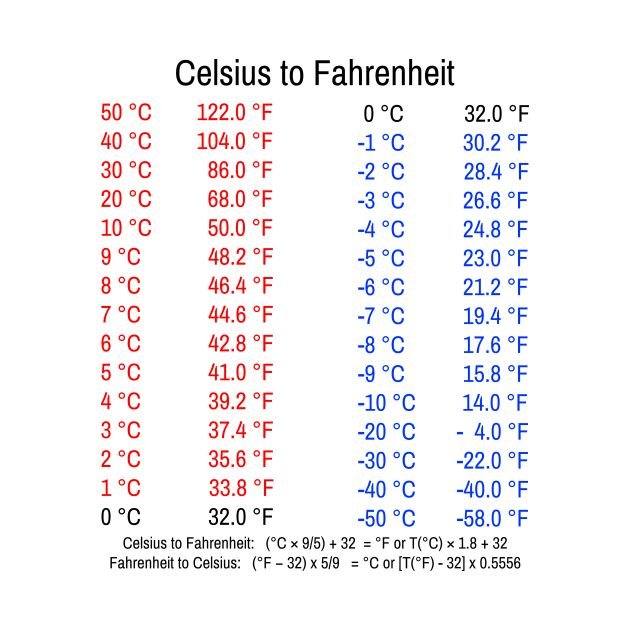
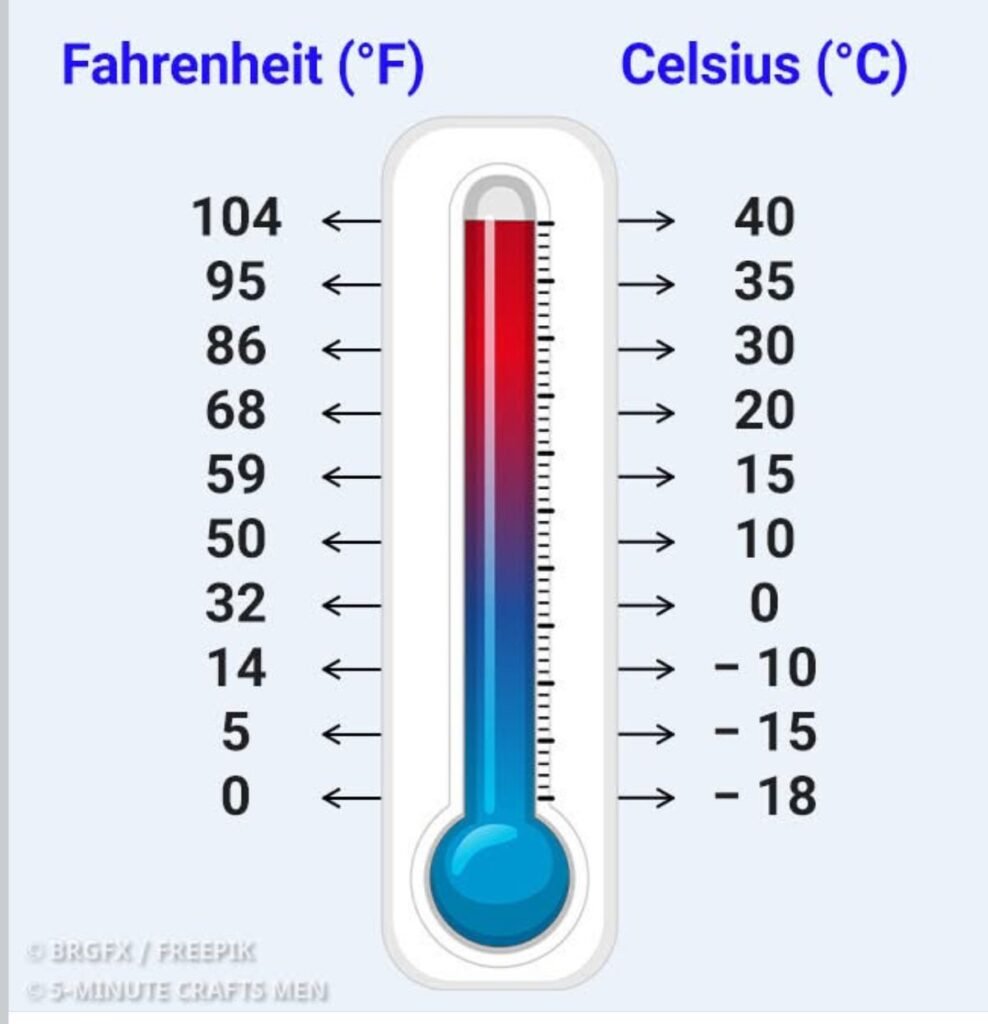
Rather than doing the math on every calculation, try memorizing a few of the key temperatures — they provide mental anchors. Then estimate based on proximity.
Essential Benchmarks:
| Celsius | Fahrenheit | What It Means |
|---|---|---|
| -40°C | -40°F | Extremely cold (they’re the same!) |
| 0°C | 32°F | Water freezes |
| 10°C | 50°F | Cool day |
| 20°C | 68°F | Room temperature |
| 30°C | 86°F | Hot summer day |
| 40°C | 104°F | Very hot |
| 100°C | 212°F | Water boils |
How to use it: If someone tells you that it is 25°C outside, then you will know that it ranges between 20°C (68°F) and 30°C (86°F). Quick guess: 77°F. Actual answer: 77°F. Nailed it!
This approach involves almost no calculation. All you have to do is remember these seven numbers and interpolate between them.
Building Your Mental Library
Begin with the five most common benchmarks: 0°C, 10°C, 20°C, 30°C and 40°C. Use them for a week and they will become natural. Your brain will begin to convert temperatures without your even having to consciously think about it.
You were learning how to estimate distances, as it turns out. You don’t run through the mental exercise of calculating what, exactly, 100 yards is every time you take a peek at a football field. You just know. So it goes with temperature benchmarks.
Shortcut #4: The 10-Degree Rule (To Be Precise)
And if you want better accuracy than what the double-plus-30 rule can provide, but don’t want to do any complicated math, use the 10-degree rule.
The Rule: Every 10°C = 18°F increase in Fahrenheit.
Work up or down by 10s from your nearest benchmark.
Example: What’s 35°C in Fahrenheit?
- Start at 30°C = 86°F (baseline)
- Add 5°C (half of 10°C) = add 9°F (half of 18°F)
- 86°F + 9°F = 95°F
The right answer is 95°F. You got it!
Another example: What is 15°C in Fahrenheit?
- Begin at 20°C = 68°F (reference)
- Subtract 5°C = subtract 9°F
- 68°F – 9°F = 59°F
The right one is 59°F. Perfect once again!
It is a little of both mental math and correctly doing the math, isn’t it? You can use it for baking or in the science lab, anywhere precision counts.
When Every Degree Counts
Bakers swear by this method. 175°C vs 180°C may not seem big, but it can be the difference between beautiful golden cookies and burnt ones. The 10-degree guidance allows you to convert accurately without interrupting your workflow.
Shortcut #5: The Kelvin Quick-Add Technique
Kelvin conversions intimidate people unnecessarily. They are, in fact, the very easiest conversions of all because there is no multiplying.
Celsius to Kelvin: Add 273 (or 273.15 for a more accurate answer)
Kelvin to Celsius: Subtract 273 (or 273.15 for exact)
Examples:
- 25°C = 25 + 273 = 298K
- 300K = 300 – 273 = 27°C
- 0°C = 0 + 273 = 273K
For most practical uses rounding to 273 is just fine. Scientists, when it counts, use 273.15.
Fahrenheit to Kelvin: Convert to Celsius first, then add 273.
Example: 77°F
- 77°F = 25°C (using subtract-30-and-halve)
- 25°C + 273 = 298K
Why Kelvin Is Easier Than It Seems
Kelvin is convenient because it uses the same degree-size as Celsius. The only thing that differs is where zero begins. Celsius puts zero where water freezes. Kelvin sets zero to “absolute zero” (the coldest temperature theoretically possible in the universe).
Knowing these equivalence relations, Kelvin conversions are a breeze. No fractions, no bizarre multipliers, just plain old addition and subtraction.
According to NIST (National Institute of Standards and Technology), understanding temperature scales is fundamental to scientific measurement and everyday applications.
Build Your Own Conversion Cheat Sheet
Now you know all five shortcuts. Record the standards and techniques that are most useful for you.
For Travelers:
- Double-plus-30 (C to F)
- Subtract-30-and-halve (F to C)
- Key benchmarks: 0, 10, 20, 30°C
For Students:
- Kelvin quick-add
- 10-degree rule for precision
- All benchmark temperatures
For Cooks:
- Benchmark method
- 10-degree rule
- Oven conversion (normally 25°F = approximately 15°C increments)
Stash this card in your wallet, stick it on the fridge or save it to your phone. As soon as you use these shortcuts for two weeks, you will no longer need the card. The conversions will become automatic.
Common Temperature Conversion Errors to Avoid
Even when people take shortcuts, they still tend to make the same kinds of mistakes. Here’s what to watch out for:
Mistake #1: Failing to add the +32 offset Celsius and Fahrenheit do not begin in the same spot. Water freezes at 0°C but 32°F. Keep in mind this discrepancy.
Mistake #2: Using shortcuts out of range The double-plus-30 shortcut only works well from 0-40°C. After that it’s just not going to give you a very accurate answer. Use the 10-degree rule for cooking temperatures above 200°C.
Mistake #3: Misusing Kelvin for Celsius The degree symbol never enters the picture with Kelvin. It’s 300K, not 300°K. This might seem pedantic, but it reflects that Kelvin is an absolute scale, not a relative one.
Mistake #4: Over-precision If you’re looking up weather, it’s okay to be within 3-5 degrees. Don’t bother calculating a result to the decimal point unless you’re doing science or precision baking.
Practice Makes Perfect: Temperature Conversion Exercises
For practice, try these real-world scenarios:
- How warm is 18°C in Paris compared to Fahrenheit?
- My oven recipe says 350°F. How much in Celsius is that?
- A chemistry experiment needs 298K. What is that in Celsius?
- The pool is 28°C. Is that a good temperature for swimming?
- It is -5°C outside according to your European friend. What’s that in Fahrenheit?
Answers:
- (18 × 2) + 30 = 66°F (actual: 64°F) – Light jacket weather
- (350 – 30) ÷ 2 = 160°C (actual: 177°C) – Round to 175°C for baking
- 298 – 273 = 25°C – Room temperature
- 28°C is somewhere between 20°C (68°F) and 30°C (86°F), so around 82°F – Just right for swimming!
- Use benchmarks: 0°C = 32°F, so -5°C is approximately 23°F – Extremely cold!
With practice, you get very quick at these conversions. Before long, you’ll do them without even thinking.
Frequently Asked Questions
Q: Can these shortcuts be accurate enough for scientific work? A: Benchmark and 10-degree rule methods are good enough for most lab work. But if you are looking at published research or critical experiments, use the exact formulas or conversion utilities to get accurate measurements.
Q: Why not use just one temperature scale? A: Great question! Most of the world does prefer Celsius. The United States is clinging to Fahrenheit, not just out of tradition and inertia but also for some very practical reasons. Change happens slowly.
Q: What’s the first shortcut I should learn? A: If you are in the United States, try using the double-plus-30 strategy. Begin with subtract-30-and-halve if you’re not from here. These cover 90% of everyday conversion needs.
Q: Can I utilize these shortcuts with conversion apps? A: You can, but the idea is that you no longer need apps! Use these shortcuts in your head, providing quick answers without pulling out your phone.
Q: What about converting negative temperatures? A: The double-plus-30 trick still works, but it does get less accurate. For subzero temperatures, either stick to the benchmark method or apply the real formula for precision.
Q: How do I remember which way to convert? A: Keep this in mind: Fahrenheit numbers are larger than Celsius (except at -40° where they are equal). If you’re converting to Fahrenheit, you’re going UP. If you’re converting to Celsius, you’re going DOWN.
Your Temperature Conversion Toolkit
You’re now armed with five life-changing shortcuts that the world’s best chefs, travelers and scientists have in their back pocket every single day:
- Double-plus-30: Quick Celsius-to-Fahrenheit estimates
- Subtract-30-and-halve: Fast Fahrenheit-to-Celsius conversions
- Benchmark method: No-math reference-point estimation
- 10-degree rule: Accurate conversions in incremental steps
- Kelvin quick-add: Effortless scientific temperature conversions
These aren’t just mathematical tricks. They’re handy tools that make your life a little easier every day.
Begin with one shortcut that’s easy for you to use. Try it for a week and see if it becomes natural. Then add another. After a month, you’ll convert between temperatures faster than most folks can open their calculator app.
The secret is not in memorizing formulas or carrying conversion charts around. The trick is to have quick, usable shortcuts that work in the real world.
You can make temperature conversion relatively painless. With those five shortcuts, you’ll never get stuck between Celsius, Fahrenheit, or Kelvin again. You’ll be the one everyone comes to when they need to quickly convert something and you will answer confidently every time.
Now you can convert with more confidence. Whether you’re baking a French pastry, planning a trip to Tokyo or helping your kid with science homework, the tools are at your fingertips. Temperature conversion just became the simplest thing you’ll do all day.