





























The Importance of Temperature Conversions in Everyday Life
We live with temperature every day. Whether it’s when looking up the weather report, preparing that favorite recipe, or just reading for a science project you are working on; knowing different temperature scales is useful in making sense of the world.
Various countries rely on different temperature scales. The United States uses Fahrenheit, most other countries use Celsius. The whole scientific world uses Kelvin for its experimentations. Knowing how to switch between these scales is not just useful — for traveling, cooking, science and everyday communication alike; it’s downright necessary.
This guide will demystify 12 straightforward conversion tactics you can easily learn. You’ll learn the formulas, shortcuts and practical tricks that make you want to convert between temperatures as much as you might count to ten.
The Three Primary Temperature Scales Explained
Before we get into conversions, let’s figure out what this thing is.
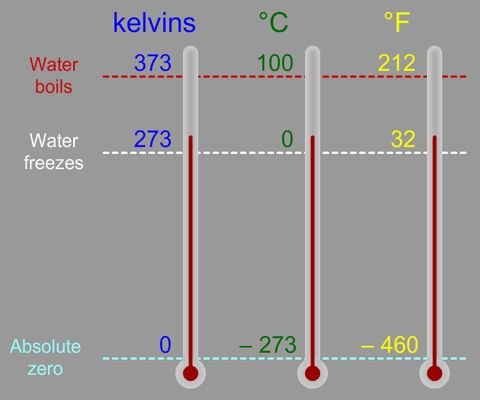
Celsius (°C) is based on the properties of water. At a pressure level of 1 atm water freezes at 0°C and boils at 100°C. This is a reasonable scale used in Europe, Asia, Africa and now Australasia.
Fahrenheit (°F) places the freezing point of water at 32°F and the boiling point at 212°F, so you’ll generally see this scale used for weather reports and oven temperatures in the U.S.
Kelvin (K) takes absolute zero as its starting point, the coldest temperature that is possible, when molecules stop moving. This is a scale scientists adore because it has no negative values. The melting and boiling points of water are 273.15 K and 373.15 K, respectively.
Each scale does a different job, but they all measure the same thing — how hot or cold something is.
Conversion Formula 1: Celsius to Fahrenheit
This is likely to be the most common conversion you require.
The Formula: °F = (°C × 9/5) + 32
To convert temperatures in degrees Celsius to Fahrenheit, multiply by nine, divide by five and add 32.
We can break this down step by step. Get your °C value and multiply it by 9/5. Then add 32 to your answer.
Example: Convert 25°C to Fahrenheit
- Step 1: 25 × 9/5 = 45
- Step 2: 45 + 32 = 77°F
So 25°C is equal to 77°F – a lovely spring afternoon!
Quick Tip: Keep in mind that numbers in Celsius are always lower than the equivalent Fahrenheit values (except for -40, when they’re the same).
Conversion Method 2: The Fahrenheit to Celsius Formula
And reversing it is just as simple.
The Formula: °C = (°F – 32) × 5/9
Begin by subtracting 32 from your Fahrenheit temperature. Then multiply that figure by 5/9 (or roughly 0.556).
Example: Convert 68°F to Celsius
- Step 1: 68 – 32 = 36
- Step 2: 36 × 5/9 = 20°C
Room temperature is 68°F which is exactly 20°C.
Memory Device: Subtract first, then multiply. The reverse conversion of Celsius to Fahrenheit.
Method 3: Quick Mental Math Approach
At times you’d prefer to have a rough estimate without taking out a calculator.
For Celsius to Fahrenheit: Double the Celsius number and add 30. It’s not a perfect match, but it gets you close.
Example: 20°C × 2 = 40, then +30 = 70°F (actual answer is 68°F)
For Fahrenheit to Celsius: Deduct 30, then divide by 2.
Example: 80°F – 30 = 50; 50 ÷ 2 = 25°C (actual answer is 26.7°C)
This method is most accurate between 0°C and 40°C, typical for day-to-day use – good for fast weather comparisons!
Method 4: Converting Celsius to Kelvin
This conversion is used by scientists all the time in their labs.
The Formula: K = °C + 273.15
Just add 273.15 to any Celsius temperature. That’s it! No multiplication or division required.
Example: Convert 25°C to Kelvin
25 + 273.15 = 298.15 K
Note that Kelvin does not employ the degree mark (°). We say “298 Kelvin,” not “298 degrees Kelvin.”
Science Fact: Absolute zero is 0 K or -273.15°C; where all molecular motion ceases.
Method 5: Kelvin to Celsius
This reverses the previous conversion.
The Formula: °C = K – 273.15
Subtract 273.15 from any Kelvin temperature.
Example: What is 300 Kelvin in Celsius?
300 – 273.15 = 26.85°C
This conversion is important in chemistry and physics problems, where students may be dealing with gas laws or the study of thermodynamics.
Method 6: How to Convert Fahrenheit to Kelvin
This would demand a two-step approach on account of the lack of direct relation between Fahrenheit and Kelvin.
The Formula: K = (°F − 32) × 5/9 + 273.15
Get from Fahrenheit to Celsius; then add 273.15.
Example: Convert 77°F to Kelvin
- Step 1: (77 – 32) × 5/9 = 25°C
- Step 2: 25 + 273.15 = 298.15 K
Alternate Method: First convert to Celsius, then Kelvin. When complex conversions are sub-divided into smaller ones, errors can be kept to a minimum.
Method 7: Converting Kelvin to Fahrenheit
Another two-step conversion process.
The Formula: °F = (K – 273.15) × 9/5 + 32
Subtract 273.15 for Celsius, then convert it to Fahrenheit.
Example: Change 310 Kelvin to Fahrenheit
- Step 1: 310 – 273.15 = 36.85°C
- Step 2: (36.85 × 9/5) + 32 = 98.33°F
This is almost normal human body temperature!
Method of Conversion 8: Using Reference Points
It is to your benefit to memorize some key temps giving you the ability for quicker conversions.
Water’s Freezing Point:
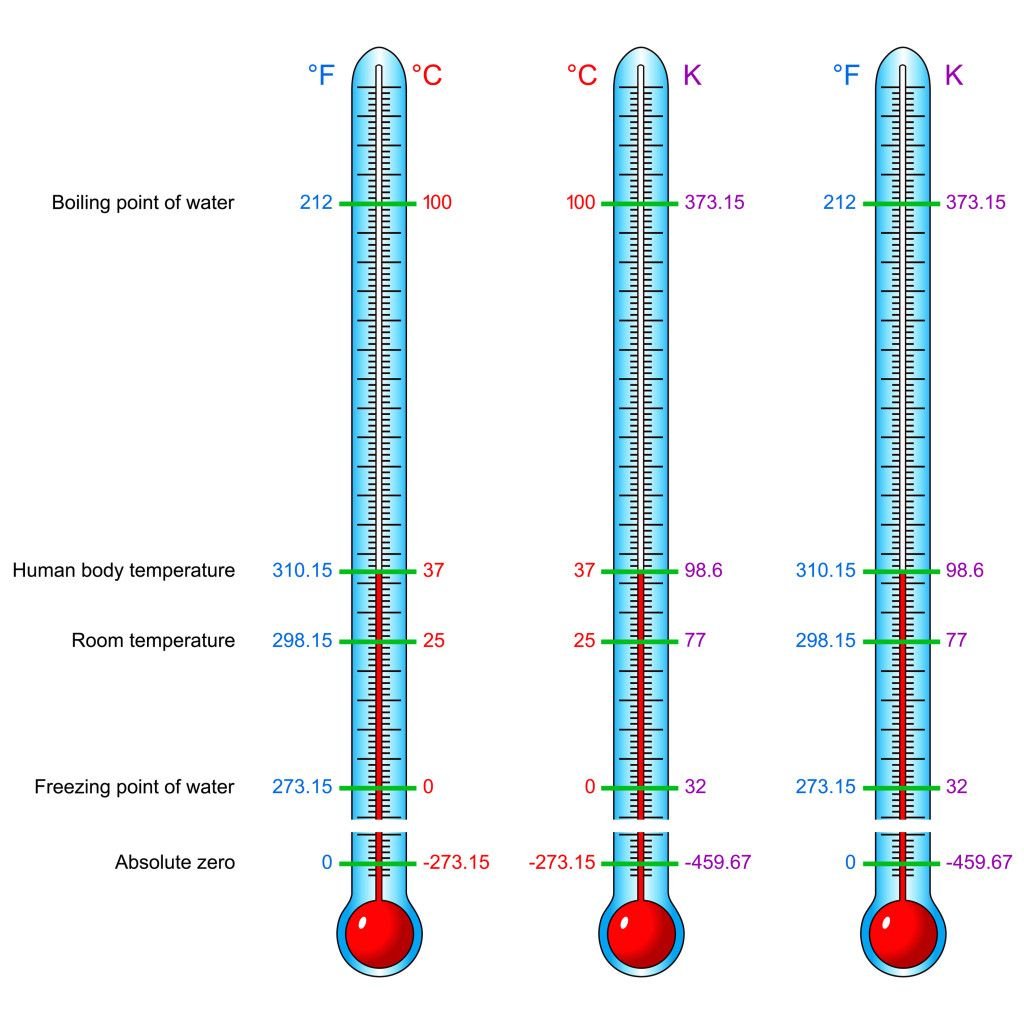
- 0°C = 32°F = 273.15 K
Water’s Boiling Point:
- 100°C = 212°F = 373.15 K
Comfortable Room Temperature:
- 20°C = 68°F = 293.15 K
Human Body Temperature:
- 37°C = 98.6°F = 310.15 K
Hot Summer Day:
- 35°C = 95°F = 308.15 K
From these, you can infer other temperatures. If something is halfway between freezing and boiling on one scale, it will be halfway on another scale as well.
The Ratio Method – Conversion Method 9
The knowledge of the relationship between the scales aids materially in performing conversions.
The Celsius and Fahrenheit scales have a 100-degree range versus a 180-degree range between water’s freezing and boiling points.
Ratio: 100°C range = 180°F range, or reduced to 5:9
That’s why we have 5/9 and 9/5 in our conversion formulas. Five degrees Celsius represents 9 degrees Fahrenheit.
Practical Use: When temperature is increased 10 degrees Celsius, it increases 18 degrees Fahrenheit. This comes in handy when you’re traveling internationally.
Method 10: Online Conversion Tables
Reference charts for when accuracy is critical reduce the risk of miscalculations.
| Celsius (°C) | Fahrenheit (°F) | Kelvin (K) |
|---|---|---|
| -40 | -40 | 233.15 |
| -20 | -4 | 253.15 |
| 0 | 32 | 273.15 |
| 10 | 50 | 283.15 |
| 20 | 68 | 293.15 |
| 30 | 86 | 303.15 |
| 40 | 104 | 313.15 |
| 50 | 122 | 323.15 |
| 60 | 140 | 333.15 |
| 70 | 158 | 343.15 |
| 80 | 176 | 353.15 |
| 90 | 194 | 363.15 |
| 100 | 212 | 373.15 |
This table can be kept in your kitchen, classroom or workshop. It includes the typical values of most common temperature ranges. For more comprehensive measurement conversion guides, explore additional resources to help with various unit conversions.
Conversion Technique 11: Digital Tools & Apps
Conversions are instant and error-free thanks to technology.
Calculator Methods: Most smartphones have a calculator. Just plug in the formulas above.
Weather Apps: Majority of the weather apps show temperature in Celsius as well as Fahrenheit. Switch between them to get comfortable moving around in both scales.
Dedicated Conversion Apps: Apps such as Unit Converter, ConvertPad or Google’s built-in converter can take care of temperature conversions immediately. Just enter “25 Celsius to Fahrenheit” in Google’s search bar.
Smart Home Devices: Alexa, Google Assistant or Siri can do temperature conversions for you. Say “Hey Google, what is 350 Fahrenheit in Celsius?”
Although having a tech tool may be easy, doing the math allows you to have better problem-solving skills.
Method 12: Cooking Temperature Conversions
If you are trying out recipes from another country, then you may need to convert temperatures for accurate results.
Common Baking Temperatures:
| Description | Fahrenheit | Celsius |
|---|---|---|
| Warm | 200°F | 95°C |
| Very Slow | 250°F | 120°C |
| Slow | 300°F | 150°C |
| Moderate | 350°F | 175°C |
| Moderately Hot | 375°F | 190°C |
| Hot | 400°F | 200°C |
| Very Hot | 450°F | 230°C |
| Extremely Hot | 500°F | 260°C |
Cooking Tip: It is usual to have a 25°F variance on most ovens. When converting recipes, round the temperature to the closest 25°F or 10°C increment.
Meat Temperature Guide:
- Rare beef: 52°C (125°F)
- Medium beef: 63°C (145°F)
- Well-done beef: 71°C (160°F)
- Chicken (safe): 74°C (165°F)
Precise cooking temperature conversion ensures perfect results for the perfect meal! For detailed food safety guidelines, visit the USDA Food Safety and Inspection Service.
Common Conversion Mistakes to Avoid
Simple equations trip people up, too. Watch out for these errors.
Mistake 1: Not adding or subtracting 32 when converting between Celsius and Fahrenheit. It’s important to account for the offset because the scales start at different points.
Mistake 2: Confusing multiply and divide. Don’t forget: For C to F, multiply by 9/5; for F to C, multiply by 5/9.
Mistake 3: Using the degree symbol with Kelvin. It’s just “K,” not “°K.”
Mistake 4: Rounding too early. Round your final answer to one or two decimal places only after finishing all computations.
Mistake 5: Confusing negative temperatures. -10°C is much warmer than -10°F, so complete the whole conversion formula.
Practical Applications in Different Fields
Temperature conversions are not just academic exercises. They solve real-world problems.
Travel: If you know what the weather is going to be like in your destination, you can pack more appropriately. Europeans use Celsius, so Americans had better be ready with easy-to-convert numbers.
Science Labs: Accurate temperature control is critical for chemistry and physics experiments. Researchers switch between scales all the time when they adhere to international research standards.
Medicine: Different scales are used in the monitoring of body temperature worldwide. Knowing that 98.6°F corresponds to 37°C helps you to interpret medical information anywhere in the world.
Automotive: Engine temperatures, tire pressure calculations, and fluid specifications often require conversions between measurement systems.
Manufacturing: Industrial processes specify temperature to an exact degree. If they are using tools that are calibrated in different units, workers must convert measurements as well.
Teaching Temperature Conversions to Others
The best way to learn conversions is to teach them.
Visual Aids: Draw thermometers with the three scales parallel to each other. This enables learners to visualize relationships between numbers.
Practice Problems: Begin with simple integers and then move on to decimals. Repetition builds confidence and speed.
Real-Life Scenarios: Employ real-life use cases such as weather reports, cooking challenges, or a fun science experiment.
Games and Quizzes: Make studying into a game. Who can convert fastest? And who gets the most right answers?
Encourage Mental Math: Develop number sense by estimating first, then solving. It helps you develop an intuition for temperature relations.
Frequently Asked Questions
What is the temperature in Celsius that equals the temperature in Fahrenheit?
Negative 40 degrees is the same in each scale. They meet at -40°C = -40°F. This is the only place where the numbers agree perfectly.
Why do Americans use Fahrenheit and not Celsius?
Historical reasons and tradition. The United States adopted Fahrenheit before the widespread implementation of the metric system. If we had to adapt it today, we’d need to reprogram millions of thermostats, thermometers and consumer goods all over again.
Does Kelvin read as accurately as Celsius or Fahrenheit?
All scales are equally accurate in measuring temperature. Kelvin is more useful in science because it starts at absolute zero and does not include negative numbers, which simplifies some calculations.
How do you convert negative temperatures?
Use the same formulas. For example, -10°C to Fahrenheit: (-10 × 9/5) + 32 = -18 + 32 = 14°F. Negative temperatures act just like positive ones.
What are the best methods to remember conversion formulas?
Create a mnemonic device. For Celsius to Fahrenheit, the phrase “Times nine-fifths, plus 32” should come to mind. Repeat as often as possible, until it’s automatic.
Can I convert temperatures on a smartphone without internet?
Yes! With the formulas provided in this guide, open your calculator app. Offline unit converter apps are also available for most phones.
Your Temperature Conversion Toolkit
You have 12 ways now to convert temperatures. Some require precise calculations, while others provide quick approximations. Some people do it with a little tech, some with mental math.
You could choose the option you think best suits your circumstances. Need a quick weather comparison? Use the mental math trick. Working on a chemistry lab report? Stick with exact formulas. Cooking from a British recipe? Reference the conversion table.
Practice makes it easier to master temperature conversion. Begin by converting the current temperature from the weather app between scales. Translate your oven settings when experimenting with new recipes. Try to predict the temperature and then calculate it.
With practice, you’ll feel more and more comfortable converting between those numbers. Eventually you’ll learn that 20°C is a comfortable room temperature while 100°F is what it feels like on a hot summer day. You will be able to read weather forecasts from any country and follow recipes from around the world.
Taking a temperature measurement connects us to our environment and to people across the globe. Once you learn these 12 conversion techniques, you’ll never be stumped by different temperature scales again. Whether you are on the road, in the kitchen, studying, or simply curious to discover how the world works, these skills are going to serve you well for years to come.