




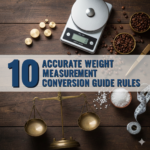








How to Change Your Life by Mastering Weight Conversions
Weight conversions may seem like a trivial skill, but when you need them… Then suddenly, they’re everywhere.
You’re using a British baking recipe that lists 225 grams of flour. Your grandma’s hand-typed cookbook recipes are in ounces. The shipping site requests package weight in kilograms. Your fitness app measures progress in pounds.
The world thinks in different measurement tongues. Learning to translate between them opens doors you didn’t even know were shut.
This guide will give you 8 tried and true tips that turn weight conversions from a hassle into second nature. And it’s not just a set of formulas to remember. They’re practical plans that operate in actual kitchens, gyms, post offices and grocery stores.
Let’s get to the tips that actually matter.
Tip 1: Nail Down Your Core Conversion Numbers First
Before you start to memorize complex relationships, nail these basics down. They’re the basis for all other things.
The Essential Four:
- 1 pound = 16 ounces
- 1 kilogram = 1000 grams
- 1 pound = 453.6 grams
- 1 kilogram = 2.2 pounds
Write these down. Add them to your phone’s lock screen. Tape them to the inside of your kitchen cabinet. With these four conversions, 90% of all daily measurement problems are solved.
Why These Four Matter Most
Every other weight conversion is derived from these fundamentals. Once you have learned that 1 pound is equivalent to 16 ounces, you can work out any pound-to-ounce conversion through simple multiplication or division.
The factor of 2.2 shows constantly as the relation between kilograms and pounds. Body weight, luggage limits, produce prices and shipping costs — the number crops up everywhere.
Quick Reference Table:
| From | To | Multiply By | Example |
|---|---|---|---|
| Pounds | Ounces | 16 | 3 lbs × 16 = 48 oz |
| Ounces | Pounds | 0.0625 | 32 oz × 0.0625 = 2 lbs |
| Kilograms | Grams | 1000 | 2 kg × 1000 = 2000 g |
| Grams | Kilograms | 0.001 | 500 g × 0.001 = 0.5 kg |
| Pounds | Kilograms | 0.4536 | 10 lbs × 0.4536 = 4.536 kg |
| Kilograms | Pounds | 2.2 | 5 kg × 2.2 = 11 lbs |
Keep doing them until they feel second nature. Your brain will begin to do this for you, even on the fly.
Tip 2: Create a Personal Conversion Reference Library
When you look up units in a generic conversion chart, it gives you hundreds of conversions that you’ll never employ. Build your own dedicated resource instead.
Begin by choosing the conversions that occur most frequently for you. A baker requires different conversions than a weightlifter. A parent keeping an eye on baby’s growth might want a different set of measurements than someone who is shipping online orders.
Creating Your Custom Conversion Sheet
For Home Cooks:
- Standard ingredient weights (butter, flour, sugar)
- Recipe scaling factors
- Oven temperature conversions (bonus!)
For Fitness Enthusiasts:
- Bodyweight ranges in both systems
- Dumbbell and barbell weights
- Protein powder measurements
For Online Sellers:
- Package weight tiers
- International shipping brackets
- Common product weights
Save this reference where you have it in mind. A laminated card in your kitchen drawer trumps a spreadsheet tucked away in a drawer you never open.
A simple spreadsheet on your phone can work for many people. Update it whenever you find a new conversion that you regularly use.
Tip 3: Know the Faster Estimation Methods
Perfect accuracy isn’t always necessary. On occasion, “good enough” is better and faster.
The Half-and-Subtract Technique for Converting Pounds to Kilograms
You don’t have to multiply it by 0.4536, just do this:
- Divide the pounds by 2
- Subtract 10% from that number
Example: 50 pounds to kilograms
- 50 ÷ 2 = 25
- 10% of 25 = 2.5
- 25 – 2.5 = 22.5 kg
- (Actual answer: 22.68 kg)
You’re within 1 percent of the correct answer and doing this in your head!
The Double-and-Add Technique for Kilograms to Pounds
- Multiply kilograms by 2
- Add 10% to that number
Example: 30 kilograms to pounds
- 30 × 2 = 60
- 10% of 60 = 6
- 60 + 6 = 66 pounds
- (Actual answer: 66.14 pounds)
These hacks are great when you need a quick estimate at the store, gym, or even while planning meals.
When Precision Actually Matters
Save precision for when it matters:
- Baking delicate pastries
- Medical dosages
- Scientific experiments
- Precious metal transactions
- Official documentation
For everything else, mental estimates are a labor-saving convention and work perfectly fine. For comprehensive conversion resources and calculators, visit Measurement Conversion Guide for additional support.
Tip 4: Use Technology Smartly, But Not As A Crutch
Modern tools make conversions instant. The trick is to make them your aids, not crutches.
Smart Tool Strategies
Voice-controlled digital assistants can do the math when your hands are occupied. If you’re cooking, packing or working out, “Hey Siri, convert 300 grams to ounces.”
There are calculators on your phone to do the math, but if you know what you’re calculating, there’s less chance of doing it wrong. If you type 150 ÷ 2.2 instead of 150 × 2.2, you will realize the mistake if you grasp the relationship.
Bookmarks: Bookmarks in browser of trusted sites will help save you time when you are looking for conversions. Bookmark two or three reliable calculators instead of a random Google search.
The Best Free Digital Tools
For Quick Lookups:
- Google’s native converter (simply type “5 lbs to kg” in the search)
- WolframAlpha for complex conversions
- ConvertUnits.com for comprehensive options
For Kitchen Work:
- Kitchen Calculator Pro (for recipes specifically)
- Paprika Recipe Manager (does the recipe conversion for you)
- Yummly (includes conversion features)
For Fitness Tracking:
- MyFitnessPal (automatic unit switching)
- Strong (dual unit weightlifting app)
- Fitbit app (shows both types of units)
When you need to search around, download apps tailored to your needs instead of general “unit converter”-type apps you may never use.
Tip 5: Think in Both Systems Simultaneously
Bilingual speakers don’t translate every word as they speak — they think in both languages. Apply the same thing for measurements.
Begin combining weights with their metric and imperial measures as well. When you lift a 5-pound bag of flour, think “5 pounds, approximately 2.3 kilograms.” If you weigh 70 kilograms, imagine “70 kg, approximately 154 pounds.”
Building Dual-System Thinking
Weight Anchors to Memorize:
| Imperial | Metric | Common Item |
|---|---|---|
| 1 oz | 28 g | Slice of bread |
| 4 oz | 113 g | Stick of butter |
| 8 oz | 227 g | Cup of water |
| 1 lb | 454 g | Block of butter |
| 2.2 lbs | 1 kg | Bag of sugar |
| 5 lbs | 2.3 kg | Bag of flour |
| 10 lbs | 4.5 kg | Bowling ball |
Associate these weights with tangible things you manipulate often. Concrete associations are more memorable to your brain than abstract numbers.
After a few weeks of consciously practicing it, you’ll just know that something weighing 3 pounds is about 1.4 kilograms without having to compute anything.
Tip 6: Conversion Precision is Contextual
Various circumstances warrant different degrees of precision. It saves time and lowers stress to match your precision to the task.
Three Precision Levels
Rough Estimate (±5% accuracy):
- Grocery shopping
- Estimating luggage weight
- Casual fitness tracking
- General cooking
Take advantage of mental math tricks or round numbers freely.
Standard Accuracy (±1% accuracy):
- Most baking recipes
- Meal prep portioning
- Package shipping
- Diet tracking
Use calculator or conversion app.
High Precision (±0.1% accuracy):
- Professional baking
- Laboratory work
- Medication dosing
- Jewelry weighing
Harness the power of calibrated digital scales and accurate conversion factors with multiple decimal places.
Knowing what level you require avoids both sloppy mistakes and unnecessary perfectionism.
Real-World Precision Examples
Making banana bread? Round up 120 grams of flour to 4 ounces. Despite its small difference, this will not change the outcome.
Weighing gold for sale? Don’t round anything. Quantify using precise conversions and established scales.
Tracking protein intake? Rounding to the nearest 5 grams is nice; it’s easy and doesn’t lose any useful accuracy.
Tip 7: Develop Conversion Habits Around Routines
The easiest way to memorize conversions is relating them to things you already do.
Kitchen Conversion Habits
Whenever you measure anything, say both measurements out loud. “Two cups of flour, that’s 240 grams.” This enhances the connection without formal study time.
When you’re meal prepping, weigh out portions in both measurements. Your brain learns equivalents through repetition.
Fitness Conversion Habits
Keep track of the weights you use in your workouts with both pounds and kilograms. Most gyms have equipment that is listed in both units anyway.
When you jump up in weight, figure the difference in both systems. “I went from 135 pounds to 155 pounds, which is about 61 kilograms to 70 kilograms.”
Shopping Conversion Habits
Compare price per pound versus price per kilogram when both are listed. This develops hands-on conversion skills while uncovering better deals.
For international online shopping, convert product weights before checking shipping costs.
The 30-Day Conversion Challenge
Resolve to spend one month of deliberate conversion practice:
Week 1: Convert whatever you eat or drink
Week 2: Convert the weight of anything related to exercise
Week 3: Convert weights while shopping
Week 4: Convert measurements in recipes as often as possible
After 30 days, the conversions are instinctual, not intentional.
Tip 8: Know Common Conversion Traps and How to Avoid Them
Even professionals get these wrong. Awareness of the traps is how you get around them.
Pitfall 1: Not Understanding Fluid Ounces vs. Weight Ounces
A fluid ounce measures volume. A regular ounce measures weight. They are two entirely distinct units that share the same name.
Water weighs around 8 ounces per 8 fluid ounces. But 8 fluid ounces of honey is equivalent to about 12 ounces, because honey is denser than water.
Solution: Pay attention to context. Generally recipes specify “fluid oz” for liquids and simply “oz” for solids.
Pitfall 2: Overlooking the Weight of the Container (Tare)
Placing the bowl on a scale and measuring out ingredients without deducting the weight of the bowl is going to add ounces or grams to every measurement.
Solution: Digital scales should have a “tare” or “zero” button you can use. Just put your empty vessel on top of the scale, hit tare and start adding ingredients. The balance does not take into account the weight of the container.
Pitfall 3: Confusing Metric Tons and US Tons
A metric ton, or tonne, is 1,000 kilograms or roughly 2,205 pounds. A US ton is equivalent to 2,000 pounds or about 907 kilograms. They’re close but not identical.
Solution: When the difference is relevant, make clear which ton you are referring to. For everyday conversation, the distinction rarely causes problems.
Pitfall 4: Over-Relying on Rounded Conversions
Remembering “1 kg = 2 lbs” is convenient but inaccurate. The actual conversion is 2.2 pounds.
For small quantities this doesn’t matter much. But convert 100 kilograms at 2 (instead of 2.2) and you’re off by about 20 pounds.
Solution: Round numbers are good for quick approximations, but revert to precise conversions if you’re working with large quantities or need accurate results.
Applying Your Conversion Skills in Real Life
Now that you have eight ultimate tips, let’s look at how to incorporate them into real life.
Morning Routine Integration
Hop on the scale and do the conversion in your head. Whether your scale shows pounds or kilograms, determine the other measurement.
Meal Planning Integration
If you are cooking using recipes, convert the measurements in advance. This prevents scrambling mid-recipe.
Shopping Integration
Easily compare items sold in various units. Which provides more product, a 16-ounce package or a 500-gram pack? (The 500-gram pack size measures roughly at about 17.6 ounces, so it’s slightly bigger.)
Fitness Integration
Log weights in both systems. A lot of fitness apps allow for dual entry. Having regular exposure to both numbers helps develop intuitive understanding.
Tracking Your Progress
Keep an easy log for one month. Look at cases where you’ve needed to do some sort of conversion, and how you handled it.
- Used mental math successfully
- Needed calculator but knew which operation
- Used an app
- Made a mistake (and what caused it)
This insight speeds up learning as it reveals patterns in your conversion use and shows you which tips work best for you.
Frequently Asked Questions
What’s the easiest weight conversion to remember?
Simplest and most useful is the kilogram-to-pound conversion (multiply by 2.2). It comes up all the time in travel, fitness and international shopping. Master this one first.
How do I convert recipes between metric and imperial measurements?
Concentrate on the most texture-sensitive ingredients: flour, sugar and fats. For these, use precise conversions. For flexible ingredients like vegetables and seasonings, rough estimates are fine. A kitchen scale means no guesswork at all.
Do I need an expensive kitchen scale for conversions?
No. Get one of those basic digital scales that sell for $15-$25; they work great for home cooking. They usually toggle between grams and ounces with a button click. Only invest in pricey scales if you’re doing professional baking or need laboratory-level precision.
Why do other countries use different systems of measurement?
The metric system was adopted by most of the world because it uses units of 10, making calculations easier. The United States primarily uses the imperial system due to historical reasons and the cost of replacing infrastructure, packaging, and public familiarity with these measurements.
Can I convert weights accurately without internet access?
Absolutely. If you memorize the four basic conversions from Tip 1, that’ll cover most situations. For additional conversion needs, a small printed reference card works anywhere. Some people store conversion notes in their phone’s offline notes app.
What’s the difference between mass and weight in conversions?
Technically, mass (measured in kilograms) refers to the amount of matter present within an object, whereas weight (measured in pounds) is the force that gravity exerts on that matter. For the purposes of day-to-day conversions on Earth, you can treat them as the same. The difference is meaningful only in scientific contexts.
How precise do I need to be when converting cooking measurements?
For most cooking, rounding to the nearest 5 grams or quarter ounce is fine. Baking requires more precision — round to the nearest gram or tenth of an ounce. Professional baking requires exact measurements with no rounding.
Are conversion apps better than doing calculations myself?
Apps provide speed and accuracy, but don’t build understanding. Reach for apps when you want a quick answer, but practice manual conversions regularly to develop intuitive number sense. The aim is to reach for apps less and less as your skills grow.
Your Weight Conversion Mastery Roadmap
You now have eight powerful techniques for weight conversion mastery. Here’s your implementation plan.
Immediate Actions (Today):
- Jot down the four fundamental conversions
- Decide which conversions you use most frequently
- Get one conversion app for what you specifically need
This Week:
- Develop your own conversion reference sheet
- Practice the mental math shortcuts three times a day
- Convert weights of things during your daily activities
This Month:
- Complete the 30-day conversion challenge
- Develop habits of converting for cooking, fitness or shopping
- Monitor your progress and adjust tactics
Ongoing:
- Think in both measurement systems simultaneously
- Match precision to context appropriately
- Teach others what you know (teaching reinforces learning)
Weight conversions stop being obstacles when they become habits. These eight tips provide the framework. Your consistent practice delivers the results.
The key difference between someone who struggles with conversions and someone who handles them with ease isn’t natural talent — it’s focused practice using proven methods.
Start applying these tips today. A month from now, you’ll wonder why you ever thought weight conversions were difficult. The measurements that used to baffle you will sound as familiar as reading in your first language.
Every expert was once a beginner who chose to learn systematically rather than struggle indefinitely. You’ve taken the first step by reading this guide. Now go ahead and apply these tips!