





















The Surprising Cosmological Importance of Temperature Conversion
Down from our food to every aspect of our daily routines. Whether you’re in the kitchen making your favorite recipes or on a travel adventure, it’s important to understand both temperature scales and prove that when survival is on the line there’s nothing more important than accuracy! Whether it’s for overseas travel, the science experiment you’re working on, or just trying to figure out if Europeans have a good case when they say 25°C is warm enough to go to the beach, being able to convert between different temperature scales helps prevent confusion and costly errors.
Then there are the three most common temperature measurements scales — Celsius, Fahrenheit and Kelvin — which have different purposes. Physicists like Kelvin for measuring absolute temperatures, Americans have some sort of honorary attachment to Fahrenheit for daily weather and the rest of the world sticks to Celsius. This post breaks down eight temperature conversion tips that’ll make you a pro, complete with simple formulas, examples from the real world and some neat tricks to try out.
Demystifying the Big Three Temperature Scales
Before we dive into tips for converting, you need to know what makes each temperature scale special.
Celsius: The Metric Standard
Celsius (°C) is the standard temperature unit in many countries and widely used worldwide. There is no clear answer, but it was first developed in 1742 by the Swedish astronomer Anders Celsius. The scale is wonderfully straightforward: The freezing point of water is zero degrees Celsius and the boiling point is 100 degrees at sea level. This 100 degree distance also helps to make the calculations very easy and rational.
Fahrenheit: The American Choice
Temperature readings across the U.S. are still primarily done in Fahrenheit (°F), and the same is true for the Bahamas and a handful of other holdouts. This scale was introduced by Daniel Gabriel Fahrenheit in 1724. Water freezes at 32°F and boils at 212°F: it might appear arbitrary, but Fahrenheit actually gives you more resolutions for the temperatures of everyday life without having to resort to decimal points.
Kelvin: The Scientific Absolute
Kelvin is a scientific unit of measurement for temperature based on absolute zero. Notice that there is no degree symbol—it’s just “K,” not “°K.” Named for Lord Kelvin, this scale begins at absolute zero (the coldest temperature possible where atoms cease moving). At 273.15K, water solidifies and at a temperature of 373.15 K it boils.
Tip #1: Understand the Basic Conversion Formulas
At the core of temperature conversion are these three basic equations.
Celsius to Fahrenheit
The formula is: °F = (°C × 9/5) + 32
Example: Convert 25°C to Fahrenheit
- Multiply 25 by 9/5: 25 × 1.8 = 45
- Add 32: 45 + 32 = 77°F
Fahrenheit to Celsius
The formula is: °C = (°F – 32) × 5/9
Example: Convert 68°F to Celsius
- Subtract 32: 68 – 32 = 36
- Multiply by 5/9: 36 × 0.556 = 20°C
Celsius to Kelvin
The equation is: K = °C + 273.15
Example: Convert 0°C to Kelvin
- Add 273.15: 0 + 273.15 = 273.15 K
Kelvin to Celsius
The formula is: °C = K – 273.15
One degree Celsius corresponds to one Kelvin, meaning that the difference between these two temperature scales is never more than their origin offset by a constant value of 273.15°C.
Example: How to convert Kelvin to Celsius?
- Minus 273.15: 300 – 273.15 = 26.85°C
Tip #2: Take Advantage of the Quick Mental Math Shortcut
It’s not really feasible to carry a calculator around everywhere. And believe it or not, those mental math tricks can actually work really well for everyday conversions.
An Easy Way to Convert Fahrenheit to Celsius
For a back-of-the-envelope approximation, subtract 30 from the Fahrenheit temperature and divide by 2.
Example: What is 82°F in Celsius?
- 82 – 30 = 52
- 52 / 2 = 26°C (correct answer: 27.8°C)
That provides a close enough rough estimate for casual purposes.
The Quick and Easy Celsius to Fahrenheit Fast Track
Take double the Celsius temperature and add 30.
Example: What’s 18°C in Fahrenheit?
- 18 × 2 = 36
- 36 + 30 = 66°F (real answer: 64.4°F)
With this method, again, you wind up with a ballpark figure that quickly lets you know the temperature without having to work through precise calculations.
Tip #3: Learn Temperature Values by Heart
Your brain functions better with landmarks than formulas. Learning these common temperatures will help you estimate conversions at a glance.
| Temperature Event | Celsius | Fahrenheit | Kelvin |
|---|---|---|---|
| Absolute Zero | -273.15°C | -459.67°F | 0 K |
| Water Freezes | 0°C | 32°F | 273.15 K |
| Room Temperature | 20-22°C | 68-72°F | 293-295 K |
| Body Temperature | 37°C | 98.6°F | 310 K |
| Water Boils | 100°C | 212°F | 373.15 K |
Once you have these anchor points, you can estimate other temperatures relative to them. If someone tells you it’s 15°C outside, then you know the average air temperature is cooler than your average heated room but way warmer than freezing — maybe up around high 50s in Fahrenheit.
Tip #4: Don’t Forget the Exotic Intersection Point
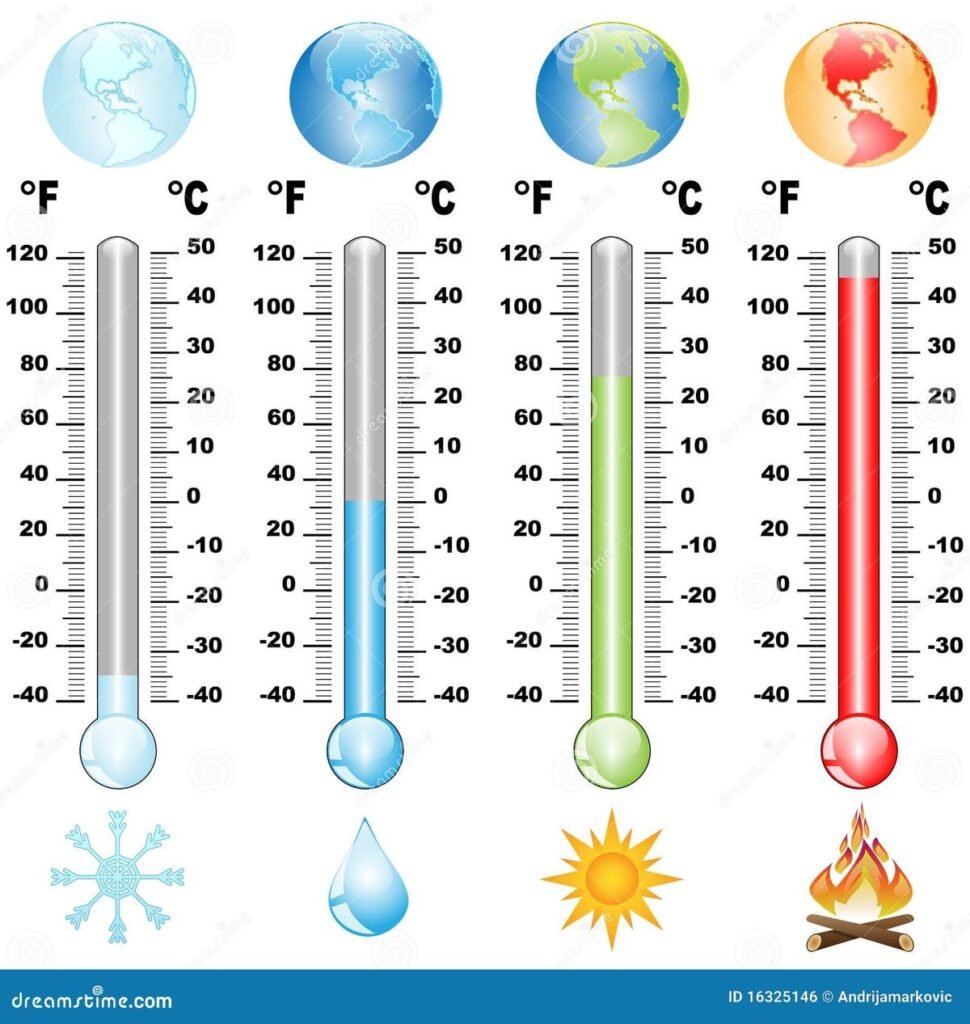
-40 degrees is the one magical temperature that represents the same number in Celsius and Fahrenheit.
At -40°C = -40°F, the scales converge. It is a useful sanity check when making conversions. If you get a converted temperature here that’s way out of line, keeping this intersection point in mind will allow you to recognize mistakes and correct them.
This is because the formulas are a linear combination intersecting at this point. It isn’t just a fluke — it’s baked in to the mathematical relationship between the two scales.
Tip #5: Know When To Use Scales
Picking the correct temperature scale for where you are at will save a lot of confusion and mistakes.
Use Celsius When:
- Following international recipes
- Reading the forecast in weather maps outside the United States
- Performing scientific experiments only that happening at classroom stage
- Ever compare temperatures with someone across Europe, Asia, Africa or South America
Use Fahrenheit When:
- Cooking with American recipes
- Talking about the weather in the United States
- Setting thermostats in American homes
- Interpreting body temperature from a U.S. medical thermometer
Use Kelvin When:
- Performing chemistry or physics calculations
- Working with gas laws and thermodynamics
- Dealing with extremely low temperatures
- Publishing scientific research papers
Put context into perspective to avoid unnecessary conversion. If you are in Rome, pretend there is no such thing as Fahrenheit. If you’re in Texas, stick with Fahrenheit.
Tip #6: Use Technology, But Don’t Be Co-dependent
Temperature conversion is easy on smartphones and browser tabs, but if you rely on it in order to get by, you weaken yourself.
Smart Tool Usage:
- Take the help of apps for check values on your manual calculation while learning
- You have to do the conversions by hand yourself BEFORE you even try using technology
- Bookmark a couple of reputable conversion websites for in-a-pinch reference
- Put your weather app to Celsius and Fahrenheit display: Try to get used to it
Recommended Approaches:
Temperatures can be changed instantly by the voice assistants like Siri, Google Assistant or Alexa. Just type “Convert 75 Fahrenheit to Celsius” into your favorite browser search box and you’ll immediately get back a number. But get some routine conversions in your head so you’re not helpless without your phone.
For more comprehensive conversion tools and resources, visit our measurement conversion guide to explore various unit conversions beyond temperature.
Tip #7: Develop Visual Conversion Points of Interest
Visual aids help in ensuring that knowledge is not only memorized but also learned.
The Thermometer Comparison Chart
Draw or print a two-scale thermometer, with Celsius on one side and Fahrenheit on the other. Mark significant temperatures such as freezing, room temperature, body temperature, and the boiling points. Tape this chart on a wall next to where you read or work.
Temperature Conversion Table
Prepare a temperature cheat sheet for common temperatures:
| Celsius | Fahrenheit | Common Reference |
|---|---|---|
| -18°C | 0°F | Typical freezer temperature |
| 0°C | 32°F | Water freezes |
| 10°C | 50°F | Cool spring day |
| 20°C | 68°F | Comfortable room |
| 30°C | 86°F | Hot summer day |
| 37°C | 98.6°F | Normal body temp |
| 100°C | 212°F | Water boils |
| 175°C | 350°F | Common baking temp |
Print this sheet out and stick it on your kitchen corkboard/fridge or save it to your phone.
Tip #8: Do Not Commit Common Conversion Errors
Even really experienced people make these mistakes. They help you be accurate.
Error 1: Not “Adding” or “Subtracting” 32
Key in converting between Celsius and Fahrenheit: the 32-degree difference. If you try to remedy this by multiplying the Celsius temperatures by 9/5 and 5/9, respectively without correcting for different zero points, you’ll end up with vastly wrong answers.
Incorrect: 20°C × 9/5 = 36°F (Actually 68°F)
Correct: (20°C × 9/5) + 32 = 68°F
Mistake 2: Confusing Multiplication and Division
The reciprocal of 9/5 is 5/9. Using the incorrect one gives your answer a through-and-through flip.
Note: TO Fahrenheit Use 9/5 (and the number gets bigger). Going TO Celsius is using 5/9 (and not just because the number is smaller because you also subtracted that 32 first).
Error 3: Using Degree Symbols for Kelvin
Kelvin is an absolute scale, so you write “300 K,” not “300°K.” It’s a small thing but as trivialities go it signals that you know what you’re talking about in scientific terms.
Mistake 4: Rounding Too Early
If you’re performing a multi-step calculation, carry extra decimal places until the end. Rounding intermediate steps accumulates errors.
Bad: How many degrees Fahrenheit is 37°C?
- 37 × 2 = 74 (close to 1.8)
- 74 + 32 = 106°F (Wrong! Should be 98.6°F)
Better approach: To be accurate, don’t use 2; instead try 1.8.
Real-World Applications of Temperature Conversion
Knowing these conversions can open up practical situations you’ll face all the time.
International Cooking and Baking
If you’re following a European recipe, they list their oven temperatures in Celsius. American ovens show Fahrenheit. You really don’t want to mess it up — converting improperly can wreck your dish. That’s 356°F (which you’d adjust to something like 350°F on most ovens) for a recipe that calls for 180°C.
Travel and Weather Planning
Converting weather to/from international destinations is not so easy. Oh, and when Paris reads 28°C and you know that’s about 82°F, not actually cold like that number might suggest to Fahrenheit-thinking-only people in the room.
Science Experiments and Lab Work
Converting from Kelvin is something that many chemistry and physics problems entail. This is not strictly true, given the nature of gas law calculations require absolute temperature (Kelvin), so conversion from Celsius is always necessary.
According to the National Institute of Standards and Technology, understanding temperature scales and their proper application is fundamental to scientific accuracy and international standardization.
Medical Situations
Temperatures also differ depending on the type of thermometer or where it’s taken. European thermometers are in Celsius, American ones Fahrenheit. Knowing that 38°C is equal to 100.4°F allows you to recognize a fever, even if your thermometer sets temperatures in one scale only.
Building Long-Term Conversion Confidence
As with any skill, thorough practice and use of temperature conversion makes perfect.
Daily Practice Ideas:
- Convert the daily local weather forecast in scale each morning
- Practice with cooking temperatures in the context of recipes
- Test yourself by asking for total body, room and water temperatures
- Test your conversion speed against friends or classmates
Pattern Recognition:
But once you do it repeatedly, you’ll begin to see patterns. Mid-20s Celsius always feels comfortable. Anything above 30°C is hot. Below 10°C requires a jacket. These intuitive relationships are formed naturally with experience.
Teaching Others:
Teaching how to convert temperatures to another people is a good way to invite you to understand it better. Assist a little brother or sister, teach your parent or make tutorial videos. Teaching exposes your gaps in knowledge and cements what you really know.
Frequently Asked Questions
Why have Americans kept Fahrenheit instead of Celsius?
The truth is that the U.S. just never finished converting to the metric system — a level of commitment most other countries managed somehow to muster in order to join the international trade in goods and ideas enabled by modern science. It’s a familiar standard and it would be transformative to change it, essentially replacing millions of thermometers, updating infrastructure and retraining whole populations. The price and exertion do not justify the trade-off for daily American existence.
Which system of measuring temperature is the most accurate?
All three scales are equally true — they just measure the same thing in different ways. How the thermometer is calibrated is of no less consequence than its scale. But Kelvin is favored in science, since it begins at absolute zero — a figure where there is no longer any energy to extract from an object and negative numbers are irrelevant.
Are temperatures below absolute zero possible?
No, not close. Absolute zero (0 K, -273.15°C, -459.67°F) would be the temperature at which atoms cease all movement. In fact, it’s just the definition of the lowest possible temperature. There is nothing colder, there’s no more motion to take away.
Is there any way to convert Fahrenheit straight to Kelvin?
Plug in this formula — K = (°F – 32) × 5/9 + 273.15. In other words, you first convert Fahrenheit to Celsius, and then add 273.15. There are no simpler direct lines, as the scales’ zeroes and degree widths have changed.
Why does water boil at a lower temperature when in high altitudes?
At high elevations, atmospheric pressure is lower, so water becomes vapor more easily and boils at temperatures below 100°C (212°F). For instance, at the top of Mount Everest, water boils at only about 70°C (158°F). This also influences how long something needs to cook, which is why you sometimes need special recipes for high-altitude cooking.
Can somebody please tell me what is room temperature?
Room temperature is usually considered to be within the 68-72°F (20-22°C) range. But in fact, comfort is relative to humidity, personal preference and climate. There is a “scientific room temperature” defined as 20°C (68°F), or less commonly, 25°C (77°F).
It’s Time For Your Temperature Conversion Adventure To Begin
Temperature conversion isn’t about learning a bunch of complicated rules or hauling around charts to refer to. It’s all the process of practice, referents and real-world application building intuitive insight. The eight tricks we’ve just described provide all the tools you need to juggle Celsius, Fahrenheit and Kelvin in any scenario.
Begin with the basic formulas, but not end there. Apply mental math tricks for rapid estimation! Remember some of the more useful benchmark temperatures that help you to remember where your loaf is at. Make visual aids that your brain understands. Try with practical applications; such as weather forecasts, cooking temperatures, and scientific exercises.
Also, practice those transformations often. The more you do it, the easier it gets. Pretty soon you’ll just know that 0°C is coat weather, 25°C means pleasant — and 35°C is genuinely very warm, without having to engage in any mathematical calculations. You’ll breeze through recipes from different countries, interpret international weather reports and make sense of scientific calculations.
Temperature conversion is a basic skill that you need for international communication, scientific literacy and the everyday living experience. Now that you have these 8 ultimate tips in your pocket, you are ready to conquer temperature measurement conversion and do so with confidence wherever life may lead.