


























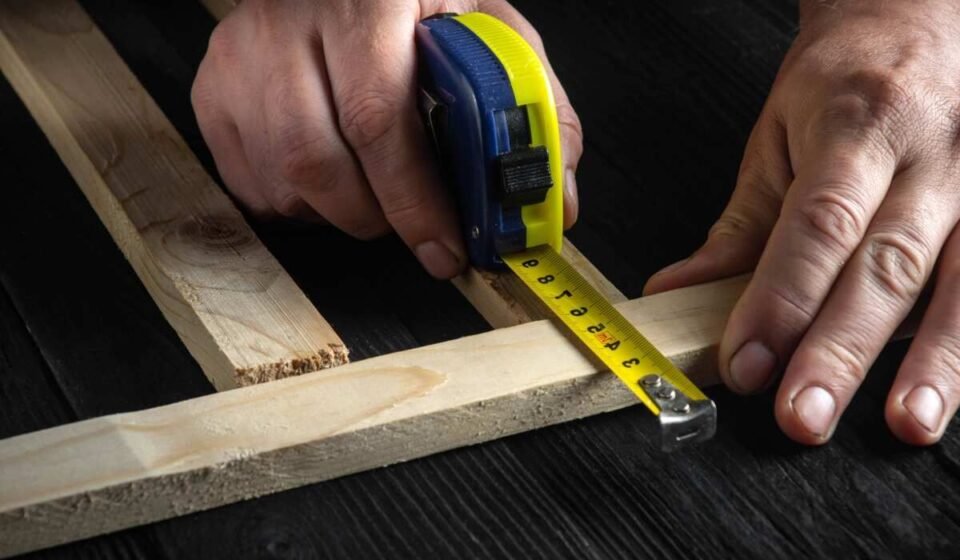

7 Smart Length Measurement Hacks I Wish I Knew Sooner
There’s a strange moment we’ve all had at least once.
You’re standing in a hardware store, staring at a shelf, wondering if that 42-inch shelf board will actually fit into the 39.5-inch gap in your hallway. Or you’re trying to center a painting on a wall and somehow end up with it 3 inches too far left. Or you order curtains online and they either puddle dramatically like a Shakespearean stage prop—or hover awkwardly above the floor like high-water pants.
Measuring length sounds basic. It’s one of the first things we learn in school. But in real life? It’s full of tiny traps, rounding errors, assumptions, warped tapes, uneven floors, and that classic overconfidence: “Eh, it’ll fit.”
Over the years—through DIY projects, furniture mishaps, tailoring experiments, and more than one regretful online purchase—I’ve picked up a handful of length measurement tricks that saved me time, money, and embarrassment.
Here are the seven smart length measurement hacks I genuinely wish I knew sooner.
Hack #1: Measure Twice — But in Two Different Ways
You’ve heard “measure twice, cut once.” That’s fine advice, but here’s the upgrade: measure twice using two different reference points.
Why? Because small positioning errors compound fast.
For example:
- Measuring a doorway from top to bottom can give you one number.
- Measuring from the floor to the top trim can give you another.
- If the floor slopes slightly (and many do), those numbers won’t match.
Instead of repeating the same measurement in the same way, change your angle or method.
Example: Measuring a Wall for a Shelf
| Measurement Method | Result (inches) | Notes |
|---|---|---|
| Left side height | 84.0 | From floor to ceiling |
| Center height | 83.6 | Slight dip in ceiling |
| Right side height | 83.8 | Floor slightly raised |
If you only measured the left side, your tall shelf might scrape or not fit on the right.
Rule of thumb: When measuring vertical or horizontal spaces, check at least three points.
Hack #2: Use the “Credit Card Trick” for Small Gaps
Ever needed to measure a tiny space—like the clearance between furniture and a wall—but your tape measure won’t fit?
Most credit cards are standardized:
- Width: 3.37 inches (85.6 mm)
- Height: 2.125 inches (54 mm)
That means your wallet can double as a measuring tool.
If a gap fits exactly two card widths, that’s roughly 6.74 inches.
Quick Reference Table
| Common Object | Approximate Length |
|---|---|
| Credit card width | 3.37 in (8.56 cm) |
| US dollar bill | 6.14 in (15.6 cm) |
| Standard sheet of paper (short side) | 8.5 in (21.6 cm) |
| Smartphone (average) | 5.8–6.5 in |
You don’t need lab precision for everything. Sometimes you just need “close enough” to decide.
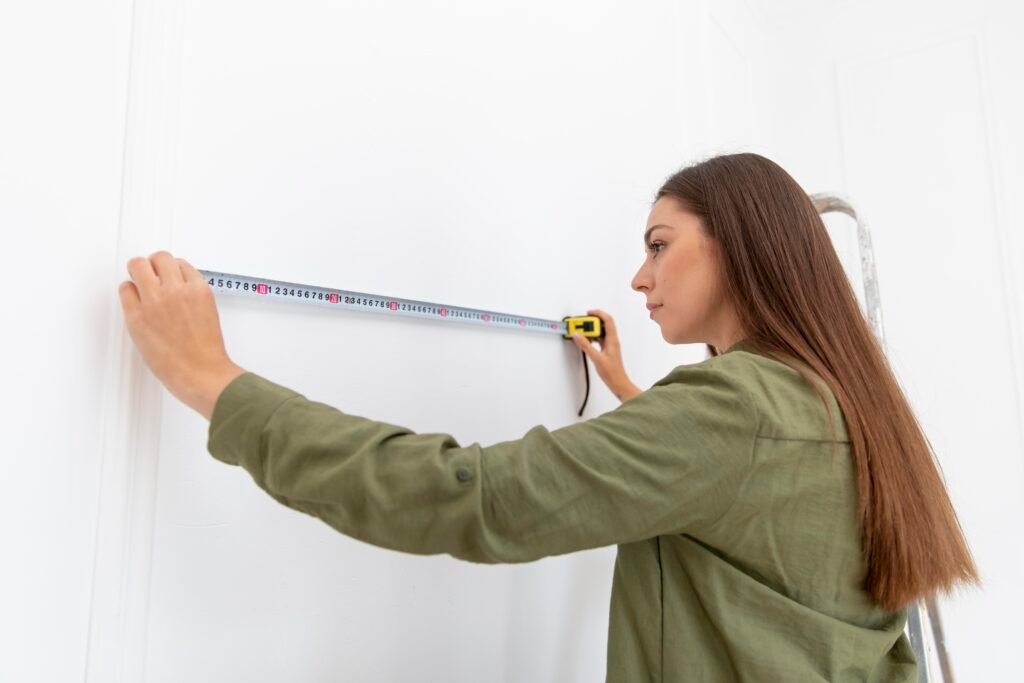
Hack #3: The Diagonal Test for Fit
Here’s one that would have saved me from wrestling a sofa through a doorway.
If an object doesn’t fit straight through an opening, measure diagonally.
For a rectangular opening:
Maximum diagonal = √(height² + width²)
Let’s say your doorway is:
- 80 inches tall
- 30 inches wide
Diagonal = √(80² + 30²)
= √(6400 + 900)
= √7300
≈ 85.4 inches
That means an 84-inch object might fit through diagonally—even if it’s too long vertically.
Doorway Diagonal Chart
| Height (in) | Width (in) | Max Diagonal (in) |
|---|---|---|
| 80 | 30 | 85.4 |
| 78 | 32 | 84.4 |
| 84 | 36 | 91.4 |
This trick is pure geometry—and pure sanity.
Hack #4: Mark the Tape, Don’t Trust Memory
You measure 47 and 5/8 inches.
You turn around.
Was it 47 3/8? Or 48 5/8? Or… something with a 5?
Memory is unreliable under pressure.
Instead:
- Use painter’s tape to mark the exact length.
- Or physically bend the tape at the measured point.
- Or snap a photo with the tape still in place.
It sounds obvious, but the number of miscuts that happen because someone “remembers roughly” is astonishing.
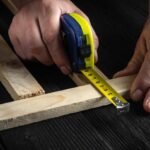
Hack #5: Always Check the Hook on Your Tape Measure
The little metal hook at the end of a tape measure is supposed to move slightly.
That movement compensates for:
- Inside measurements (pushing against a wall)
- Outside measurements (hooking onto an edge)
But here’s the problem: over time, it loosens or bends.
If the hook shifts too much, your measurements can be off by 1/16 to 1/8 inch every time.
That doesn’t sound like much—until you’re assembling cabinets or cutting trim.
Quick Accuracy Test
- Measure 10 inches using the hook.
- Measure the same 10 inches starting at the 1-inch mark.
- Compare results.
If there’s a noticeable difference, your tape might need replacing.
Hack #6: Use Body-Based Estimations (But Calibrate First)
Your body can be a surprisingly consistent measuring tool.
Examples:
- Forearm (elbow to wrist): ~10–12 inches (varies by person)
- Arm span ≈ your height
- Stride length: often 2.2–2.5 feet
But here’s the key: calibrate once.
Measure your own:
- Arm span
- Forearm length
- Stride length
Write it down.
Personal Calibration Template
| Body Reference | Your Measurement |
|---|---|
| Arm span | ________ |
| Forearm | ________ |
| Hand width | ________ |
| Normal stride | ________ |
Now when you’re estimating a room size or outdoor space, you’re not guessing—you’re approximating with data.
Hack #7: Account for Expansion, Contraction, and Real-World Imperfection
Materials move.
Wood expands with humidity. Metal contracts in cold. Fabric stretches.
If you measure something perfectly tight in summer, it may shrink in winter.
Expansion Overview
| Material | Movement Risk | What to Do |
|---|---|---|
| Solid wood | High | Leave expansion gaps |
| Laminate flooring | Moderate | Follow manufacturer spacing |
| Steel | Low | Usually negligible indoors |
| Fabric | Moderate | Add seam allowance |
Ignoring material behavior is one of the most common length-related mistakes in home projects.
Perfection in measurement doesn’t matter if the material won’t stay the same size.
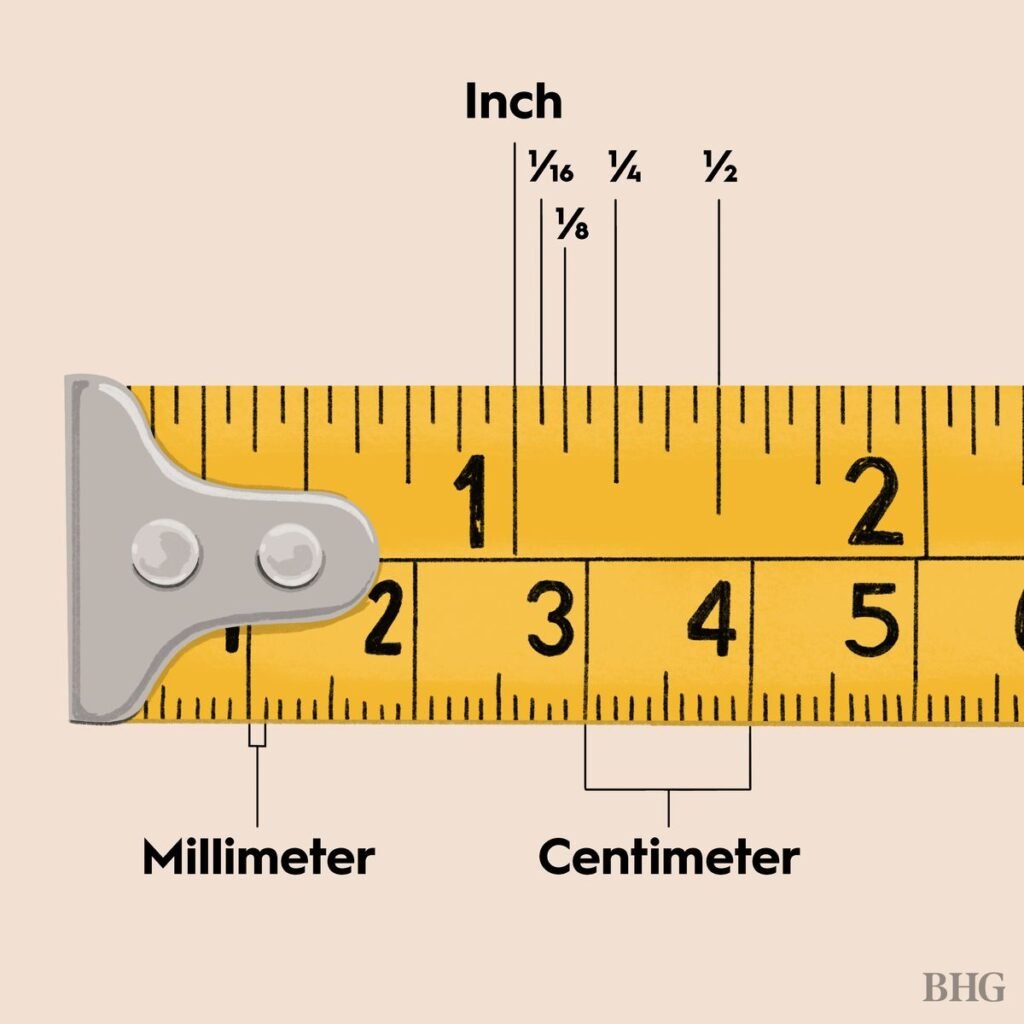
Visual Length Conversion Chart
Below is a simplified conversion reference many people end up Googling mid-project.
| Inches | Feet | Centimeters |
|---|---|---|
| 12 | 1 | 30.48 |
| 24 | 2 | 60.96 |
| 36 | 3 | 91.44 |
| 48 | 4 | 121.92 |
| 60 | 5 | 152.4 |
| 72 | 6 | 182.88 |
Printing something like this and keeping it in your workshop can save surprising amounts of time.
Common Measurement Mistakes (And Their Real Cost)
| Mistake | Consequence |
|---|---|
| Rounding too early | Cumulative error |
| Measuring from baseboard instead of wall | Crooked installations |
| Ignoring floor slope | Uneven cabinets |
| Not accounting for trim thickness | Doors that won’t close |
| Forgetting tool error | Repeat cuts |
The cost isn’t just money—it’s frustration, lost time, and redo work.
A Simple 5-Step “Safe Measurement” Checklist
Before cutting, ordering, or installing anything:
- Measure in at least two spots.
- Check your tool accuracy.
- Confirm unit (inches vs centimeters).
- Account for material behavior.
- Write it down immediately.
It takes two extra minutes. It saves hours.
Frequently Asked Questions
1. How accurate does a measurement really need to be?
It depends on the project. Framing work can tolerate small variations, but cabinetry and trim often require precision within 1/16 inch. The more visible or fitted the object, the more precise you need to be.
2. Why does my tape measure hook move?
It’s designed to move. The sliding compensates for the hook’s thickness when measuring inside versus outside edges. However, excessive looseness can cause inaccuracies.
3. Is it better to measure in inches or centimeters?
Use whichever unit your tools and materials are designed for. Switching units mid-project increases conversion errors. Consistency matters more than preference.
4. Can I rely on phone measuring apps?
They’re convenient but not always precise. For rough estimates, they’re fine. For cutting materials or ordering expensive items, use a physical measuring tool.
5. What’s the most common measurement mistake?
Rushing. Most errors happen not because someone doesn’t know how to measure—but because they assume they won’t make a mistake.
6. How do professionals avoid measurement errors?
Professionals double-check critical dimensions, mark clearly, use quality tools, and build small safety tolerances into their work. Experience reduces errors—but systems prevent them.
Final Thoughts
Length measurement isn’t glamorous. It’s not exciting. But it’s one of those foundational skills that quietly determines whether your projects succeed or spiral.
The difference between something fitting perfectly and something being “almost right” is usually a fraction of an inch—and a moment of attention.
Once you start measuring with intention instead of assumption, everything changes.