



Why Volume Conversions Matter in Daily Life
Ever tried following a recipe from another country only to get confused by unfamiliar measurements? You’re not alone.
Volume measurements appear everywhere in our lives. From cooking dinner to filling up gas tanks, from science experiments to mixing paint, we constantly work with different volume units.
The challenge? Different countries and industries use different measurement systems. Americans cook with cups and tablespoons. Europeans measure in milliliters and liters. Scientists prefer metric units while traditional bakers stick with imperial measurements.
This guide breaks down 11 essential volume conversion tables that solve these everyday problems. No complicated math required. Just simple, practical charts you can reference anytime.
The Two Main Volume Systems You Need to Know
Before diving into conversion tables, let’s understand the two primary systems.
The Metric System uses liters and milliliters. This decimal-based system makes calculations straightforward because everything multiplies by 10. Most countries worldwide use metric measurements for volume.
The Imperial System includes gallons, quarts, pints, cups, and fluid ounces. Common in the United States, this system has historical roots in British measurements. The relationships between units aren’t as neat as the metric system, which makes conversions trickier.
Some situations also use specialized measurements. Cooking often involves teaspoons and tablespoons. Oil and gas industries work with barrels. Understanding these different systems prevents costly mistakes and confusion.
Table 1: Basic Metric Volume Conversions
The metric system’s beauty lies in its simplicity. Everything scales by factors of 10.
| Unit | Equals | Conversion Factor |
|---|---|---|
| 1 kiloliter (kL) | 1,000 liters | ×1,000 |
| 1 hectoliter (hL) | 100 liters | ×100 |
| 1 decaliter (daL) | 10 liters | ×10 |
| 1 liter (L) | Base unit | ×1 |
| 1 deciliter (dL) | 0.1 liters | ÷10 |
| 1 centiliter (cL) | 0.01 liters | ÷100 |
| 1 milliliter (mL) | 0.001 liters | ÷1,000 |
Quick tip: Moving down the table? Multiply. Moving up? Divide. Want to convert 5 liters to milliliters? Multiply by 1,000 to get 5,000 mL.
Most daily tasks involve liters and milliliters. A soda bottle holds 2 liters. Medicine doses measure in milliliters. Water bottles often display 500 mL or 1 L capacities.
Table 2: Imperial Volume Conversions
Imperial measurements require memorizing specific relationships between units.
| Unit | Equals | In Fluid Ounces |
|---|---|---|
| 1 gallon (gal) | 4 quarts | 128 fl oz |
| 1 quart (qt) | 2 pints | 32 fl oz |
| 1 pint (pt) | 2 cups | 16 fl oz |
| 1 cup (c) | 8 fluid ounces | 8 fl oz |
| 1 fluid ounce (fl oz) | 2 tablespoons | 1 fl oz |
| 1 tablespoon (tbsp) | 3 teaspoons | 0.5 fl oz |
| 1 teaspoon (tsp) | Base small unit | 0.167 fl oz |
The relationships aren’t as clean as metric measurements, but patterns exist. Notice how units typically double: 2 cups make a pint, 2 pints make a quart, 4 quarts make a gallon.
Gas stations sell fuel by the gallon. Milk comes in gallons, half-gallons, quarts, and pints. Recipes call for cups and tablespoons.
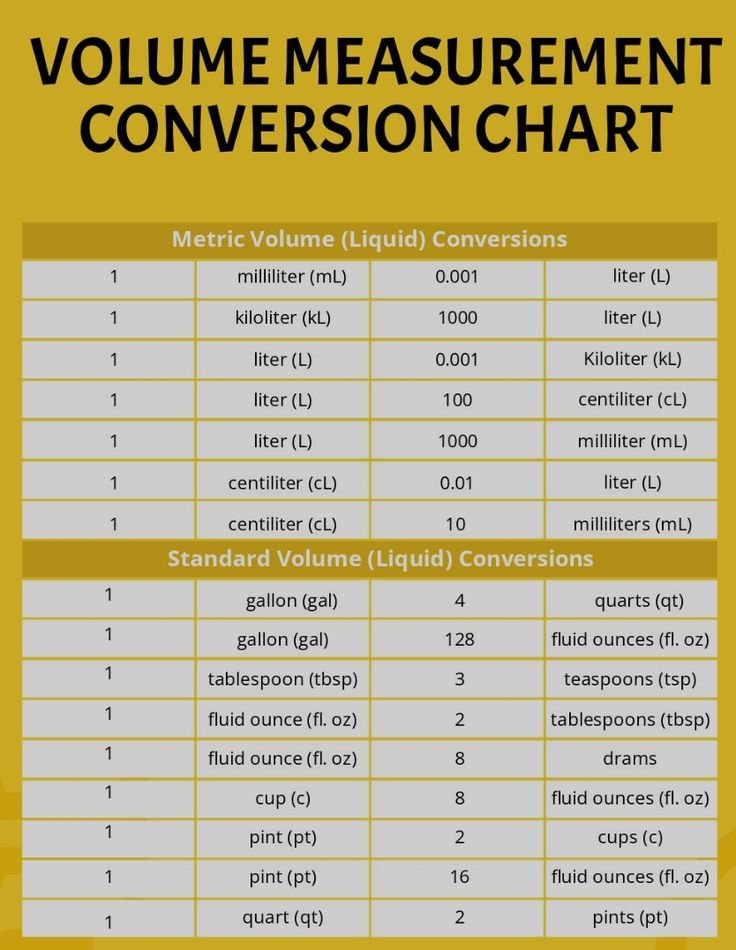
Table 3: Metric to Imperial Conversions
This table bridges the two systems for international recipes and projects.
| Metric | Imperial Equivalent | Rounded Value |
|---|---|---|
| 1 liter | 1.057 quarts | ~1 quart |
| 1 liter | 0.264 gallons | ~1/4 gallon |
| 1 liter | 33.814 fluid ounces | ~34 fl oz |
| 500 mL | 2.113 cups | ~2 cups |
| 250 mL | 1.057 cups | ~1 cup |
| 100 mL | 3.381 fluid ounces | ~3.4 fl oz |
| 30 mL | 1.014 fluid ounces | ~1 fl oz |
| 15 mL | 1 tablespoon | 1 tbsp |
| 5 mL | 1 teaspoon | 1 tsp |
Real-world application: European recipes listing 250 mL milk? That’s roughly 1 cup. Australian recipe calling for 500 mL water? Use 2 cups.
The rounded values work fine for most cooking. Scientific work requires precise decimals, but kitchen measurements tolerate small variations.
Table 4: Cooking Measurement Quick Reference
Cooks need fast conversions without pulling out calculators.
| Measurement | Equals | Also Equals |
|---|---|---|
| 1 cup | 16 tablespoons | 48 teaspoons |
| 3/4 cup | 12 tablespoons | 36 teaspoons |
| 2/3 cup | 10 tbsp + 2 tsp | ~11 tablespoons |
| 1/2 cup | 8 tablespoons | 24 teaspoons |
| 1/3 cup | 5 tbsp + 1 tsp | ~5.3 tablespoons |
| 1/4 cup | 4 tablespoons | 12 teaspoons |
| 1/8 cup | 2 tablespoons | 6 teaspoons |
These conversions save time when you can’t find the right measuring cup. Missing a 1/3 cup measure? Use 5 tablespoons plus 1 teaspoon instead.
Baking demands accuracy because chemical reactions depend on precise ratios. Cooking allows more flexibility. A little extra garlic never hurt anyone, but extra baking powder can ruin a cake.
Table 5: Fluid Ounces to Milliliters
Americans measuring medicine or baby formula need this conversion daily.
| Fluid Ounces | Milliliters | Common Use |
|---|---|---|
| 1 fl oz | 29.574 mL | Medicine dosage |
| 2 fl oz | 59.147 mL | Shot glass |
| 4 fl oz | 118.294 mL | Baby bottle serving |
| 6 fl oz | 177.441 mL | Small juice |
| 8 fl oz | 236.588 mL | 1 cup water |
| 12 fl oz | 354.882 mL | Soda can |
| 16 fl oz | 473.176 mL | 1 pint |
| 32 fl oz | 946.353 mL | Sports drink |
| 64 fl oz | 1,892.706 mL | Half gallon |
Medical professionals often round 30 mL to 1 fluid ounce for practical purposes. This approximation works well for most non-critical applications.
Baby formula instructions frequently switch between ounces and milliliters. Keep this chart handy for midnight feedings when your brain isn’t working at full capacity.
Table 6: Liters to Gallons Conversion
Fuel efficiency, water storage, and large-scale cooking need gallon-liter conversions.
| Liters | Gallons | Practical Example |
|---|---|---|
| 1 L | 0.264 gal | Large water bottle |
| 5 L | 1.321 gal | Small gas can |
| 10 L | 2.642 gal | Aquarium size |
| 20 L | 5.283 gal | Water cooler jug |
| 50 L | 13.209 gal | Fish tank |
| 100 L | 26.417 gal | Small bathtub |
| 200 L | 52.834 gal | Large water heater |
Car fuel tanks typically hold 40-80 liters (10-20 gallons). When traveling internationally, you’ll see fuel economy measured in liters per 100 kilometers instead of miles per gallon.
Swimming pools measure in thousands of gallons or tens of thousands of liters. A small above-ground pool might hold 10,000 gallons or roughly 38,000 liters.
Table 7: Teaspoons and Tablespoons Made Simple
Small measurements cause big confusion in kitchens everywhere.
| Amount | Teaspoons | Tablespoons | Milliliters |
|---|---|---|---|
| Dash | 1/16 tsp | – | 0.3 mL |
| Pinch | 1/8 tsp | – | 0.6 mL |
| 1 tsp | 1 tsp | 1/3 tbsp | 5 mL |
| 1/2 tbsp | 1.5 tsp | 0.5 tbsp | 7.5 mL |
| 1 tbsp | 3 tsp | 1 tbsp | 15 mL |
| 1/8 cup | 6 tsp | 2 tbsp | 30 mL |
| 1/4 cup | 12 tsp | 4 tbsp | 60 mL |
Recipe says “a pinch of salt”? That’s about 1/8 teaspoon. “A dash of pepper”? Even less, around 1/16 teaspoon.
International recipes often use grams for dry ingredients and milliliters for liquids. Converting teaspoons to milliliters helps when following European or Asian recipes. For more comprehensive measurement conversion resources, visit the Measurement Conversion Guide for additional tools and calculators.
Table 8: Commercial and Industrial Volume Units
Certain industries use specialized volume measurements.
| Unit | Equals | Common Industry |
|---|---|---|
| 1 barrel (oil) | 42 gallons | Petroleum |
| 1 barrel (oil) | 159 liters | Petroleum |
| 1 hogshead | 63 gallons | Wine/beer |
| 1 cubic meter | 1,000 liters | Construction |
| 1 cubic foot | 7.481 gallons | Plumbing |
| 1 cubic foot | 28.317 liters | HVAC |
Oil prices quote in dollars per barrel. Understanding that one barrel equals 42 gallons helps calculate per-gallon costs.
Construction projects specify concrete in cubic yards. Plumbers calculate water flow in gallons per minute. Each trade has preferred measurements that professionals learn through experience.
Table 9: Quick Kitchen Substitutions
Don’t have the right measuring tool? These substitutions save trips to the store.
| If Recipe Calls For | You Can Use | Notes |
|---|---|---|
| 1 cup | 2 coffee mugs (half full) | Approximate |
| 1 tablespoon | 3 teaspoons | Exact |
| 1/4 cup | 4 tablespoons | Exact |
| 1 fluid ounce | 2 tablespoons | Exact |
| 1 liter | 4 cups + 3 tbsp | Close enough |
| 250 mL | 1 cup + 1 tbsp | Very close |
Standard coffee mugs hold about 8 ounces when filled completely, but most people fill them halfway, making them roughly 1/2 cup measures.
These approximations work for most cooking. Baking requires more precision because slight variations affect texture and rise.
Table 10: International Cooking Conversions
Different countries have slightly different cup and spoon measurements.
| Country | Cup Size | Tablespoon | Notes |
|---|---|---|---|
| United States | 240 mL | 15 mL | Standard |
| United Kingdom | 250 mL | 15 mL | Metric cup |
| Australia | 250 mL | 20 mL | Larger spoon |
| Canada | 250 mL | 15 mL | Metric standard |
| Japan | 200 mL | 15 mL | Smaller cup |
Australian tablespoons hold more than American ones. When following Australian recipes, use slightly less if you have American measuring spoons.
Japanese rice cooker cups measure 180 mL, not 240 mL like American cups. This difference matters when making rice perfectly.
Table 11: Temperature and Volume Together
Some substances change volume with temperature. Water behaves differently at various temperatures.
| Temperature | 1 Cup Water Weighs | Volume Behavior |
|---|---|---|
| 32°F (0°C) | 236.5 g | Ice expands |
| 70°F (21°C) | 236.6 g | Standard measure |
| 212°F (100°C) | 235.9 g | Steam rises |
Cold water is slightly denser than hot water. This rarely matters in cooking but becomes important in scientific calculations.
Ice takes up about 9% more space than liquid water. That’s why ice cubes float and why frozen water bottles bulge.
Smart Tips for Accurate Volume Measurements
Getting measurements right improves results dramatically.
Level off dry ingredients using a straight edge. Scooping flour directly creates packed measurements that use too much. Spoon flour into cups instead, then level.
Read liquid measurements at eye level. Looking down into a measuring cup creates optical illusions. The meniscus (curved surface) of liquids should align with the measurement line.
Use the right tools for the job. Liquid measuring cups have pour spouts. Dry measuring cups let you level off ingredients. They’re designed differently for good reasons.
Temperature affects volume. Measure cold ingredients cold and hot ingredients hot unless recipes specify otherwise. Room temperature measurements work for most cooking.
Digital scales eliminate guesswork. Weight measurements (grams, ounces) are more accurate than volume measurements, especially for baking.
Common Conversion Mistakes to Avoid
Even experienced cooks make these errors.
Confusing fluid ounces with weight ounces. Fluid ounces measure volume. Regular ounces measure weight. Eight fluid ounces of water weighs approximately eight ounces, but this doesn’t work for all substances.
Packing brown sugar when recipes don’t call for it. Some recipes specify “packed” brown sugar. Others want it loose. Follow instructions carefully.
Using metric cups for American recipes. The 10 mL difference between American cups (240 mL) and metric cups (250 mL) adds up in large recipes.
Forgetting liquid versus dry measurements. A cup of flour measured in a liquid measuring cup differs from a cup measured in a dry measuring cup.
Estimating instead of measuring critical ingredients. Baking soda, baking powder, and salt amounts matter significantly. Always measure these precisely.
Practical Applications Beyond the Kitchen
Volume conversions matter in many situations.
Car maintenance requires understanding oil capacities in quarts or liters. Adding too much or too little oil damages engines.
Aquarium keeping demands precise water volume calculations for proper fish stocking and chemical treatments. An inch of fish per gallon is a common rule.
Gardening and farming use gallons to calculate fertilizer and pesticide applications. Too much fertilizer burns plants. Too little wastes money.
Medical dosing relies on accurate milliliter measurements. Giving incorrect medicine amounts to children can be dangerous.
Home improvement projects need volume calculations for paint, stain, and sealant coverage. Buying too little means extra trips to the store.
Frequently Asked Questions
How many milliliters are in a standard coffee cup?
A standard American coffee cup holds about 240 mL (8 fluid ounces). However, actual coffee mugs vary widely from 200-400 mL depending on size and style.
Why do recipes use volume instead of weight measurements?
American cooking traditions relied on volume measurements before kitchen scales became common. Volume measurements are faster and don’t require special equipment. Professional bakers prefer weight measurements for accuracy.
Can I use a kitchen scale instead of measuring cups?
Yes, and it’s often more accurate. One cup of all-purpose flour weighs approximately 120-125 grams. Water is simple: 1 mL equals 1 gram. Different ingredients have different densities, so you’ll need conversion charts.
Do metric and imperial tablespoons differ?
Most countries use 15 mL tablespoons, including the US and UK. Australia uses 20 mL tablespoons, which affects recipe results. Always check which standard a recipe follows.
What’s the easiest way to convert between systems?
Keep conversion tables handy in your kitchen or use smartphone apps. Many modern measuring cups display both metric and imperial measurements, eliminating conversion needs. The National Institute of Standards and Technology (NIST) provides official conversion standards for precise measurements.
How precise do measurements need to be for cooking?
Cooking allows flexibility. Being off by 10-15% rarely matters for soups, stews, or stir-fries. Baking demands precision within 5% because chemical reactions depend on exact proportions.
Wrapping Up Your Volume Conversion Journey
Mastering volume conversions opens up cooking possibilities and practical skills.
These 11 tables cover the most common conversions you’ll encounter. Print them out. Keep them in your kitchen. Bookmark this page on your phone.
Start with the conversions you use most. Cooks might memorize cooking measurements first. Science students focus on metric conversions. Car enthusiasts learn fuel volume conversions.
With practice, common conversions become automatic. You’ll instinctively know that 500 mL equals about 2 cups. You’ll quickly estimate gallon-to-liter conversions.
The key is having reliable references when you need them. These tables provide that foundation. Whether you’re following a French recipe, calculating aquarium volume, or converting gas mileage, you now have the tools.
Volume measurement conversions aren’t complicated. They just require the right information at the right time. These simple tables deliver exactly that.