


















Why Temperature Conversions Really Matter More Than You’d Expect
You’re looking online for a recipe by a British food blogger. The instructions say to bake at 180°C. Your oven displays only Fahrenheit. Now what?
Or perhaps you’re following the forecast while planning a trip to Europe. You see temperatures of 25°C where you still don’t know if you need a coat or shorts.
Temperature conversions pop up everywhere. You need to know temperature in cooking, when traveling, in science class, while watching the weather and even when reading your car’s dashboard.
Most people freak out when they see unfamiliar temperature units. The formulas look complicated. The math seems hard. Plus, really, who remembers those conversion equations from school?
This guide changes everything. Here are six serious real-world examples that shed light on temperature conversions you can use. The following examples actually explain how to convert temperatures in scenarios you encounter.
No confusing theory. No boring textbook problems. Only practical things that stick in your brain and work when you need them.
So let’s get into these life-changing temperature conversion examples.
The Temperature Scales You Need to Know
Before discussing examples, let us just briefly note the three major temperature scales people use worldwide.
Fahrenheit: The American Standard
Fahrenheit (°F) rules in the United States. Americans check the weather, cook food and adjust thermostats in Fahrenheit.
Water freezes at 32°F and boils at 212°F on this scale. Room temperature sits around 68-72°F.
Celsius: The Global Choice
Celsius (°C), also known as Centigrade, is the worldwide standard. Almost every other country besides the United States operates on Celsius.
Water freezes at 0°C and boils at 100°C. This scale is more intuitive because it uses water’s freezing and boiling points as solid round numbers.
Room temperature measures about 20-22°C.
Kelvin: The Scientific Scale
Kelvin (K) usage occurs largely within the scientific communities. It is used by scientists because it starts at absolute zero — the coldest possible temperature.
Water freezes at 273.15 K and boils at 373.15 K. You won’t find Kelvin on weather apps or recipes, but it is a crucial scale for physics and chemistry.
Quick Reference Table
| Event | Fahrenheit | Celsius | Kelvin |
|---|---|---|---|
| Water Freezes | 32°F | 0°C | 273.15 K |
| Room Temperature | 68-72°F | 20-22°C | 293-295 K |
| Human Body Temp | 98.6°F | 37°C | 310.15 K |
| Water Boils | 212°F | 100°C | 373.15 K |
The Essential Conversion Formulas
There are only two simple equations you will need to switch from Fahrenheit to Celsius. Let’s break them down simply.
Fahrenheit to Celsius Formula
°C = (°F – 32) × 5/9
This formula has three steps:
- Subtract 32 from the Fahrenheit number
- Multiply the result by 5
- Divide that answer by 9
Celsius to Fahrenheit Formula
°F = (°C × 9/5) + 32
This one even comes with three easy steps:
- Multiply the Celsius temperature by 9
- Divide that result by 5
- Add 32 to the answer
The Simplified Approach
Some people prefer to simply multiply or divide by 1.8 rather than using the 9/5 fraction.
- Fahrenheit to Celsius: (°F – 32) ÷ 1.8
- Celsius to Fahrenheit: (°C × 1.8) + 32
You get the very same answer with both methods. Use whichever feels more comfortable.
Example 1: Roast Chicken to Perfection
Your grandmother shared her famous roast chicken recipe. It calls for 375°F for 90 minutes. But you’ve recently moved to Canada, and your new oven displays only Celsius.
The Conversion Process
Starting temperature: 375°F
Using the formula: °C = (°F – 32) × 5/9
Step 1: 375 – 32 = 343 Step 2: 343 × 5 = 1,715 Step 3: 1,715 ÷ 9 = 190.56°C
Round to 190°C for practical cooking purposes.
Why This Matters
Oven temperatures also play a major role in cooking outcomes. Set your oven too low, and your chicken stays raw inside. Turn it up too high, and you’ll sear the outside while leaving the inside undercooked.
A difference of 25-50 degrees can destroy a dish. That’s why accurate temperature conversion is important when you’re cooking.
Common Oven Temperature Conversions
| Fahrenheit | Celsius | Common Use |
|---|---|---|
| 325°F | 163°C | Slow roasting |
| 350°F | 177°C | Standard baking |
| 375°F | 190°C | Roasting meat |
| 400°F | 204°C | Fast roasting |
| 425°F | 218°C | Pizza, vegetables |
| 450°F | 232°C | High-heat searing |
Pro Cooking Tip
Most modern ovens have temperature fluctuations of ±10-15 degrees. When converting temperatures for cooking, rounding to the nearest 5 or 10 degrees is just fine.
For the roast chicken, setting your oven anywhere from 190-195°C will give you great results.
Example 2: Planning Your European Travel Wardrobe
You will be going to Paris in April. The weather report is predicting highs of 15°C and lows of 8°C per day, and you need to work out what to pack.
Converting the High Temperature
Starting temperature: 15°C
Using the formula: °F = (°C × 9/5) + 32
Step 1: 15 × 9 = 135 Step 2: 135 ÷ 5 = 27 Step 3: 27 + 32 = 59°F
Converting the Low Temperature
Starting temperature: 8°C
Step 1: 8 × 9 = 72 Step 2: 72 ÷ 5 = 14.4 Step 3: 14.4 + 32 = 46.4°F (round to 46°F)
What These Temperatures Mean
Daily highs of 59°F feel cool but pleasant. You will need a light jacket or sweater during the day.
Nighttime lows of 46°F get chilly. Bring a warmer jacket for evening strolls and dinners.
This definitely isn’t beach weather, but it’s perfect for sightseeing with layers.
Temperature and Clothing Guide
| Temperature Range (°F) | What to Wear |
|---|---|
| Below 32°F | Heavy winter coat, gloves, hat |
| 32-50°F | Warm jacket, layers, scarf |
| 50-65°F | Light jacket or sweater |
| 65-75°F | Long sleeves or t-shirt |
| 75-85°F | Shorts and t-shirt |
| Above 85°F | Light, breathable clothing |
Example 3: Understanding Your Child’s Fever
Your toddler feels warm. You take the temperature with a thermometer that reads in Celsius and registers 38.5°C. The pediatrician’s fever guidelines are all expressed in Fahrenheit. Is this a serious fever?
The Critical Conversion
Starting temperature: 38.5°C
Using the simplified formula: °F = (°C × 1.8) + 32
Step 1: 38.5 × 1.8 = 69.3 Step 2: 69.3 + 32 = 101.3°F
Medical Context
Normal body temperature is 98.6°F (37°C). Your child has a mild fever, with a temperature of 101.3°F.
Most pediatricians recommend:
- Below 100.4°F (38°C): Monitor, but not urgent
- 100.4-102°F (38-39°C): Mild fever, comfort measures
- Above 102°F (39°C): Contact doctor, especially for young children
At 101.3°F, your child has a mild fever. Provide them with plenty of fluids, make sure they are comfortable and watch closely for any changes.
Body Temperature Reference Chart
| Condition | Fahrenheit | Celsius |
|---|---|---|
| Hypothermia | Below 95°F | Below 35°C |
| Low Normal | 96-97°F | 35.5-36°C |
| Normal Range | 97-99°F | 36-37.2°C |
| Low Fever | 99-100.4°F | 37.2-38°C |
| Mild Fever | 100.4-102°F | 38-39°C |
| Moderate Fever | 102-104°F | 39-40°C |
| High Fever | Above 104°F | Above 40°C |
Why Precision Matters in Medicine
Medical temperature conversions require accuracy. One degree can be the difference between “monitor at home” and “go to the emergency room.”
Always use the full conversion formula for health-related temperatures. Don’t round or estimate.
Example 4: Swimming Pool Comfort Levels
You’re in the market to buy a home with a pool. The listing states that the heated pool maintains 28°C. You’re used to Fahrenheit pool temperatures. Is this warm enough for comfortable swimming?
Converting Pool Temperature
Starting temperature: 28°C
Using the formula: °F = (°C × 1.8) + 32
Step 1: 28 × 1.8 = 50.4 Step 2: 50.4 + 32 = 82.4°F
Interpreting the Result
A pool at 82.4°F is pleasantly warm. This temperature generally performs well for recreational swimming and is warm enough to feel comfortable but not too hot.
Most people find pools comfortable between 78-84°F (26-29°C). Your pool at 82.4°F lands right in the sweet spot.
Pool Temperature Preferences
| Pool Type | Fahrenheit Range | Celsius Range |
|---|---|---|
| Competitive Swimming | 77-82°F | 25-28°C |
| Recreational Swimming | 78-84°F | 26-29°C |
| Children’s Play Pool | 84-86°F | 29-30°C |
| Therapy/Hot Tub | 92-104°F | 33-40°C |
Energy Cost Consideration
Every degree you raise pool temperature costs money in heating bills. A pool at 28°C (82°F) uses significantly less energy than one at 30°C (86°F).
Converting temperatures helps you understand both comfort and operating costs when evaluating heated pools. For more comprehensive conversion guides and tools, visit Measurement Conversion Guide Online.
Example 5: Baking Bread at High Altitude
You discovered a great French bread recipe on the internet. It tells you to preheat your oven to 230°C. Your American oven is in Fahrenheit. What temperature should you set?
The Bread Baking Conversion
Starting temperature: 230°C
Using the formula: °F = (°C × 1.8) + 32
Step 1: 230 × 1.8 = 414 Step 2: 414 + 32 = 446°F
Baking Reality Check
446°F is extremely hot for most baking. This high heat gives the loaf that perfect crusty exterior artisan breads require.
Many home bakers are wary of such high temperatures, but professional bread recipes often specify 450-500°F (232-260°C) for the first part of baking.
The Two-Stage Baking Method
French bread recipes frequently include two temperatures:
- High heat (450°F/230°C) for the first 15-20 minutes to create crust
- Lower heat (375-400°F/190-204°C) for the remaining time to bake through
Understanding these conversions ensures you follow the recipe correctly and achieve professional results.
Baking Temperature Guide
| Baked Good | Fahrenheit | Celsius |
|---|---|---|
| Delicate Cakes | 325-350°F | 163-177°C |
| Cookies | 350-375°F | 177-190°C |
| Standard Cakes | 350-375°F | 177-190°C |
| Pies | 375-425°F | 190-218°C |
| Artisan Bread | 425-475°F | 218-246°C |
| Pizza | 450-500°F | 232-260°C |
Example 6: Car Dashboard Temperature Warning
You are driving your European car in the summer. The dashboard temperature warning light comes on, showing the engine at 105°C. How serious is this overheating?
Converting Engine Temperature
Starting temperature: 105°C
Using the formula: °F = (°C × 1.8) + 32
Step 1: 105 × 1.8 = 189 Step 2: 189 + 32 = 221°F
The Severity Assessment
221°F is definitely overheating. Most car engines operate safely between 195-220°F (90-104°C).
At 221°F, your engine is in the danger zone. You should:
- Pull over safely
- Turn off the engine
- Allow it to cool for at least 30 minutes
- Check coolant levels
- Call for help if the problem persists
Normal Operating Temperatures
| Engine Condition | Fahrenheit | Celsius |
|---|---|---|
| Cold Start | 32-70°F | 0-21°C |
| Warming Up | 70-160°F | 21-71°C |
| Normal Operating | 195-220°F | 90-104°C |
| Beginning Overheat | 220-230°F | 104-110°C |
| Dangerous Overheat | Above 230°F | Above 110°C |
Why This Conversion Saves Money
Understanding this temperature conversion could prevent catastrophic engine damage. Continuing to drive with an engine at 105°C (221°F) might cause:
- Warped cylinder heads ($1,500-3,000 repair)
- Blown head gasket ($1,000-2,000 repair)
- Complete engine failure ($4,000-8,000+ replacement)
A simple temperature conversion and quick action could save you thousands of dollars.
Mental Math Shortcuts for Quick Estimates
Sometimes you need a rough conversion without pulling out a calculator. Here are quick estimation tricks.
Celsius to Fahrenheit Quick Method
Double the Celsius temperature and add 30.
Example: 20°C
- 20 × 2 = 40
- 40 + 30 = 70°F
The exact answer is 68°F, so you’re very close!
This shortcut works best between 0-40°C (32-104°F).
Fahrenheit to Celsius Quick Method
Subtract 30 from Fahrenheit, then divide by 2.
Example: 80°F
- 80 – 30 = 50
- 50 ÷ 2 = 25°C
The exact answer is 26.7°C, so you’re in the ballpark!
Key Temperature Benchmarks to Memorize
Remembering these exact conversions helps with mental estimates:
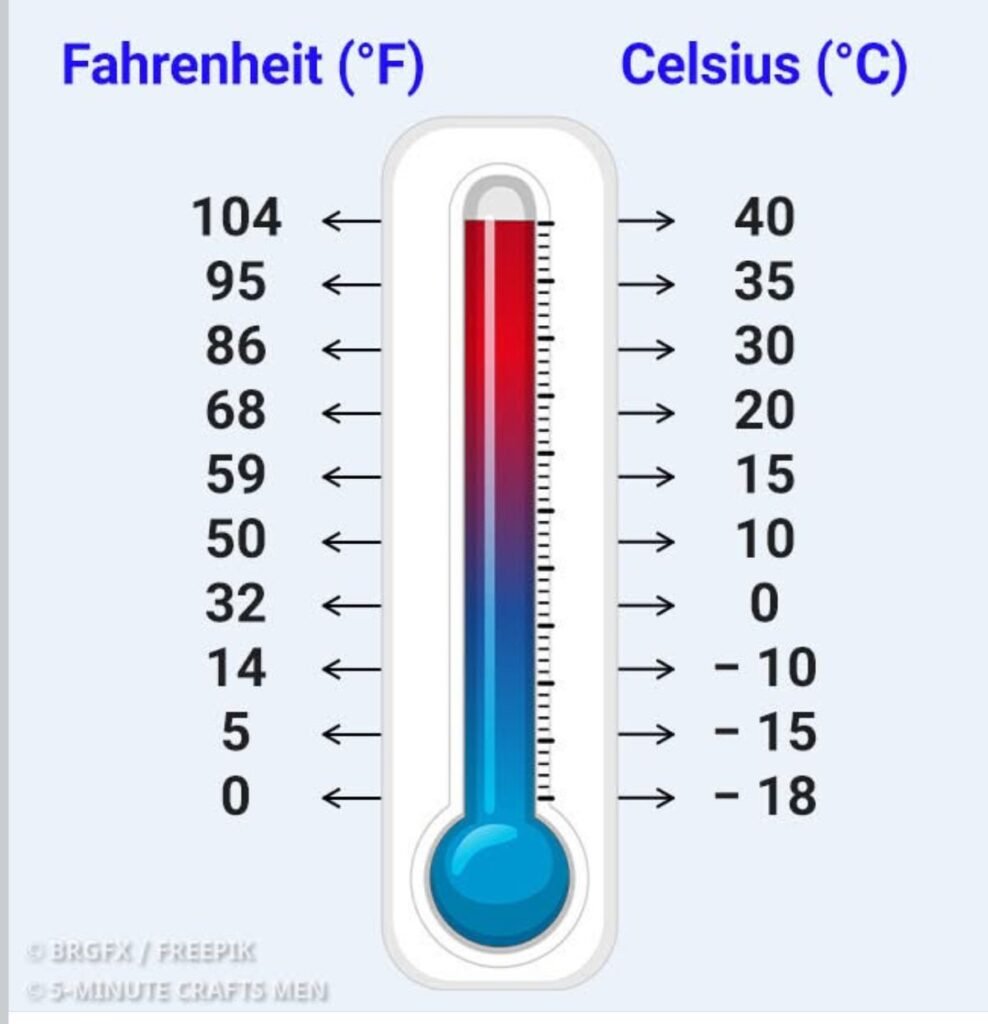
| Celsius | Fahrenheit | Context |
|---|---|---|
| -40°C | -40°F | Same in both scales! |
| 0°C | 32°F | Water freezes |
| 10°C | 50°F | Cool day |
| 20°C | 68°F | Room temperature |
| 30°C | 86°F | Warm day |
| 37°C | 98.6°F | Body temperature |
| 100°C | 212°F | Water boils |
Once you know these benchmarks, you can estimate nearby temperatures easily.
Common Temperature Conversion Mistakes
Even simple conversions trip people up. Avoid these common errors.
Mistake #1: Forgetting to Add or Subtract 32
The 32-degree offset between scales is crucial. Water freezes at 0°C but 32°F, not 0°F.
Wrong: 100°C × 1.8 = 180°F (missing the +32) Correct: 100°C × 1.8 + 32 = 212°F
Mistake #2: Mixing Up the Formulas
Using the Celsius-to-Fahrenheit formula when converting Fahrenheit to Celsius gives wildly wrong answers.
Always check: Are you starting with °F or °C? Use the matching formula.
Mistake #3: Rounding Too Early
Round your final answer, not the intermediate steps.
Wrong process: 75°F – 32 = 43, round to 40, then 40 × 5/9 = 22°C Right process: 75 – 32 = 43, 43 × 5/9 = 23.89, round to 24°C
Mistake #4: Using the Wrong Scale
Some thermometers have dual scales. Make sure you’re reading the correct side before converting.
Check the units! That “38” might be 38°C (100°F – a fever) or 38°F (3°C – quite cold).
Frequently Asked Questions
What’s the easiest way to convert Fahrenheit to Celsius?
The simplest formula is (°F – 32) ÷ 1.8 = °C. For quick mental math, subtract 30 and divide by 2 for a close estimate. For example, 70°F minus 30 equals 40, divided by 2 equals 20°C. The exact answer is 21°C, so this gets you very close.
Why do Fahrenheit and Celsius meet at -40 degrees?
At -40 degrees, both scales show the same number: -40°F = -40°C. This happens because of the mathematical relationship between the scales. It’s the only temperature where they intersect.
Is Celsius more accurate than Fahrenheit?
Neither scale is more “accurate” – they’re just different ways of measuring the same thing. Celsius is simpler for scientific work because water freezes at 0 and boils at 100. Fahrenheit allows finer distinctions without decimals since its degrees are smaller.
Do I need to convert temperatures for cooking?
Yes, oven temperatures must be converted accurately. A recipe calling for 180°C needs 356°F, not a guess. Most modern ovens show both scales, but if yours doesn’t, always convert before cooking.
What temperature conversion do weather forecasters use?
Weather services use whichever scale their country prefers. US forecasters report in Fahrenheit, while most other countries use Celsius. International weather apps often let you switch between scales.
Can I just memorize common temperature conversions?
Memorizing common conversions (like 100°C = 212°F) helps, but you’ll still need the formula for unusual temperatures. Learning both the formula and key benchmarks gives you maximum flexibility.
How do scientists convert between Celsius and Kelvin?
Converting between Celsius and Kelvin is much simpler: K = °C + 273.15. So 0°C equals 273.15 K, and 100°C equals 373.15 K. There’s no multiplication or division involved.
Why does the United States still use Fahrenheit?
Historical tradition and the massive cost of switching keep the US on Fahrenheit. Changing every thermostat, oven, sign, and document would cost billions. Most Americans are comfortable with Fahrenheit and resist change. For more information on temperature standards, you can visit the National Institute of Standards and Technology (NIST).
Mastering Temperature Conversions in Real Life
Temperature conversions aren’t just abstract math problems. They’re practical skills that affect your daily life in concrete ways.
The six examples in this temperature measurement conversion guide show you exactly how these conversions work in real situations. Cooking, traveling, medical care, home buying, baking, and car maintenance all require accurate temperature knowledge.
Practice these conversions with temperatures you encounter every day. Convert the weather forecast each morning. Convert your oven temperature when trying new recipes. Convert your body temperature when you’re feeling sick.
The formulas are simple: (°F – 32) × 5/9 for Fahrenheit to Celsius, and (°C × 9/5) + 32 for Celsius to Fahrenheit.
Within two weeks of regular practice, these conversions will become second nature. You’ll estimate temperatures in your head and know exactly what to expect when you see unfamiliar units.
Start applying these temperature measurement conversion guide examples today. The next time you see a temperature in an unfamiliar scale, you’ll know exactly what to do.
Your conversion confidence starts right now.