

































Why Smart People Get Tripped Up by Temperature Conversions
Even the smartest minds are flummoxed by temperature conversion. So you’re reading a recipe from Europe that tells you to bake at 180 degrees Celsius, and your oven tells you only Fahrenheit. Or perhaps the Tokyo weather forecast is 30°C, and you have no idea if you should bring a jacket.
It sounds easy enough in theory, until you find yourself standing in your kitchen with half-mixed batter or booking a hotel not knowing whether you’re going to freeze or sweat. Common conversion formulas require fractions, multiplication and addition which can be time consuming when you need answers in a hurry.
Nearly everyone reaches for their smartphone and Googles it at least once. That’s fine but it takes too long and makes you reliant on technology to do what your brain is capable of, with some of the right tricks.
This guide shares five smart temperature measurement conversion guide hacks that will get answered more quickly than grabbing your calculator. These methods rely on nothing more advanced than basic mental math, memorable patterns and practical shortcuts culled from cooks, travelers and students around the world.
You will learn tricks that translate temperatures in seconds, remember formulas with ease, and estimate well enough for any real-life situation. No more confusion between Celsius and Fahrenheit — just fast, foolproof conversions whenever you move around the world.
There are five temperature conversion hacks you need to know once and for all.
Trick 1: Double and Add 30 Rule (Celsius to Fahrenheit)
How This Quick Method Works
For example, to convert Celsius to Fahrenheit manually, you would multiply by 1.8 and add 32. That’s a lot of confusing mental math when you’re short on time.
The shortcut: Multiply the temperature in Celsius by two, then add 30.
With this approximation, you’re within a few degrees of the right answer — good enough for cooking, weather planning and everyday conversation.
Step-by-Step Application
Let’s apply this trick to convert 20°C to Fahrenheit:
- Start with 20°C
- Double it: 20 × 2 = 40
- Add 30: 40 + 30 = 70°F
That works out to precisely 68°F, so you’re only 2 degrees off. That will make no difference when it comes to whether you grab a sweater or leave it at home.
When This Trick Shines
Cooking scenarios: A recipe requires a temperature of 180 degrees. Double it (360), then add 30 (390). Preheat your oven to 390°F. The exact conversion is 356°F, but ovens aren’t that precise anyway.
Weather planning: Barcelona predicts there’ll be 25°C. Double it (50), add 30 (80). Expect around 80°F—definitely T-shirt weather.
Room temperature: Your European hotel room thermostat registers at 22°C. Double that (44), add 30 (74). That is about 72°F, an average room temperature.
Quick Reference Table
| Celsius (°C) | Double + 30 | Exact °F | Difference |
|---|---|---|---|
| 0 | 30 | 32 | 2° |
| 10 | 50 | 50 | 0° |
| 20 | 70 | 68 | 2° |
| 25 | 80 | 77 | 3° |
| 30 | 90 | 86 | 4° |
| 35 | 100 | 95 | 5° |
| 40 | 110 | 104 | 6° |
Pro tip: This works well between 0°C and 40°C, so most room-temperature situations will be covered. For extreme temperatures, use the exact formula that follows, or other workarounds below.
Trick 2: Subtract 30 and Divide in Half Technique (Fahrenheit to Celsius)
Reversing the Quick Conversion
When you need to convert from Fahrenheit to Celsius, this trick does the opposite.
The shortcut: Subtract 30 from the Fahrenheit temperature and divide by 2.
And again, you achieve closeness for practical purposes without the hassle of dealing in the exact formulation.
Real-World Example
Converting 80°F to Celsius:
- Start with 80°F
- Subtract 30: 80 – 30 = 50
- Divide by 2: 50 ÷ 2 = 25°C
The real value is 26.7°C, so you’re within 2 degrees — good enough for most practical purposes.
Practical Applications
Setting thermostats: Your Airbnb instructions say 72°F. Subtract 30 (42), divide by 2 (21). Put the metric thermostat at 21°C.
Medical context: You’re worried because you have a 100°F fever. Then just subtract 30 (70) and divide by two (35). That’s 35°C, indicating that we are above the normal 37°C body temperature threshold.
Swimming Pools: The hotel swimming pool is 78°F. Subtract 30 (48), divide by 2 (24). You can anticipate the water temperature will be around 24°C.
Fahrenheit to Celsius Quick Guide
| Fahrenheit (°F) | Subtract 30 ÷ 2 | Exact °C | Difference |
|---|---|---|---|
| 32 | 1 | 0 | 1° |
| 50 | 10 | 10 | 0° |
| 68 | 19 | 20 | 1° |
| 77 | 23.5 | 25 | 1.5° |
| 86 | 28 | 30 | 2° |
| 95 | 32.5 | 35 | 2.5° |
| 104 | 37 | 40 | 3° |
Keep in mind: These first two moves are opposites. Learn them both, and you can convert in either direction without having to remember complicated formulas.
Trick 3: Know the Important Temperature Benchmarks
Building Your Mental Reference Points
Instead of working out all of these conversions individually, learn some common temperature benchmarks. Your brain naturally interpolates between known points more quickly than doing math.
Essential Temperature Anchors
Freezing and boiling water:
- 0°C = 32°F (water freezes)
- 100°C = 212°F (water boils)
Comfortable living temperatures:
- 20°C = 68°F (room temperature)
- 25°C = 77°F (warm room)
- 30°C = 86°F (hot day)
Body and cooking temperatures:
- 37°C = 98.6°F (normal body temperature)
- 180°C = 356°F (moderate oven)
- 200°C = 392°F (hot oven)
Extreme weather:
- -18°C = 0°F (very cold)
- 38°C = 100°F (very hot)
Using Benchmarks for Quick Estimates
When you get to a new temperature, find the closest benchmark and convert mentally.
Example 1: The temperature reads as 28°C and you know that 25°C is 77°F and 30°C is 86°F. Since 28°C sits between them, estimate around 82°F.
Example 2: A recipe calls for 190°C. You know 180°C is 356°F and 200°C is 392°F. Split the difference and around about 375°F will be spot on.
Example 3: Your child is sporting a temperature of 39°C. You know that normal body temperature (37°C) is 98.6°F. Just 2 degrees higher means around 102°F — definitely a fever requiring attention.
Common Temperature Benchmark Chart
| Celsius (°C) | Fahrenheit (°F) | What It Means |
|---|---|---|
| -40 | -40 | Extremely cold (same in both!) |
| -18 | 0 | Very cold winter |
| 0 | 32 | Water freezes |
| 10 | 50 | Cool spring day |
| 20 | 68 | Room temperature |
| 25 | 77 | Comfortable warm |
| 30 | 86 | Hot summer day |
| 37 | 98.6 | Normal body temp |
| 100 | 212 | Water boils |
| 180 | 356 | Moderate oven |
| 200 | 392 | Hot oven |
Memory aid: Make a story that connects these numbers. “I freeze at 32, I feel fine at 68, and boil at 212” helps American students remember key Fahrenheit points.
Trick 4: The Fraction Shortcut for Exact Conversions
When Precision Actually Matters
Sometimes approximations won’t cut it. In scientific experiments, precise baking recipes or medical situations exact conversions are necessary.
The actual formulas may look complicated, but when converting the terms into elementary fractions they can be applied.
The Exact Formulas Simplified
Celsius to Fahrenheit: °F = (°C × 9/5) + 32
Simplified approach:
- Multiply Celsius by 9
- Divide that result by 5
- Add 32
Fahrenheit to Celsius: °C = (°F – 32) × 5/9
Simplified approach:
- Subtract 32 from Fahrenheit
- Multiply that result by 5
- Divide by 9
Working Through Examples
Converting 75°C to Fahrenheit exactly:
- Multiply: 75 × 9 = 675
- Divide: 675 ÷ 5 = 135
- Add: 135 + 32 = 167°F
Converting 95°F to Celsius exactly:
- Subtract: 95 – 32 = 63
- Multiply: 63 × 5 = 315
- Divide: 315 ÷ 9 = 35°C
Mental Math Simplification
Multiplication by 9/5 is the same as multiplying by 2 minus 10%.
Example with 50°C:
- Fast way: 50 × 2 = 100, minus 10% (10) = 90, plus 32 = 122°F
- Exact formula: (50 × 9/5) + 32 = 122°F
Both get to the answer, but the percentage approach makes more sense in your head.
Precision Conversion Reference
| Celsius | Exact Fahrenheit | Celsius | Exact Fahrenheit |
|---|---|---|---|
| 5 | 41 | 45 | 113 |
| 10 | 50 | 50 | 122 |
| 15 | 59 | 55 | 131 |
| 20 | 68 | 60 | 140 |
| 25 | 77 | 65 | 149 |
| 30 | 86 | 70 | 158 |
| 35 | 95 | 75 | 167 |
| 40 | 104 | 80 | 176 |
When to employ this trick: Laboratory work, professional baking, medical dosing or anytime someone specifically requests the precise conversion.
Trick 5: The Pattern Recognition Strategy
Discovering the Secret Patterns in Temperature Scales
Both temperature scales have predictable patterns so it’s easier to convert once you know them.
The 10-Degree Pattern
Each 10°C increase is approximately equivalent to an 18°F increase.
Starting from 0°C = 32°F:
- 10°C = 50°F (increase of 18)
- 20°C = 68°F (increase of 18)
- 30°C = 86°F (increase of 18)
- 40°C = 104°F (increase of 18)
This pattern allows you to estimate any temperature by starting at a known point and counting by 18s.
Example: What’s 35°C in Fahrenheit?
- Start at 30°C = 86°F
- Every 10°C equals 18°F, so 5°C equals 9°F
- 86 + 9 = 95°F
The 5-Degree Celsius Pattern
Now, 10°C is the same as 18°F, so half (5°C) is equivalent to 9°F.
This is a smaller increment, which means you have better control:
- 0°C = 32°F
- 5°C = 41°F (add 9)
- 10°C = 50°F (add 9)
- 15°C = 59°F (add 9)
- 20°C = 68°F (add 9)
The Intersection Point
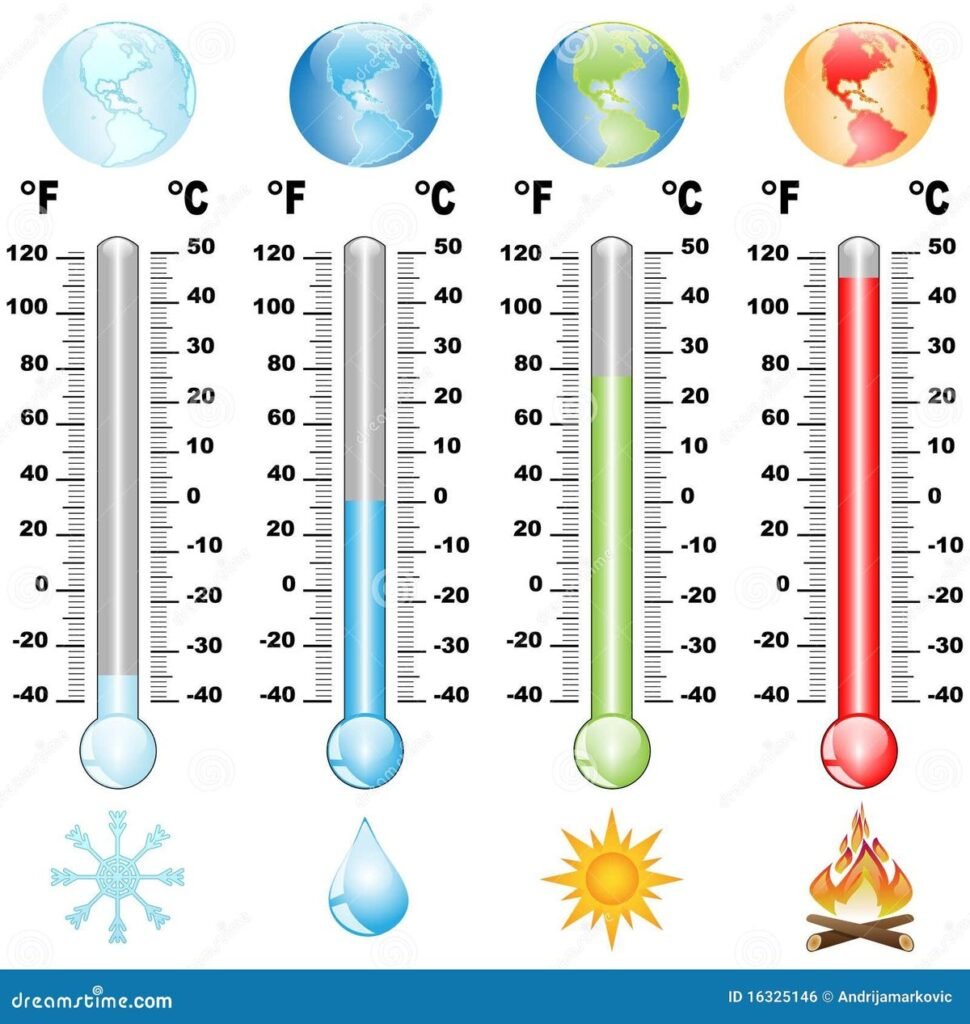
The two scales coincide at -40 degrees.
-40°C = -40°F
This special point can be used as an excellent reference for extreme cold calculations. It’s also a cool piece of trivia to bring up at parties.
Pattern-Based Conversion Chart
| Pattern Step | Celsius Change | Fahrenheit Change |
|---|---|---|
| Large jump | +10°C | +18°F |
| Medium jump | +5°C | +9°F |
| Small jump | +1°C | +1.8°F |
| Tiny adjustment | +0.5°C | +0.9°F |
Practice exercise: Try converting 23°C using patterns.
- Start at 20°C = 68°F
- Add 5°C (equal to 9°F): 68 + 9 = 77°F
- Subtract 2°C (which roughly converts to 3.6°F): 77 – 4 = 73°F
- Exact answer: 73.4°F
Half a degree off with only simple pattern addition!
Selecting the Appropriate Trick for Various Circumstances
Quick Decision Guide
Need speed over accuracy? Use Trick 1 or 2 (double/add, or subtract/halve)
Want reasonable precision? Use Trick 3 (benchmark temperatures)
Require exact numbers? Use Trick 4 (fraction formulas)
Doing multiple conversions? Use Trick 5 (pattern recognition)
Combining Tricks for Maximum Power
The true masters combine two or more tricks.
Example: Converting 165°F to Celsius when cooking
Trick combination:
- Use Trick 3: 165°F is between 150°F (65°C) and 180°F (82°C)
- Apply Trick 2 for fast math: (165 – 30) ÷ 2 = 67.5°C
- Check with Trick 5 pattern: From 150°F (65°C), adding 15°F should be about equal to adding 8°C, giving roughly 73°C
- Average the estimates: (67.5 + 73) ÷ 2 = 70°C (True answer: 73.9°C)
Multiple approaches increase confidence and can catch errors.
Common Pitfalls in Temperature Conversion
Mixing Up the Formulas
The largest mistake is to forget which way you are converting. Always double-check: Am I beginning with Celsius or Fahrenheit?
Wrong: Converting 30°C using the Fahrenheit-to-Celsius formula Right: Converting 30°C using the Celsius-to-Fahrenheit formula
Forgetting to Add or Subtract 32
A lot of people can recall the multiplication by 9/5 or 5/9 but forget the adjustment of adding +32 or subtracting -32.
Wrong: 20°C × 9/5 = 36°F (missing the +32) Right: (20°C × 9/5) + 32 = 68°F
Rounding Too Early
Round only at final step in multi-step conversions to preserve accuracy.
Wrong: 77°F – 32 = 45 (round to 50) × 5 = 250 ÷ 9 = 28°C Right: (77 – 32) × 5 ÷ 9 = 25°C
Assuming Linear Relationships
Temperature scales aren’t directly proportional. Doubling Celsius doesn’t double Fahrenheit.
Faulty reasoning: If 10°C = 50°F, then 20°C must equal 100°F Reality: 20°C equals 68°F because of the +32 offset
Practicing Your Temperature Conversion Skills
Daily Conversion Challenges
Morning routine: Convert your local weather forecast both ways each day.
Cooking practice: Convert all the temperatures in a recipe by hand, then check with a calculator.
Trip preparation: Convert average temperatures in places you’re researching to develop a sense for them.
Making It Stick
Teach it to someone else: When you explain these tricks to a friend or relative, you’ll memorize them even more firmly.
Make flashcards: Put temperatures on one side, conversions on the other. Quiz yourself during downtime.
Use sticky notes: Stick benchmark temperatures around the house, in places like near the oven, thermostat or refrigerator.
Testing Your Skills
Can you do these in your head without a calculator?
- 15°C to Fahrenheit
- 90°F to Celsius
- 37°C to Fahrenheit
- 212°F to Celsius
Answers:
- 59°F (double and add 30 gives you 60°F — close enough!)
- 32°C (subtract 30 ÷ 2 = 30°C, close enough!)
- 98.6°F (memorized benchmark!)
- 100°C (memorized benchmark!)
Frequently Asked Questions
What is the easiest temperature conversion trick to learn first?
Begin with Trick 1 (double and add 30 for Celsius to Fahrenheit). It’s the easiest mental math, and it takes care of the most frequent conversion direction for Americans traveling abroad or reading international recipes.
Do any of these tricks work for negative temperatures?
Below freezing, the double/add and subtract/halve tactics lose validity. For negative temperatures use Trick 3 (benchmarking) or Trick 4 (exact formulas). Keep in mind -40°C = -40°F as a reference point.
Why don’t schools teach these shortcuts?
Schools concentrate on exact formulas to develop mathematical knowledge. These shortcuts trade some accuracy away for speed and practicality. Both are useful: exact math for exams and shortcuts for real life.
Can I use these tricks for scientific work?
Only Trick 4 (the precise formula) is valid for science. With laboratory work, research data and science reporting, the precision that approximation methods offer won’t do. The National Institute of Standards and Technology (NIST) provides authoritative guidance on temperature measurements.
How can I tell if my conversion is close enough?
For cooking, you’re usually okay within 5 degrees. For weather-related decisions, a margin of 3 degrees is fine. For medical applications, always use exact conversions. When in doubt, calculate precisely.
What if I can’t remember which way to convert?
See if the number makes sense. Fahrenheit numbers are always bigger than their Celsius equivalents (except below -40). If you convert 25°C and end up with 13, then you definitely went the wrong way!
Is there a trick for Kelvin conversions too?
Yes! Kelvin to Celsius is simple: just subtract 273.15. For Kelvin to Fahrenheit: Convert to Celsius first, then use these tricks. K to C: K – 273.15 = C.
Why is -40 the same in both scales?
This occurs because the formulas have a point of intersection mathematically. It’s not arbitrary — the math itself leads to this convergence point at precisely -40 degrees.
Your Road to Mastering Temperature Conversions
You don’t need a calculator, or a phone app, or to memorize elaborate formulas from textbooks. These five smart temperature measurement conversion guide tricks transform a frustrating math exercise into simple mental work anyone can master.
Begin with the trick that best fits your most common need. Travelers should memorize Trick 1 for quick weather conversions. Home cooks benefit most from Trick 3’s benchmark temperatures. Students need Trick 4 for homework accuracy.
Practice one trick until you have it down this week. Next week, integrate a second trick. In under a month, you’ll know how to convert temperatures more quickly than you can unlock your phone.
The true power is in combining several tricks. Use quick estimates for initial calculations, then verify with pattern recognition or exact formulas when needed. This layered technique develops both speed and confidence.
Temperature confusion ends here. These tried-and-true tricks will help you navigate international recipes, pack appropriately for any climate, set thermostats correctly, and handle temperature-related decisions with ease.
Print this guide out and keep it handy until these tricks become second nature. Before long, you’ll be the person others ask when they need a quick temperature conversion—no calculator required.
Master these five smart tricks and never struggle with temperature conversions again.