


























3 Proven Temperature Measurement Lessons I Learned the Hard Way
There’s something humbling about watching a system fail because you trusted a number that looked perfectly reasonable.
I’ve burned product batches, misdiagnosed equipment faults, and once nearly shut down a line for a problem that didn’t exist — all because I misunderstood temperature measurement. Not temperature itself. The measurement of it.
Temperature feels simple. It’s a number. A reading. A display on a screen.
But in real-world environments — industrial plants, labs, HVAC systems, food production lines, data centers — temperature is not a number. It’s a dynamic, lagging, environment-sensitive variable that lies to you if you don’t respect it.
Here are the three biggest lessons I learned the hard way — and what they changed in the way I design, install, and interpret temperature systems today.
Lesson #1: Accuracy on Paper Means Nothing Without Proper Installation
The first time I learned this lesson, I trusted a high-spec sensor more than I trusted physics.
It was a premium RTD probe. Certified. Calibrated. Manufacturer accuracy ±0.1°C. On paper, it was flawless.
In practice? It was wrong by almost 8°C.
What Actually Happened
The sensor was mounted in a large stainless-steel tank monitoring a heated liquid mixture. The control system kept overcompensating, overheating the contents. Operators blamed the heater. Maintenance blamed the controller. Engineering blamed the tuning.
The real problem?
The probe wasn’t fully immersed. Half the sensing element sat in the fluid. The other half was influenced by ambient air inside the tank headspace.
We were measuring an average of two environments.
The Hard Truth
A temperature sensor measures the temperature of itself — not the process.
If it isn’t in thermal equilibrium with what you care about, you’re reading fiction.
Common Installation Errors and Their Impact
| Installation Error | Typical Result | Real-World Consequence |
|---|---|---|
| Partial immersion | Averaged or unstable readings | Over/under heating |
| Poor thermal contact | Slow response, inaccurate measurement | Control oscillations |
| Excessive insertion depth | Mechanical stress, premature failure | Sensor replacement |
| Installed near heat source wall | Hot spots distort measurement | Local overheating |
| No thermal paste (surface sensors) | High measurement lag | Delayed response |
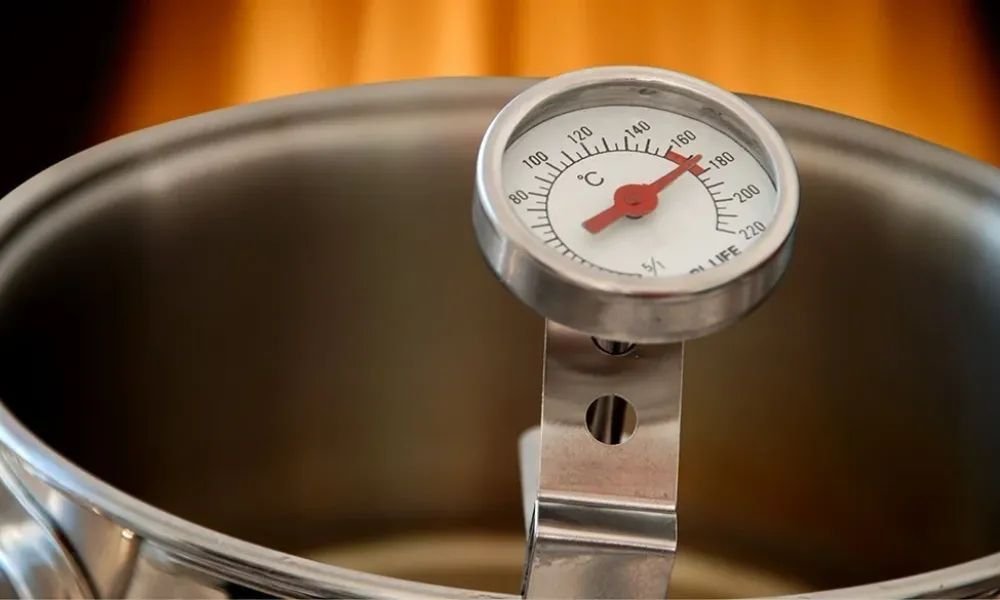
Thermal Equilibrium Is Everything
To understand this lesson properly, think in terms of heat transfer modes:
- Conduction
- Convection
- Radiation
If your sensor is influenced by more than one heat transfer path, your measurement becomes a blend.
Example: Pipe Measurement Mistake
We once strapped a thermocouple to the outside of a steam pipe. No insulation. No thermal paste. No clamping pressure control.
Here’s what affected the reading:
• Pipe surface temperature
• Ambient air drafts
• Radiant heat from nearby equipment
• Sensor wire acting as a heat sink
It read 122°C.
The actual steam temperature inside? 165°C.
That’s not an error. That’s a different reality.
Visual: Effect of Improper Contact on Measured Temperature
Actual Process Temp: 150°C
Surface Contact Quality vs Measured Value:
Excellent Contact | 148–151°C
Moderate Contact | 135–145°C
Loose Contact | 110–130°C
No Insulation | 100–120°C
The “sensor accuracy” never changed. The installation did.
What I Do Differently Now
- I design mounting before selecting the sensor.
- I assume installation error before sensor defect.
- I verify immersion depth using the “10x rule” (insert probe at least 10 times its diameter).
- I insulate external sensors aggressively.
- I treat thermal paste as mandatory, not optional.
Because a $300 sensor installed poorly performs worse than a $20 sensor installed correctly.
Lesson #2: Response Time Will Ruin Your Control System If You Ignore It
The second lesson hurt more — financially.
We were running a temperature-controlled reaction process. The controller tuning looked fine on paper. But the system kept overshooting. By a lot.
The controller would call for heat. The temperature reading would lag. Then suddenly it would spike past setpoint.
We kept tuning PID parameters.
We were solving the wrong problem.
The Real Issue: Sensor Lag
The temperature sensor had a time constant of 18 seconds.
The process dynamics changed in about 5 seconds.
The sensor was always late to the party.
By the time it “noticed” the temperature increase, the process had already overshot.
Understanding Time Constant
The time constant (τ) of a sensor is the time required to reach 63.2% of a step change in temperature.
If the actual temperature jumps from 20°C to 100°C:
After 1τ → sensor reads ~70°C
After 2τ → ~88°C
After 3τ → ~95°C
If τ is large, your reading is always behind reality.
Sensor Response Comparison Table
| Sensor Type | Typical Time Constant (τ) | Best Use Case |
|---|---|---|
| Bare thermocouple | 0.5 – 2 seconds | Fast dynamics |
| Grounded thermocouple | 2 – 5 seconds | General use |
| Ungrounded TC | 4 – 10 seconds | Electrically noisy areas |
| Thin-film RTD | 1 – 5 seconds | Moderate response |
| Wire-wound RTD | 5 – 20 seconds | Stable environments |
| Thermistor | < 1 second | Precision + speed |
Overshoot Scenario (Real Data Pattern)
Setpoint: 120°C
Actual Process Behavior:
Time (s) | True Temp | Sensor Reading
0 | 80 | 80
5 | 110 | 92
10 | 130 | 108
15 | 125 | 118
20 | 120 | 123
Controller sees 92°C at 5 seconds — still far from setpoint — so it keeps heating.
But the process is already at 110°C.
That 18-second lag cost us material.
What I Changed
• I match sensor response to process dynamics.
• I use smaller diameter probes for faster response.
• I avoid thick thermowells unless required.
• I simulate lag during control tuning.
• I separate control sensors from monitoring sensors.
One key insight:
The most accurate sensor is useless if it’s too slow.
Speed often beats precision in control applications.
Lesson #3: Calibration Drift Is Inevitable — Plan for It
The third lesson wasn’t dramatic. It was worse.
It was subtle.
Production yields slowly declined over months. No alarms. No obvious faults. Just creeping inefficiency.
Eventually, during a scheduled audit, we recalibrated the temperature sensors.
Several were off by 3–6°C.
That small shift was enough to reduce process quality.
Why Drift Happens
Even high-quality sensors drift over time due to:
• Repeated thermal cycling
• Mechanical vibration
• Oxidation
• Insulation breakdown
• Contamination
• Moisture ingress
Thermocouples are especially prone to drift at high temperatures.
RTDs are more stable but not immune.
Drift Tendency by Sensor Type
| Sensor Type | Drift Resistance | Typical Drift Range (Annual) |
|---|---|---|
| Type K TC | Moderate | ±2–5°C at high temps |
| Type J TC | Lower | ±3–7°C |
| RTD (Pt100) | High | ±0.1–0.5°C |
| Thermistor | Moderate | ±0.2–1°C |
Drift Pattern Over Time (Illustrative)
Month 0 → 0°C offset
Month 3 → +0.5°C
Month 6 → +1.2°C
Month 9 → +2.8°C
Month 12 → +4.0°C
No alarms triggered.
But quality metrics slowly degraded.
That’s the dangerous part — drift hides inside acceptable ranges.
The Ice Bath Reality Check
After that incident, I reintroduced a simple test:
Ice bath verification (0°C check).
It’s inexpensive. It’s fast. And it catches most drift issues before they escalate.
Procedure:
- Fill container with crushed ice.
- Add minimal distilled water.
- Stir.
- Insert probe without touching sides.
- Wait for stabilization.
- Verify reading near 0°C.
That one habit saved us countless troubleshooting hours later.
The Bigger Patterns I Noticed
After years of mistakes and corrections, three broader truths became obvious.
1. Measurement Is a System, Not a Device
Sensor
- Wiring
- Mounting
- Environment
- Control logic
- Calibration practices
= Temperature measurement
You cannot evaluate one part in isolation.
2. Faster Isn’t Always Better — But Slower Is Usually Worse
In monitoring applications, stability matters.
In control applications, response time matters more.
If your process changes quickly, slow sensors create artificial instability.
3. Small Errors Compound
A 2°C error in a domestic setting is trivial.
In industrial or scientific applications, it can mean:
• Product degradation
• Energy waste
• Safety risk
• Failed validation
• Regulatory non-compliance
Precision isn’t about perfection. It’s about predictability.
Quick Diagnostic Checklist I Use Today
When temperature readings look suspicious, I ask:
- Is the probe fully immersed?
- Is the sensor influenced by ambient air?
- Is response time appropriate for process speed?
- Has calibration been verified recently?
- Is wiring introducing noise?
- Is insulation adequate?
- Is the sensor positioned in a representative location?
80% of problems are solved in those seven questions.
Comparative Overview: Choosing the Right Sensor
| Parameter | Thermocouple | RTD | Thermistor |
|---|---|---|---|
| Cost | Low | Medium | Low–Medium |
| Accuracy | Moderate | High | Very High (limited range) |
| Response Time | Fast | Moderate | Very Fast |
| Temperature Range | Very Wide | Wide | Narrow |
| Drift Resistance | Moderate | High | Moderate |
| Best For | High heat, rugged | Precision control | Electronics, tight tolerance |
The Emotional Side of Measurement Mistakes
Here’s something no textbook mentions.
When a temperature reading is wrong, you don’t know it’s wrong.
You trust it.
And that trust drives decisions.
The first time I shut down a production line based on faulty readings, I felt embarrassed. The second time, I felt cautious. By the third time, I realized temperature measurement deserves the same design discipline as mechanical or electrical systems.
It’s not a sensor problem.
It’s a systems thinking problem.
Practical Implementation Framework
If I were building a temperature measurement system today from scratch, here’s the sequence I’d follow:
Step 1: Define the Goal
- Monitoring?
- Control?
- Safety cutoff?
- Quality assurance?
Step 2: Define Required Accuracy
- ±5°C?
- ±1°C?
- ±0.1°C?
Step 3: Understand Process Dynamics
- Slow-changing?
- Rapid heating/cooling?
- Turbulent or static?
Step 4: Select Sensor Type
Match to speed + accuracy + environment.
Step 5: Design Installation
- Immersion depth
- Thermal isolation
- Mechanical protection
- Wiring shielding
Step 6: Establish Calibration Schedule
- Annual?
- Quarterly?
- Based on operating hours?
Step 7: Validate with Secondary Reference
Redundancy beats assumptions.
Final Reflection
The biggest mistake I made early in my career was thinking temperature was simple.
It’s invisible.
It’s dynamic.
It lies quietly when measured poorly.
But when respected, designed correctly, and maintained properly, temperature measurement becomes one of the most powerful tools in process control.
These three lessons — installation integrity, response time awareness, and proactive calibration — eliminated most of the temperature-related failures in my systems.
And none of them required exotic equipment.
They required attention.
Frequently Asked Questions (FAQs)
1. Why does my temperature reading fluctuate even when the process is stable?
Fluctuation often results from poor thermal contact, electrical noise in wiring, airflow influence, or an exposed sensor element. Check mounting stability, shielding, and insulation first before assuming the sensor is defective.
2. How often should temperature sensors be calibrated?
It depends on operating conditions. High-temperature or critical applications may require quarterly checks. Stable, low-temperature environments may only need annual calibration. Always follow risk-based scheduling rather than arbitrary timelines.
3. What’s the difference between accuracy and precision in temperature measurement?
Accuracy refers to how close a reading is to the true temperature. Precision refers to repeatability. A sensor can consistently read 2°C high (precise but inaccurate). Calibration corrects accuracy, not precision.
4. Are thermocouples less reliable than RTDs?
Not necessarily. Thermocouples tolerate higher temperatures and harsh environments better. RTDs offer higher accuracy and stability. The “better” choice depends entirely on application requirements.
5. Can sensor placement really cause multi-degree errors?
Yes — especially with partial immersion, surface mounting without insulation, or positioning near heat sources. Placement errors are among the most common causes of temperature measurement inaccuracy.
6. How can I reduce response time without sacrificing durability?
Use smaller-diameter probes, minimize thermowell thickness where safe, improve thermal contact, and consider grounded thermocouples if electrical isolation isn’t critical. Always balance speed with mechanical and safety requirements.