



Introduction
Volume measurements are everywhere. You’re measuring out milk for cereal, figuring out the size of a gas tank or following a recipe from overseas. But what if your recipe is in milliliters and all you have are measuring cups? Or when you are at the gas station and have to convert gallons into liters?
This ultimate guide covers 21 vital facts that explain all about volume conversions. You’ll find helpful hints, practical formulas, and some great tips on how to perform conversions between various volume units as easily as it is for pouring water from one container into another!
If you are a student working on your science homework, an aspiring home cook experimenting with international recipes or simply someone who scratches their head about measurements, consider these facts as your path from confusion to confidence.
The Basics: What Volume Really Is
Volume quantifies how much three-dimensional space a liquid, gas or solid occupies. It is like the amount of liquid or gas, or mashed potatoes, that you can fit into a container.
Volume is the quantity of what’s in your bottle and is what filling up a water bottle represents. When you fill your car with gas, you’re looking at volume. Everything else falls into place once you get this fundamental idea.
What are commonly used volume units in various countries and industries? When Americans measure liquids, they usually use gallons, quarts and cups. Most of the rest of the world uses the metric system, which is based on liters and milliliters. In scientific work, you will notice that for precision and consistency most scientists prefer the metric system.
Fact 1: The Metric System Is Based Upon Easy Multiples of Ten
The great thing about the metric system is the simplicity it introduces to volume conversion. Everything is based on multiples of ten, so fewer actual calculations and more thinking in your head.
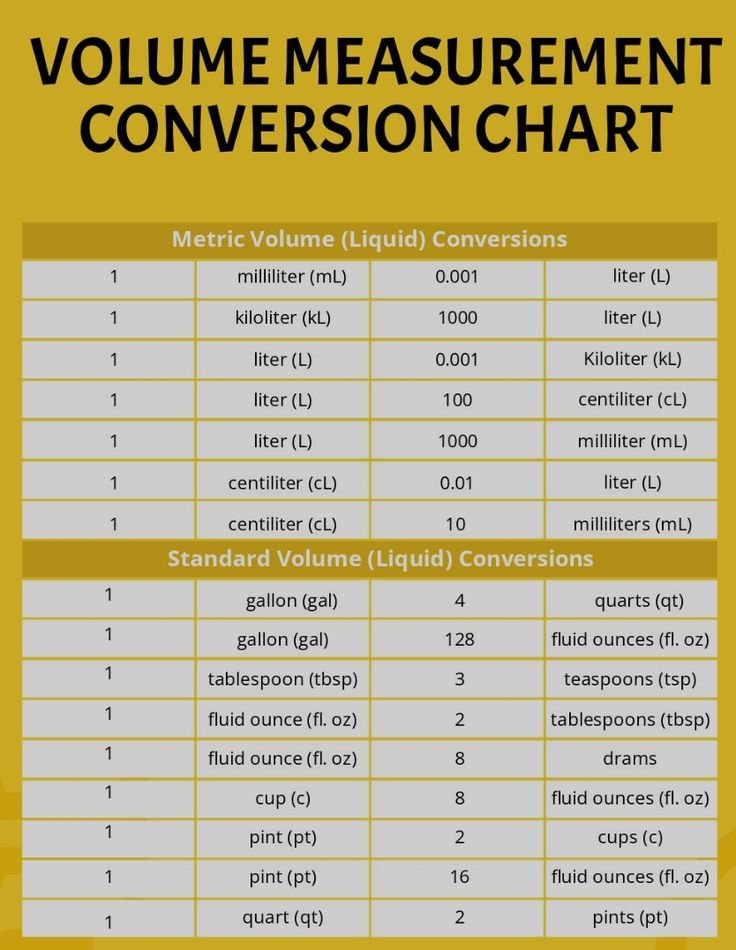
One liter equals 1,000 milliliters. One kiloliter equals 1,000 liters. That means no juggling fractions as you do with imperial measurements in a base 10 system.
Quick metric conversions:
- 1,000 milliliters (mL) = 1 liter (L)
- 1 kiloliter (kL) = 1,000 liters (L)
- 1 mL = 0.001 L
It is only a matter of moving decimals when going from one metric measurement to another. Converting 2,500 milliliters to liters? Just move the decimal three places to the left and you have 2.5 liters.
Fact 2: US Customary Units Do Not Use Simple Ratios
The US customary system is more difficult because conversions aren’t as clean-cut. You are required to memorize specific unit-to-unit ratios.
Here’s the basic breakdown:
- 1 gallon = 4 quarts
- 1 quart = 2 pints
- 1 pint = 2 cups
- 1 cup = 8 fluid ounces
- 1 fluid ounce = 2 tablespoons
- 1 tablespoon = 3 teaspoons
See how the numbers are different for each conversion? This lack of consistency makes U.S. customary conversions more difficult to remember than those in metric units.
Fact 3: A Liter Equals a Quart, and Then Some
Liters and quarts seem too different to have any connection, many will say, though in fact they are closely related. 1 L = approximately 1.057 quarts.
For rough approximations, it’s more than good enough to call them equal. Do you want to learn how to convert 5 liters into quarts? Call it 5 quarts or so. This shortcut works well for everyday activities like cooking or shopping.
The exact conversion is:
- 1 liter = 1.057 quarts
- 1 quart = 0.946 liters
Fact 4: There are Two Sizes of Gallons
This comes as a surprise to many people: the US gallon and the imperial gallon (used in Britain and some Commonwealth countries) are not the same size.
One US gallon is 3.785 liters, one imperial gallon equals 4.546 liters. That’s a 20% difference! If you are reading a British recipe or interested in fuel economy abroad, keep that distinction in mind.
| Gallon Type | How Many Liters |
|---|---|
| US Gallon | 3.785 L |
| Imperial Gallon | 4.546 L |
Fact 5: The Kitchen Does Not Measure Like the Rest of the World
There are measurements specific to cooking that don’t always match what appears on a ruler. In recipes, a cup does not equal exactly 8 fluid ounces in all countries.
US cooking measurements:
- 1 cup = 237 milliliters
- 1 tablespoon = 15 milliliters
- 1 teaspoon = 5 milliliters
International cooking (metric):
- 1 cup = 250 milliliters
- 1 tablespoon = 15 milliliters
- 1 teaspoon = 5 milliliters
The small difference in size between US and metric cups (237 mL vs 250 mL) doesn’t usually make a difference for recipes, although if you are looking to measure precisely when baking, it can be an issue.
Fact 6: The Common Structure of the Conversion Formula Never Changes
Each volume conversion proceeds like this:
New Value = Old Value × Conversion Multiplier
Looking to change 5 gallons to liters? Multiply 5 by 3.785 (the conversion factor). The answer is 18.925 liters.
Converting 2,000 milliliters to liters? Multiply 2,000 by 0.001 (or divide by 1,000). You get 2 liters.
It’s less crucial that you memorize conversion factors than it is for you to understand the basic structure of this formula. For more detailed conversion guides across different measurement types, visit Measurement Conversion Guide.
Fact 7: Gas Volume Is Affected by Temperature and Pressure
Gases, however, do not have a fixed volume and they expand and contract depending on their temperature and pressure. This is important for chemistry experiments, weather predictions and industrial processes.
Hot air expands, taking up more space. Cold air shrinks, taking up less room. Higher pressure squishes gas into less space. With less pressure, gas expands.
Scientists use “standard temperature and pressure” (STP) as a standard: 0°C and 1 atmosphere of pressure. This normalization guarantees that measurements are consistent in spite of the conditions.
Fact 8: One Milliliter Is Equivalent to One Cubic Centimeter
Is there a connection between volume and linear measurements? Yes!
Such a relationship simplifies the conversion of volume to dimensions. A 10 cm × 10 cm × 10 cm cube is exactly 1,000 cubic centimeters or milliliters or 1 liter.
Here is a similar equivalence often used by scientists and engineers:
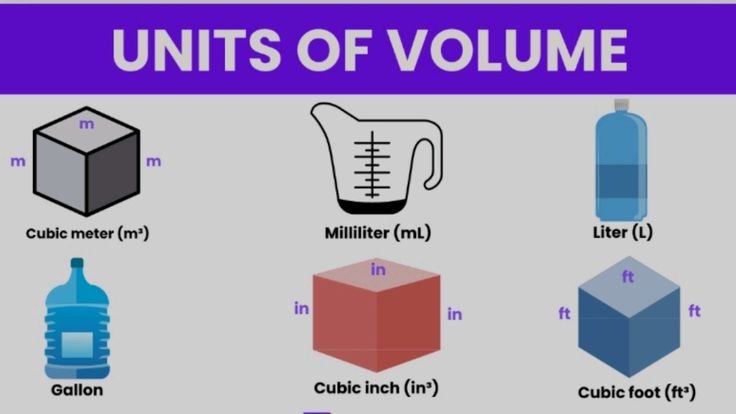
- 1 mL = 1 cm³
- 1 L = 1,000 cm³
- 1 L = 1 dm³ (cubic decimeter)
Fact 9: Weight Ounces and Fluid Ounces Are Not the Same Thing
This confuses many beginners. Fluid ounces measure volume (how much space something takes up), and regular ounces measure weight (how heavy something actually is).
8 fluid ounces of water weigh about 8 ounces because water has a density near 1. But 8 fluid ounces of honey weighs more than 8 ounces — that’s because honey is far denser than water.
Never confuse these two measurements. The weight ounces on your kitchen scale measure weight. Your measuring cup is marked in fluid ounces.
Fact 10: Going the Other Way Requires Division or Inverse Factors
For converting a larger unit to smaller units, you multiply. If you are going from a smaller unit to a bigger one, then you’ll divide.
Converting 3 liters to milliliters? Multiply by 1,000 to get 3,000 mL (larger to smaller).
Converting 500 milliliters to liters? Divide by 1,000 to get 0.5 L (smaller to larger).
Alternatively, use inverse conversion factors. To move from milliliters to liters, multiply by 0.001 rather than divide by 1,000. Same result, different method.
Fact 11: Common Kitchen Equivalents Save Time
Learn these kitchen conversions so you never have to do math again:
| Measurement | Equivalence |
|---|---|
| 1 gallon | 16 cups |
| 1 gallon | 128 fluid ounces |
| 1 quart | 4 cups |
| 1 pint | 2 cups |
| 1 cup | 16 tablespoons |
| ¼ cup | 4 tablespoons |
These equivalents are particularly useful when a recipe calls for a substitution or if you’re missing some measuring tools.
Fact 12: The Displacement Method Measures Irregular Volumes
How do you find the volume of a rock or some weird-shaped object? Use water displacement.
Fill some sort of container with water and take notice of the water level. Submerge your object completely. The water level rises. The new water level minus the old water level equals the volume of your object.
This process, which was discovered by Archimedes, will work for any object which is not porous or does not absorb water. It’s ideal for science experiments and hands-on problem solving.
Fact 13: Special Units in Pharmaceutical Measurements
It’s very important to get an accurate volume measurement in medicine. Pharmacists and doctors use:
- Drops (gtt)
- Minims
- Drams
But modern medicine relies on metric for precision:
- 1 drop ≈ 0.05 mL (depends on the density of liquid)
- 1 minim ≈ 0.062 mL
- 1 fluid dram ≈ 3.7 mL
Never guess with medication volumes. Always use the measuring device that comes with your medicine.
Fact 14: An Easy Conversion to Remember for Gallons and Liters
Need a quick mental approximation? To convert gallons to liters, multiply by 4. This gets you a bit more than the actual number, but close enough for everyday use.
- 5 gallons × 4 = about 20 L (actually: 18.9 liters)
- 10 gallons × 4 = about 40 L (actually: 37.85 liters)
For exact calculation use 3.785 as your multiply factor. If you want a rough estimate, 4 is just great.
Fact 15: Volume and Capacity Are Not the Same
Volume is the amount of space something takes up. Capacity is the amount that a container can hold.
A milk jug has a volume (the space the jug itself occupies). It also has a capacity (how much milk it holds). These are different measurements.
If the terms are used in casual writing or conversation, there is usually no issue. But in technical environments, such distinctions matter.
Fact 16: Beer, Wine and Spirits Have Different Volume Standards
Alcohol measures conform to industry-specific volume standards:
- Beer: Generally available in 12 oz bottles or 355 mL cans
- Wine: Bottles are 750 mL
- Liquor: Fifths (750 mL), pints (375 mL), handles/half-gallons (1.75 L)
A fifth of liquor got its name when it represented a fifth of a gallon. The traditional measurements remain in use alongside the metric system in many countries.
Fact 17: Laboratory Work Must Be Very Accurate
Lab work requires precision greater than that of cooking or common measurements. Scientists use:
- Graduated cylinders: Accurate to around 1% of full scale
- Volumetric flasks: Accuracy within 0.1%
- Pipettes: Dispense precise volumes
- Burettes: Measure to 0.01 mL accuracy
When precise measurements are important — say, with chemistry experiments, pharmaceutical compounding or quality control — specialized tools become necessary. The National Institute of Standards and Technology (NIST) provides detailed standards for accurate laboratory measurements.
Fact 18: Automotive Measurements Mix Systems
Automotive volumes are often confusing since they tend to blend systems of measurement. Engine displacement could be given in either liters or cubic inches. Fuel tanks are measured in gallons in America and liters elsewhere.
Common automotive conversions:
- 1 cubic inch ≈ 16.39 mL
- 1 liter ≈ 61.02 cubic inches
Displacement of an engine is given in cubic inches or liters. A 5.7-liter engine is equivalent to about 350 cubic inches. These figures enable you to compare engine specs across markets.
Fact 19: Swimming Pool Volumes Require Special Calculations
To calculate the volume of a pool, you need to know its shape:
- Rectangular pools: Volume = Length × Width × Average Depth
- Round pools: Volume = π × Radius² × Average Depth
Results are in cubic feet or cubic meters, which you’ll convert to gallons or liters:
- 1 cubic foot = 7.48 gallons
- 1 cubic meter = 1,000 liters
This calculation is used to determine chemical treatments, heating loads and filling time.
Fact 20: Online Converters Can Be Very Useful, But Know Your Math
Online converters offer immediate responses. Google, smartphone calculators and dedicated apps can instantly translate volumes.
But it’s better to know the math rather than blindly trust technology. Calculators break, Wi-Fi connections fail and batteries drain.
Learn the basic conversion factors. Leverage technology for verification and ease — but don’t become weak in the knowledge itself.
Fact 21: Practice Makes Perfect with Volume Conversions
Just as with any skill, volume conversions become automatic through repetition. Start with everyday situations:
- Double up a recipe (transforming cups to larger measures)
- Check sizes of products at the store
- Calculate how many water bottles make a gallon jug
- Estimate gas prices when traveling out of country
The longer you work with conversions, the more natural they feel. Pretty soon, you’ll be able to estimate volumes without even thinking about it.
Handy Conversion Table for Quick Reference
| From | To | Multiply By |
|---|---|---|
| Gallons | Liters | 3.785 |
| Liters | Gallons | 0.264 |
| Quarts | Liters | 0.946 |
| Liters | Quarts | 1.057 |
| Cups | Milliliters | 237 |
| Milliliters | Cups | 0.004 |
| Fluid Ounces | Milliliters | 29.57 |
| Milliliters | Fluid Ounces | 0.034 |
Print out this chart and keep it in your kitchen, or wherever you typically work, for easy reference.
Everyday Uses of Volume Conversions
Cooking and baking: International recipes mean converting between metric and US customary system measurements.
Travel: Compare fuel economy from countries that use different measuring standards.
Science classes: Chemistry and physics require precision in volume measurements and conversions.
Home improvement: Estimate paint coverage, concrete requirements, and water capacity for gardens and ponds.
Medical: Measurement of liquid medicines in accurate doses.
Shopping: Comparing product sizes to find the best value.
Every application demonstrates how the ability to do volume conversions solves real world problems.
Common Mistakes to Avoid
Mixing up weight and volume: Keep in mind that fluid ounces are a measure of volume, not weight.
Not specifying which gallon: Always clarify whether the units are US or imperial for any number of gallons.
Rounding too soon: Do all calculations, but do not make any rounding until the final answer.
Mixing systems of measurement: Don’t mix metric and US customary unless you have to.
Assuming all cups are the same: Cooking cups are slightly different in US than imperial cups.
Knowing these pitfalls helps you avoid calculation mistakes or incorrect measurements.
Tips for Teaching Volume Conversions to Others
Use real demonstrations with physical measuring cups and containers. Water being poured from a quart to cups makes the concepts concrete.
Make cheat-sheets of the most often converted measures. Laminate them for durability.
Use actual recipes to practice — double or halve ingredients to develop conversion skills.
Use online games and interactives for learning measurements.
Connect conversions to students’ interests — sports drinks, aquarium sizes, things made with their favorite recipe.
Make it relevant and hands-on. Abstract numbers take on significance only by virtue of use.
Frequently Asked Questions
How many cups in a gallon?
One US gallon is equal to 16 cups. That is equivalent to 4 quarts, 8 pints or 128 fluid ounces.
Is 1 liter more than 1 quart?
Yes, but only slightly. One liter is about 1.057 quarts, while a quart is approximately 6% smaller than a liter.
How do I change milliliters to ounces?
Multiply milliliters by 0.034 to obtain fluid ounces. For instance, 100 mL × 0.034 = 3.4 fl oz.
Why does the U.S. use a different system than other countries?
The United States inherited the British Imperial system before metrication was common. Most nations adopted the metric system during the 20th century; however, in the United States customary units maintain widespread use.
What is the simplest method for remembering metric conversions?
Always keep in mind that metric is base ten. Just slide the decimal: 1,000 mL = 1 L, or 1,000 L = 1 kL.
Can I weigh ingredients instead of using volume measurements?
For many ingredients, yes. Weighing is often more precise than volume, particularly for baking. But recipes given in volume form need conversion charts to make them weight-based.
Bringing It All Together
Volume measurements and their associated conversions are used in nearly all facets of people’s day to day life. From the coffee you wake up to, through pumping gas at the station, from science homework to home improvement projects, understanding how these measurement units are related gives us confidence and competence.
The 21 facts presented here form the basis of practical measurement abilities. You now know the differences between metric and US customary systems, understand volume in relation to physical dimensions, and understand specialized applications from cooking to chemistry.
Keep in mind that technology can help, but should not replace basic understanding. Online converters are convenient, but understanding why and how conversions function gives you the power to solve problems by yourself.
Start applying these concepts today. Take a recipe you like and convert it to metric. Determine how many bottles of water make a gallon. Compare product sizes at the supermarket. Every time you practice, these volume conversions go from messy calculations to natural estimates.
Measuring things can start to seem complicated, though it all makes sense. For the metric system the units are based on simple multiples of ten. US standard measurements need to be memorized, but basically follow simple ratios. Each system has its uses and learning both makes you more flexible.
Don’t lose this guide as you may want to refer back to it. Bookmark it, print important parts or save the conversion charts. The facts here will serve you well while cooking dinner or finishing your homework or thinking through a project.
Learn and master these 21 important facts, and you will never have to fumble — or reach for a calculator — when recipes ask for milliliters, recipes need quarts, or science experiments demand precision. Volume conversions become something you are in charge of, rather than something that confuses you.